
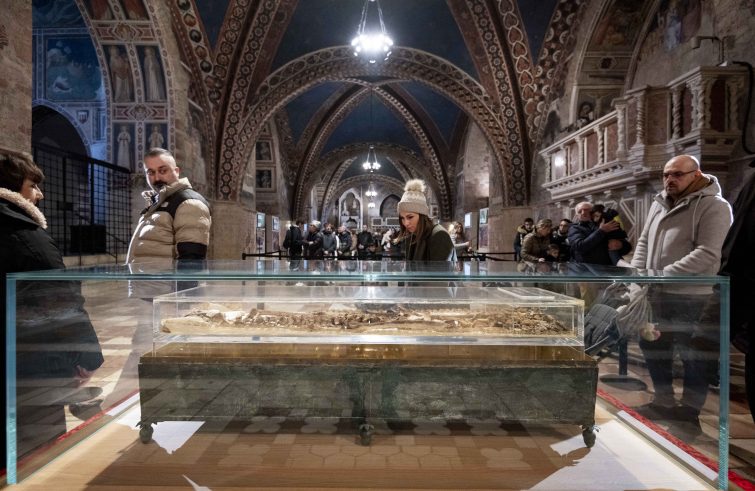
“I would like his lesson today to become a bridge for new peace pacts, because what we are witnessing is shameful”. Msgr Felice Accrocca, Metropolitan Archbishop of Benevento and Bishop-elect of Assisi-Nocera Umbra-Gualdo Tadino and Foligno, will take possession of the cathedral of San Rufino on 25 March. One of the foremost scholars of medieval Franciscan sources, he arrives in Assisi in the year marking the eighth centenary of the death of Saint Francis, while the ostension of his remains – the first in the Saint’s history, from 22 February to 22 March – is drawing pilgrims from many countries.
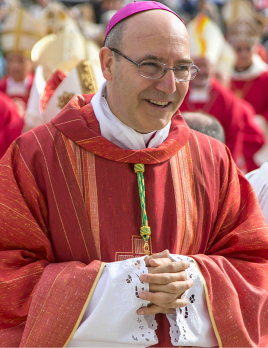
(Foto Siciliani-Gennari/SIR)
Your Excellency, the ostension of the remains of Saint Francis is drawing pilgrims from all over the world to Assisi. What do these relics represent?
They recall an experience of Christian life; otherwise, it would make no sense to go and contemplate bones. It is like visiting the tomb of a loved one: there one remembers his life, the bonds that united us to him, and all that was received.
Before those bones, an experience resurfaces which, after eight hundred years, continues to fascinate. Other bones would not have attracted such attention.
It is a striking fact, in an age where everything is consumed and forgotten within twenty-four hours.
In Francis, one does not perceive sensational aspects as in other saints. Where does his enduring appeal lie?
He bears the stigmata and performs miracles, yet this is not what the collective imagination seeks in him. What people see in him is the man who lived the Gospel. Our fascination with Francis lies entirely there, in the Gospel which he translates in an original and radical way. His body, his tomb, are the magnets of Assisi, around which the city is built like the spokes of a wheel. This explains the phenomenon we are witnessing.
It is, however, difficult to move from devotion to concrete discipleship.
It is the most arduous step. We often take refuge in devotion because it makes us feel at ease: a few genuflections, some celebrations, a little fasting, and it seems that everything has been done. But living the Gospel is something altogether different.
The recurring temptation is to fashion a God to our own measure, whereas the Gospel proposes the opposite journey: a man conformed to the measure of God
Francis followed that path to the very end, and for this reason he never ceases to attract.
The ostension and the eighth centenary,
The ostension of the remains of Saint Francis, from 22 February to 22 March 2026, is the first extended public display in the Saint’s history. The initiative forms part of the journey of preparation for the eighth centenary of his “transitus” (1226-2026), which will culminate on 3 October with the solemn celebrations in Assisi.
Your Excellency, you will enter Assisi on 25 March, the Solemnity of the Annunciation. How did you receive this appointment?
With a profound sense of responsibility. My appointment coincided with the opening of the celebrations for the eighth centenary of Saint Francis’s death, in a year laden with meaning. I approach it with fear and trembling. It is a great challenge, and I place my trust precisely in him. I know my frailties and my limits. We are in the hands of God, who knows what He is doing. I loved Francis as a scholar, and he has also become for me a reason for living, a spirituality. I trust that he will sustain and guide me.
Assisi lies just over 2,000 kilometres from both Kyiv and Gaza. What message of Francis do you wish to offer in this time of war?
Francis was above all a peacemaker. He himself says so in his Testament: “The Lord revealed a greeting to me that we should say: May the Lord give you peace!”. He and his brothers presented themselves everywhere as pilgrims of peace. Thomas of Split bears witness to this; he saw Francis preaching in Bologna on 15 August 1222 and recounts that all the substance of his words was directed towards building new pacts of peace.
His clothing was messy; the person was contemptible, his face without beauty. Yet, through the strength that God gave to his words, many city families between whom much blood had been shed were persuaded to make peace.
What Francis did in Bologna on that day was to break down walls and build bridges. I would like his lesson today to become a bridge for new peace pacts, because what we are witnessing is shameful.