
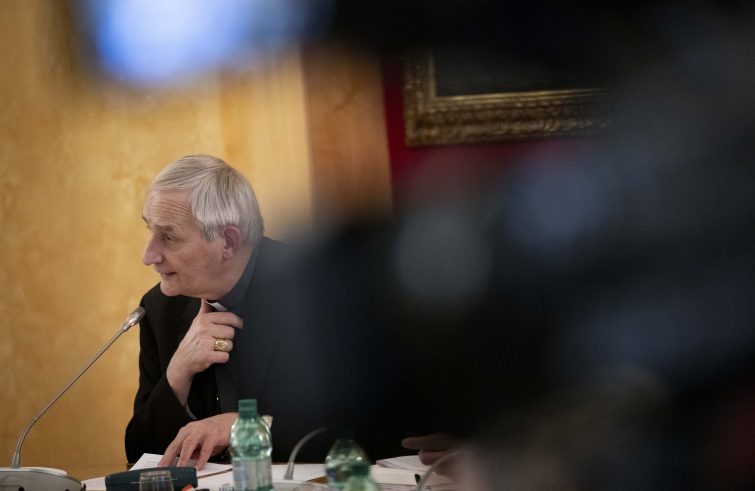
At a time when everything is translated into belonging, even the words of the Church are inevitably interpreted in a binary logic: with us or against us. This has also happened in recent weeks, following Cardinal Matteo Zuppi’s opening address to the Permanent Council of the Italian Bishops’ Conference (CEI), which many read as voting instructions on the constitutional referendum concerning the justice system. So much so that an explanatory note became necessary.
But are we really faced with taking sides?
If you read the words spoken in their entirety, you find a reference to principles: the balance between the powers of the State, the autonomy and independence of the judiciary, and the legacy of the founding fathers. There is no indication of how to vote. There is no “yes” or “no”. There is a criterion. This is a substantial difference.
When the Church intervenes in institutional matters, it recalls fundamental principles. It does not support any technical choice between alternative models – except in cases that directly touch upon fundamental moral principles. Canon law itself recalls that in matters open to debate, the faithful enjoy legitimate freedom (cf. can. 227), and that not every political option may be presented as the doctrine of the Church. The referendum on the justice system falls within this scope: it does not concern a non-negotiable principle, but an institutional arrangement on which differing assessments may legitimately exist.
The decisive point in the opening address is not the outcome of the vote, but participation. In a climate marked by disaffection and abstention, the invitation to “go to the polls” is no secondary detail. It is a call to democratic co-responsibility. In a country where participation is steadily diminishing, this in itself is a political message in the highest sense of the term: not partisan, but civic.
It is true that participation in meetings promoted by associations or movements advocating one of the referendum options may foster the perception of a political line. Yet the distinction between the collegial body of the CEI and the personal freedom of an individual pastor remains essential. Not every individual stance becomes an official line. To confuse the two levels is to read the Church as if it were a political party, with internal discipline and binding directives. That is not the case.
The problem, perhaps, lies elsewhere. We live in a context in which every word is immediately translated into a political line. If you recall the balance of powers, you are against reform. If you speak of reform, you are against balance. It is a simplification that impoverishes public debate and makes it impossible to have a discussion based on principles.
The CEI’s recent tradition shows a consistent line: to intervene on principles, not on technical solutions; to recall the common good, not to replace the discernment of the laity; to foster participation, not to dictate an outcome.
Perhaps this is the real crux of the matter. The democratic maturity of Catholics does not lie in waiting for instructions, but in building an informed conscience. The Church does not abdicate its responsibility when it does not indicate how to vote; on the contrary, it fully exercises it when it educates in discernment.
To reduce everything to taking sides means failing to recognise this difference. And it means, once again, asking the Church to be what it is not: a partisan actor in a political contest.
The words spoken did not ask people to vote in a particular way. They asked them to vote responsibly. That is less spectacular. But it is more demanding.