
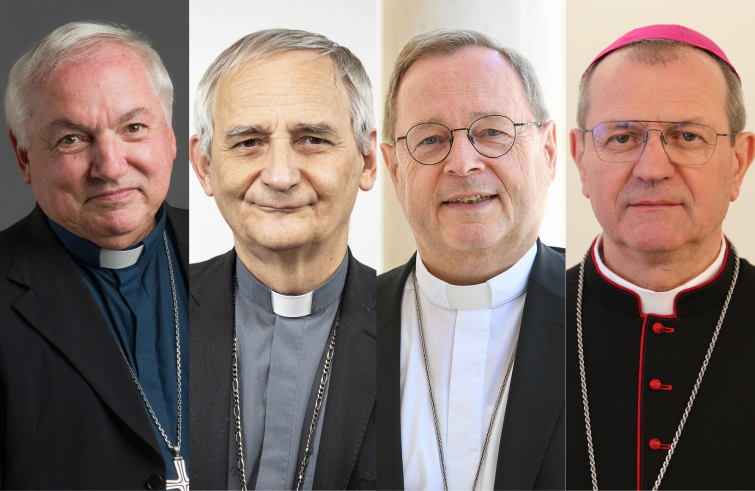
“It is wonderful to become pilgrims of hope. It is wonderful for us to continue to be pilgrims together!”. These words spoken by Pope Leo XIV at the conclusion of the Jubilee of Hope mark the starting point of the appeal signed by the Presidents of the Bishops’ Conferences of Italy, France, Germany and Poland.
The document, entitled “Christians for Europe. The Power of Hope” and published today, underlines the urgency of renewed responsibility on the part of believers for the future of the continent. “We live in a polarised world, torn apart by wars and violence”, the Bishops write. “Many of our fellow citizens are anxious and disoriented. The international order is under threat”.
In this context, Europe is called to “rediscover its soul” in order to offer “its indispensable contribution to the common good”. The appeal is signed by Cardinal Jean-Marc Aveline, Archbishop of Marseille and President of the French Bishops’ Conference; Cardinal Matteo Maria Zuppi, Archbishop of Bologna and President of the Italian Bishops’ Conference; Bishop Georg Bätzing of Limburg, President of the German Bishops’ Conference; and Archbishop Tadeusz Wojda of Gdańsk, President of the Polish Bishops’ Conference.
The founding fathers and Christian responsibility
Robert Schuman, Konrad Adenauer and Alcide De Gasperi were among the leading figures in the reconstruction of Europe after the Second World War. Rooted in strong Catholic traditions, they conceived the integration of the continent not as an ideological project but as a political choice inspired by reconciliation, solidarity and the centrality of the human person. Their vision contributed to the establishment of the first supranational institutions and laid the foundations of today’s European Union.
The reference to the founding fathers and the Schuman Declaration
The document retraces the Christian roots of the European project, recalling that “after the Hellenistic and Roman civilisations, Christianity has been one of the essential foundations of our continent” and “has largely shaped the face of a humanist Europe, marked by solidarity and openness to the world”.
“Inspired by their Christian faith, they were not naive dreamers, but the architects of a magnificent, albeit fragile, edifice”,.
the text states, citing Saint John Paul II: “Because they loved Christ, they also loved humanity and committed themselves to uniting it”.
The appeal also recalls the words of the Declaration which in 1950 led to the creation of the European Coal and Steel Community, the first step towards the European Union: “Europe will not be made all at once, or according to a single plan. It will be built through concrete achievements which first create a de facto solidarity”.
Central to the document is also the warning against nationalism, with the words of Alcide De Gasperi: “Exasperated nationalism is a form of idolatry: it places the nation in the place of God and against humanity”. The statesman from Trentino recalled that “United Europe was not born against the nation-states, but against the nationalisms that destroyed them”. The Bishops caution: “Europe cannot be reduced to an economic and financial market without betraying the original vision of its founding fathers”.
The commitment of Christians to universal fraternity
The text looks at the present with realism: “An international framework is dying and a new one has yet to be born”. Europe, “respecting the rule of law and rejecting the exclusionary logic of isolationism and violence”, must choose “the supranational resolution of conflicts” and must always be ready “to resume dialogue, even in situations of conflict, and to work for reconciliation and peace”.
The Bishops recall the words of Pope Francis on the “epochal change” under way, quoting from his address on the occasion of the Charlemagne Prize in 2016: “The ashes of the ruins could not extinguish the ardent hope and the quest of solidarity that inspired the founders of the European project”. Pope Francis also pointed to the task of the Church:
“To the rebirth of a Europe weary, yet still rich in energies and possibilities, the Church can and must play her part”, through “the proclamation of the Gospel, which today more than ever finds expression in going forth to bind the wounds of humanity with the powerful yet simple presence of Jesus”.
The appeal concludes with an invitation to concrete commitment: “The world needs Europe”, the four Presidents write, recalling the words of Robert Schuman: “When lived as selfless commitment to serving the city and humanity, politics can become an act of love for one’s neighbour”. In the name of their faith, they conclude, “Christians are called to share with all the inhabitants of the European continent their hope for a universal fraternity”.