
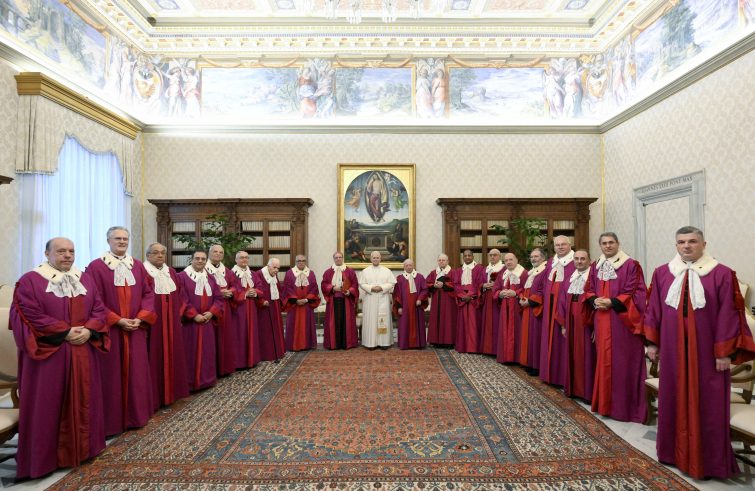
“The minister of judge, which I have had the opportunity to exercise, enables me to understand your experience better, and to appreciate the ecclesial significance of your task”. Receiving for the first time in audience the prelates of the Roman Rota on the occasion of the inauguration of the judicial year, Pope Leo XIV began from his personal experience. Reflecting on the “close connection between the truth of justice and the virtue of charity”, he explained that “these are not two opposing principles, nor are they values to be balanced according to purely pragmatic criteria, but two intrinsically united dimensions that find their deepest harmony in the very mystery of God, who is Love and Truth”. Hence the need to avoid the risk that “excessive identification with the oft troubled vicissitudes of the faithful may lead to a dangerous relativization of truth”. “Misunderstood compassion, even if apparently motivated by pastoral zeal, risks obscuring the necessary dimension of ascertaining the truth proper to the judicial office”, the Pope warned: “This can happen not only in cases of matrimonial nullity – where it could lead to pastoral decisions lacking a solid objective foundation – but also in any type of proceeding, undermining its rigour and fairness”. Another risk to be avoided, according to the Pontiff, is “a cold and detached affirmation of the truth that does not take into account all that love for people requires, omitting those concerns dictated by respect and mercy, which must be present in all stages of a proceeding”.
Fellow workers in the truth. The perspective in which all ecclesial juridical activity must be placed is the “salus animarum” as the supreme law in the Church. Leo XIV reiterated this as he urged those present “to be ‘fellow workers in the truth’”, a framework within which all aspects of canonical proceedings can be understood, in order “to contribute to shedding light on the just sentence to be reached, with rigorous intellectual honesty, technical competence and an upright conscience”.
Acting in an exemplary manner. “The faithful and the entire ecclesial community have a right to the proper and timely exercise of procedural functions, because it is a journey that affects consciences and lives”, the Pope indicated. “Service to the truth in charity must shine out in all the work of the ecclesial tribunals” and must be appreciated by the whole ecclesial community, especially by the faithful involved:
“those who seek a judgement on their marriage, those accused of committing a canonical crime, those who consider themselves victims of grave injustice, and those who claim a right”.
“Canonical processes must inspire the trust that comes from professional seriousness, intense and thoughtful work, and a convinced dedication to what can and must be perceived as a true professional vocation” – these are essential requirements for all offices and services connected with trials, which must be characterised by an “exemplary” code of ethics.
Operators of peace. In his address, the Pope set out in detail the role of all those who are actively involved in proceedings, beginning with lawyers, who are called to protect the interests of the parties “without ever going beyond what is considered right and in accordance with the law in conscience”. “Promoters of justice and defenders of the bond are cornerstones in the administration of justice, called by their mission to protect the public good”, Leo XIV went on to say, adding that “a purely bureaucratic approach in such an important role would clearly prejudice the search for truth”.
“Judges, called to the grave responsibility of determining what is right, what is true, cannot fail to remember that ‘justice goes hand in hand with peace and is permanently and actively linked to peace’”,
the Pontiff observed: “Justice and peace seek the good of one and all, and for this reason they demand order and truth. When one is threatened, both falter; when justice is offended, peace is also placed in jeopardy”. In judicial proceedings, the adversarial process “is a dialogical method for ascertaining the truth”: the concrete nature of the case, in fact, “always requires that the facts be ascertained and the reasons and evidence in favour of the various positions be compared, on the basis of the presumptions of the validity of the marriage and the innocence of the defendant, until proven otherwise”. “Legal experience testifies to the essential role of adversarial proceedings and the decisive importance of the preliminary investigation phase”, Leo XIV stressed: “The judge, maintaining independence and impartiality, must settle the dispute according to the elements and arguments that emerge during the trial. Failure to observe these basic principles of justice – and favouring unjustified disparity in the treatment of similar situations – is a significant violation of the legal profile of ecclesial communion”.
Careful assessment of marriage nullity. In the shorter process of marriage annulment before the diocesan bishop, the Pope said, it is necessary to judge “very carefully” the prima facie nature of the ground for annulment, “without forgetting that it must be the process itself, duly implemented, that confirms the existence of the annulment or determines the need to resort to the ordinary process”. “You are called to guard the truth with rigour but without rigidity, and to exercise charity without omission”, the Pope concluded: “In this balance, which is in reality a deep unity, one must manifest true Christian juridical wisdom”.