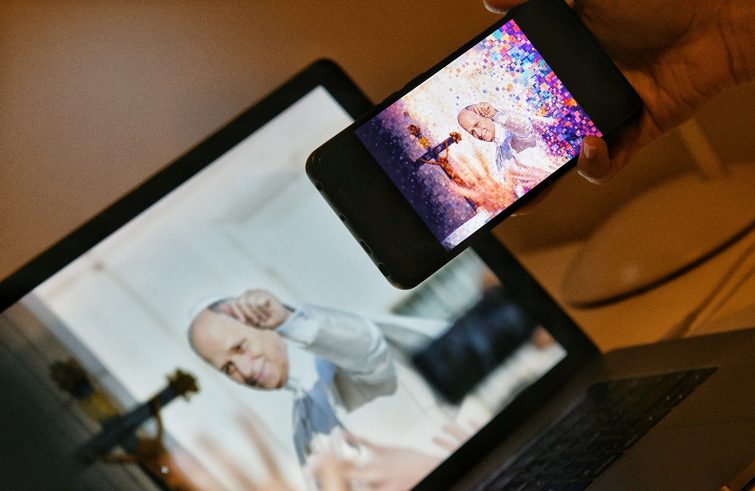
“Face and voice are sacred.” This is the heart of the Message of Pope Leo XIV for the 60th World Communications Day, released today on the memorial of Saint Francis de Sales. Entitled “Safeguarding human faces and voices”, the document addresses the challenges posed by artificial intelligence to communication and to the identity of the person. The Pope recalls how the ancient Greeks used the word “face” (prósōpon) to signify the person, while the Latin persona (from per-sonare) includes sound, “the unmistakable voice of someone”. Face and voice, explains Leo XIV, “have been given to us by God, who created us in his image and likeness, calling us to life with the Word that he himself addressed to us”. “Safeguarding human faces and voices means safeguarding ourselves,” the Pope warns, denouncing how AI systems, “by simulating human voices and faces, wisdom and knowledge, awareness and responsibility, empathy and friendship”, intrude “into the deepest level of communication, that of the relationship between human persons”. The challenge, he stresses, “is not technological, but anthropological”.
The risks of AI: from the erosion of thought to the simulation of relationships
The Message analyses the multiple risks of artificial intelligence. Leo XIV denounces algorithms that “reward rapid emotions and penalise human expressions that require more time, such as the effort to understand and reflection”, closing groups of people “into bubbles of easy consensus and easy indignation” and fuelling social polarisation. Added to this is “a naïvely uncritical reliance on artificial intelligence as an omniscient ‘friend’, dispenser of every piece of information, archive of every memory, ‘oracle’ of every form of advice”.
The Pope warns: “Withdrawing from the effort of our own thinking, contenting ourselves with an artificial statistical compilation, risks, in the long run, eroding our cognitive, emotional and communicative capacities.”
There is also concern for the creative industry, which risks being “dismantled and replaced with the label ‘Powered by AI’”, turning people “into mere passive consumers of unthought thoughts, of anonymous products, without authorship, without love”. Particular attention is paid to chatbots which, “made excessively ‘affectionate’, as well as always present and available, can become hidden architects of our emotional states”. The risk, observes Leo XIV, is that we build for ourselves “a world of mirrors, where everything is made ‘in our image and likeness’”, depriving us of encounter with the other. “Without welcoming otherness,” he warns, “there can be neither relationship nor friendship.” The Pope also highlights the problem of bias and of AI systems’ “hallucinations”, which “pass off statistical probability as knowledge”, fuelling disinformation and “a growing sense of mistrust, disorientation and insecurity”.
Responsibility, cooperation, education: the pillars of a possible alliance
In the face of these challenges, Leo XIV denounces “a serious concern regarding the oligopolistic control of algorithmic and artificial intelligence systems capable of subtly directing behaviour, and even rewriting human history – including the history of the Church – often without our being truly aware of it”.
The response does not lie in “halting digital innovation, but in guiding it”, through an alliance founded on three pillars: “responsibility, cooperation and education”.
From those who lead digital platforms, the Pope asks that “their business strategies not be guided solely by the criterion of maximising profit, but also by a farsighted vision that takes account of the common good”. From creators of AI he calls for “transparency and social responsibility”. Legislators are tasked with “ensuring respect for human dignity”. Leo XIV also addresses media organisations: “Public trust is built through accuracy and transparency, not through the pursuit of engagement at any cost.” And he adds: “Information is a public good.” Media and AI literacy, the Pope insists, is urgently needed “within educational systems at every level”, extending also “to the elderly and to marginalised members of society”. “As Catholics we can and must offer our contribution, so that people – especially the young – acquire the capacity for critical thinking and grow in freedom of spirit.” The Message concludes with an appeal: “We need faces and voices to return to speaking of the person.”