
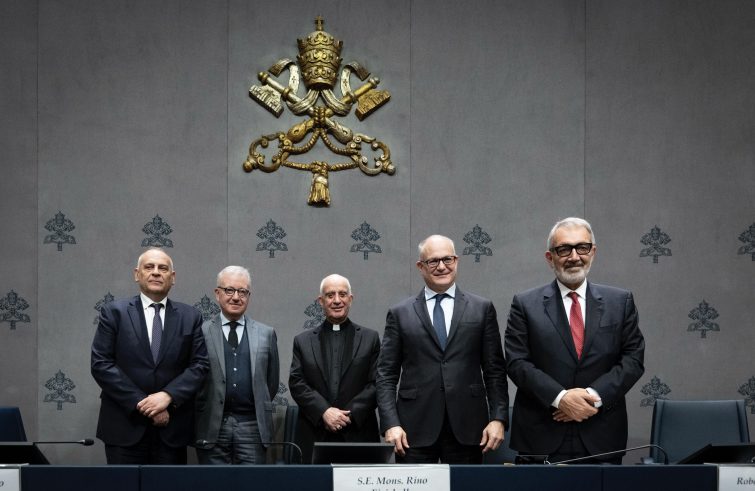
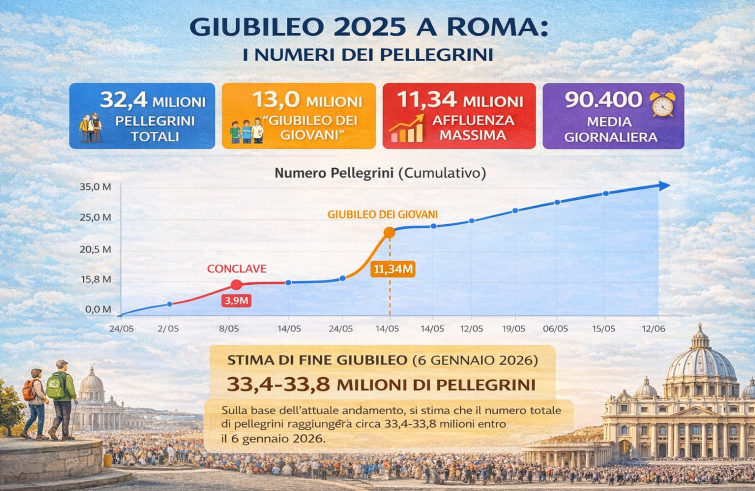
“The presence of pilgrims has taken nothing away from anyone.” This is how the overall assessment of the Jubilee 2025 may be summed up, presented this morning in the Vatican Press Office by Msgr Rino Fisichella, Pro-Prefect of the Dicastery for Evangelisation, together with the Undersecretary of the Council of Ministers Alfredo Mantovano, the Mayor of Rome Roberto Gualtieri, the President of the Lazio Region Francesco Rocca and the Prefect Lamberto Giannini. Between 33.4 and 33.8 million pilgrims will have passed through the Holy Doors by 6 January, with a daily average of 90,400 presences over the 358 days of the Holy Year. “The feared risk, suggested by some, that the presence of pilgrims would reduce tourism or cancel other major events has been fully disproved by the results achieved on all fronts,” Msgr Fisichella stressed.
The figures and the spiritual dimension
Europe led the flows with 62.63%, followed by North America (16.54%) and South America (9.44%). Among individual countries, Italy ranked first with 36.34%, followed by the United States (12.57%), Spain (6.23%), Brazil (4.67%) and Poland (3.69%). There were two attendance peaks that marked the year: the period of the death of Pope Francis and the Conclave, from 21 April to 8 May, with 3.9 million pilgrims, and the Jubilee of Young People, from 28 July to 3 August, with over 13 million. “The Jubilee was not a loss-making investment,” the prelate added, “but rather a driving force that has increased and will continue to foster overall growth in the future, adding value to infrastructure that remains for the benefit of the city of Rome and of Italy.”
Beyond the figures, Msgr Fisichella highlighted “the spiritual dimension that lies at the foundation of the Jubilee”, which “made it possible to encounter a people on the move, with a great desire for prayer and conversion”.
“The Papal Basilicas and other centres of prayer, such as the Scala Santa, recorded levels of attendance never seen before. Confessions increased, and the Jubilee celebration of the full indulgence reached everyone. The Jubilee was truly a year of grace.” Among the images destined to remain in memory, the prelate mentioned “the joy of young people at Tor Vergata”, “the procession of the confraternities with their historic statues through the Roman Forum”, and “the canonisation of two young saints as an icon of hope”. A special word was dedicated to the 5,000 volunteers who served throughout the year, joined by 2,000 from the Order of Malta.
• Total pilgrims: 33.4–33.8 million
• Daily average: 90,400 presences (358 days)
• Origin: Europe 62.63%; North America 16.54%; South America 9.44%
• Main countries: Italy 36.34%; United States 12.57%; Spain 6.23%; Brazil 4.67%; Poland 3.69%
• Attendance peaks: 3.9 million (April–May); over 13 million (Jubilee of Young People)
• Volunteers: 7,000 overall
• Projects: 332 total, 204 completed or partially completed
The “Jubilee method”
On the organisational level, Undersecretary Alfredo Mantovano outlined what he described as the “Jubilee method”, a model of interinstitutional cooperation that the government intends “not to confine to 2025”. The steering committee involved on a permanent basis more than one hundred bodies. “The role of the State administration should be, as far as possible, to coordinate rather than to command,” Mantovano explained, recalling among the virtuous examples the tunnel beneath Piazza Pia, completed despite the discovery of Roman remains, and the redevelopment of the Vela di Tor Vergata, “a project that had become the symbol of institutional failure”. President Francesco Rocca underlined that “the central element was the serenity with which this working group was able to operate towards shared objectives”, without resorting to extraordinary powers.
“The Jubilee method is not a method based on extraordinary powers,” he specified, “but one in which public administration finally demonstrates common sense.”
Mayor Roberto Gualtieri presented the overall assessment of the works: of the 332 projects, 204 are completed or partially completed. For those deemed “essential and non-deferrable”, the percentage rises to 90%. “Piazza Pia was awarded first place in The Plan Award 2025; the Monte Ciocci cycle–pedestrian route received a European Green Award,” he recalled. “Perhaps the main legacy is renewed confidence in the possibility of improving and transforming the city,” the Mayor observed. Prefect Lamberto Giannini highlighted the 70 committees for public order and security held during the year and thanked the people of Rome “for having given an extraordinary example of welcome”.
(Foto SIR)
Looking ahead to 2033
Msgr Fisichella concluded the assessment by looking to the future. “This Holy Year directs our journey towards another fundamental anniversary for all Christians,” he said, citing the Bull Spes non confundit. “In 2033, in fact, the 2,000th anniversary of the Redemption accomplished through the Passion, Death and Resurrection of the Lord Jesus will be celebrated.” For the prelate, “the journey has not ended. This was only a significant stage, but one that prepares the way for another event of grace that must be planned with foresight”. The 35 major events and the daily pilgrimage “made it possible to encounter a dynamic Church, capable of looking realistically at the challenges it faces, yet always confident of being guided by the power of the Spirit who accompanies her”. In short, “it was a Jubilee that has sown seeds, and the fruits will come in the future”.