
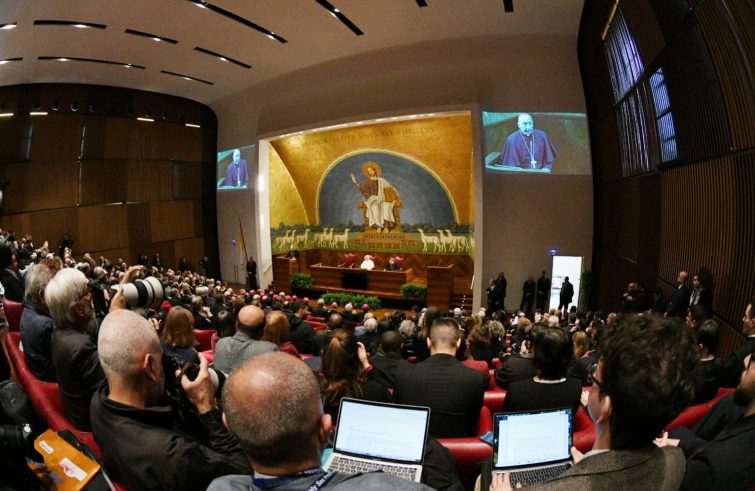
Reciprocity and fraternity, scientific rigour, the common good. Reciprocity, fraternity and scientific rigour for the common good. These were the key themes around which Pope Leo XIV structured his speech for the inauguration of the academic year at the Pontifical Lateran University, ‘the Pope’s university’. He recommended that those present adopt an attitude of ‘a grateful look at the past, but also eyes and hearts focused on the future’, who applauded him at length at the beginning and end of his speech. After outlining the long history of relations between the bishops of Rome and the PUL, the Pope emphasized the latter’s ‘unique mission’, describing it as ‘a privileged centre where the teaching of the universal Church is elaborated, received, developed and contextualized’. It is an institution to which ‘even the Roman Curia can refer for its daily work.’
“Today we urgently need to reflect on faith in order to apply it to current cultural scenarios and challenges, but also to counteract the risk of cultural emptiness, which is becoming increasingly pervasive in our age”,
is Leo’s fundamental thesis, who urged the Faculty of Theology to “reflect on the repository of faith and bring out its beauty and credibility in different contemporary contexts”. At the Lateran University, “the study of philosophy must aim at the search for truth through the resources of human reason, open to dialogue with other cultures and above all with Christian Revelation, for the integral development of the human person in all its dimensions”. “This is an important commitment, even in the face of the sometimes defeatist attitude that characterizes contemporary thought, as well as in relation to the emerging forms of rationality linked to trans-humanism and post-humanism,” explained Prevost, who asked the Faculties of Law, Canon Law and Civil Law in particular to “consider and study in depth the administrative processes, an urgent challenge for the Church”.
“Train peacemakers and advocates of justice who will build and bear witness to the Kingdom of God”,
is the task of the Peace Studies and Ecology and Environment degree programs, whose themes “are an essential part of the recent Magisterium of the Church,” emphasized Leo XIV, calling for “the continued development and enhancement of these two degree programs at an inter- and trans-disciplinary level and, if necessary, their integration with other courses”.
“Reciprocity and fraternity must lie at the heart of education”,
was the first challenge entrusted by the Pope to the PUL. “Today, unfortunately, the word ‘person’ is often used as a synonym for ‘individual’, and the appeal of individualism as the key to a successful life has disturbing implications in every area”, was Leo XIV’s cry of alarm: “The focus is on self-promotion, the primacy of the self is nurtured and cooperation becomes difficult, prejudices and walls towards others, especially those who are different, grow, the service of responsibility is exchanged for solitary leadership and, in the end, misunderstandings and conflicts multiply”. On the other hand, academic education “helps us to break out of self-referentiality and promotes a culture of reciprocity, otherness and dialogue”.
“Against what the Encyclical Fratelli tutti defines as the virus of radical individualism, I ask you to cultivate reciprocity, through relationships based on generosity and experiences that foster fraternity and dialogue between different cultures”,
the Pope appealed: “The Pontifical Lateran University, enriched by the presence of students, teachers and staff from five continents, represents a microcosm of the universal Church: be, therefore, a prophetic sign of communion and fraternity”.
“Often, Academic service is not given the appreciation it deserves, partly because of deep-rooted prejudices that unfortunately also exist within the ecclesial community”, Leo observed, condemning “the idea that research and study are of no use in real life, that what matters in the Church is pastoral practice rather than theological, biblical or legal preparation”. On the contrary, it is essential to
“promote, defend and develop” scientific rigour in order to avoid “the risk of slipping into the temptation to simplify complex issues to avoid the effort of thinking,
with the danger that, even in pastoral action and its language, we may fall into banality, approximation or rigidity”.
“We need lay people and priests who are prepared and competent”,
was the Pope’s other request, together with an invitation to “not lower our guard regarding scientific rigour, pursuing a passionate search for truth and a close dialogue with other sciences, with reality, with the problems and struggles of society”. “This requires the University to have well-trained teachers who are placed in pastoral, legal and economic conditions that allow them to devote themselves to academic life and research; that students are motivated and enthusiastic, willing to study rigorously”. Leo indicated the direction to be taken: “The University needs to engage in dialogue with other centers of study and teaching, so that, from an interdisciplinary and trans-disciplinary perspective, new paths can be explored”.
“Train people who, in the spirit of generosity and with a passion for truth and justice, can be builders of a new world, one of solidarity and brotherhood”.
The closing message: “The Lateran University occupies a special place in the Pope’s heart, and the Pope encourages you to dream big, to imagine possible spaces for the Christianity of the future, to work with joy so that everyone can discover Christ and find in Him the fulfillment to which they aspire”.