
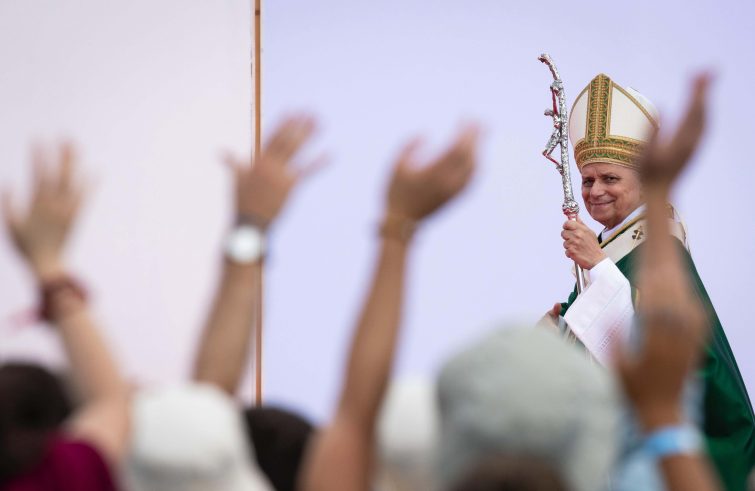
“How wonderful it would be if one day your generation were remembered as the ‘generation plus,’ remembered for the extra drive you brought to the Church and the world.” Leo XIV conveyed this message to the students taking part in the Jubilee of Education in his address delivered to them in the Paul VI Hall, which he began with unexpected words of greeting to the large number of young people who were unable to find seats in the hall and who were following the meeting on the large screens that had been set up outside. “Today I ask you to join forces to open a new season of education, in which all of us — young people and adults — become credible witnesses of truth and peace”, Leo said, following a quotation from Saint Pier Giorgio Frassati and an invitation not to be settle with appearances or fads, but to “to keep striving toward the heights,” lighting the beacon of hope in the dark hours of history.”
“You are called to be truth-speakers and peace-makers, people who stand by their word and are builders of peace”
The Pope said to the students: “Involve your peers in the search for truth and the cultivation of peace, expressing these two passions with your lives, your words and your daily actions.” The Pope accompanied the example of Saint Pier Giorgio Frassati with a reflection by John Henry Newman, who will be proclaimed a Doctor of the Church next Saturday: “true peace is born when many lives, like stars, come together and form a pattern. Together, we can form educational constellations that guide the path forward.” It was precisely the stars that Prevost, a former mathematics and physics professor, referred to and counted: “Even though there are billions upon billions of stars, we only see the closest constellations”, he explained. “Yet these are enough to point us in a direction”, even the Magi followed a star: “Like them, you too have guiding stars: parents, teachers, priests and good friends, who are like compasses that help you not to lose your way amid the ups and downs of life.”
“Each of you is a star, and together you are called to guide the future”,
The Pope’s recommendation: “When Galileo Galilei pointed his telescope at the sky, he discovered new worlds: “Education is like a telescope that allows you to look beyond and discover what you would not see on your own.
So do not remain fixated on your smartphones and their fleeting bursts of images;
instead, look to the sky, to the heights.” For “having a great deal of knowledge is not enough if we do not know who we are or what the meaning of life is”:
“Without silence, without listening, without prayer, even the light of the stars goes out.”
“We can know a great deal about the world and still ignore our own hearts”, the analysis of Leo XIV: “You too may have experienced that feeling of emptiness or restlessness that does not leave you in peace.”
“In the most serious cases, we see episodes of distress, violence, bullying and oppression — even young people who isolate themselves and no longer want to relate to others”, the Pope denounced: “I think that behind this suffering lies also a void created by a society that has forgotten how to form the spiritual dimension of the human person, focusing only on the technical, social or moral aspects of life.”
“My heart is restless until it rests in you.” This quote from Saint Augustine illustrates the meaning of educating oneself for the inner life: “to listen to our restlessness and not flee from it or fill it with things that do not satisfy. Our desire for the infinite is a compass that tells us: ‘Do not settle — you are made for something greater;’ ‘do not simply get along, but live’”.
“But, do not let the algorithm write your story! Be the authors yourselves; use technology wisely, but do not let technology use you”,
The Pope said in the central part of his address to the students, whom he referred to as “teachers in digital education”: “You live in it, and that is not a bad thing; there are enormous opportunities for study and communication.” “Artificial intelligence is also a great novelty — one of the rerum novarum, or ‘new things,’ of our time”, observed Leo XIV. However, “it is not enough to be ‘intelligent’ in virtual reality; we must also treat one another humanely, nurturing emotional, spiritual, social and ecological intelligence.”
“Learn to humanize the digital, building it as a space of fraternity and creativity — not a cage where you lock yourselves in, not an addiction or an escape”, the Pope’s invitation: “Instead of being tourists on the web, be prophets in the digital world!”.
The Pope went on to highlight the exemplary figure of holiness of Saint Carlo Acutis, “a young man who did not become a slave to the internet, but rather used it skillfully for good”, he teaches us that “the digital world is educational when it does not close us in on ourselves but opens us to others — when it does not place us at the centre but orients us toward God and others.”
“I invite you to be peacemakers first and foremost where you live — in your families, at school, in sports, and among your friends — reaching out to those who come from other cultures”,
Leo said in his closing remarks, in the context of a “future threatened by war and hatred, which divide people.” “Can this future be changed? Certainly! How? With an education for peace that is disarmed and disarming”, the Pope’s encouragement: “It is not enough, in fact, to silence weapons: we must disarm hearts, renouncing all violence and vulgarity. In this way, a disarming and disarmed education creates equality and growth for all, recognizing the equal dignity of every young person, without ever dividing young people between the privileged few who have access to expensive schools and the many who do not have access to education.”