
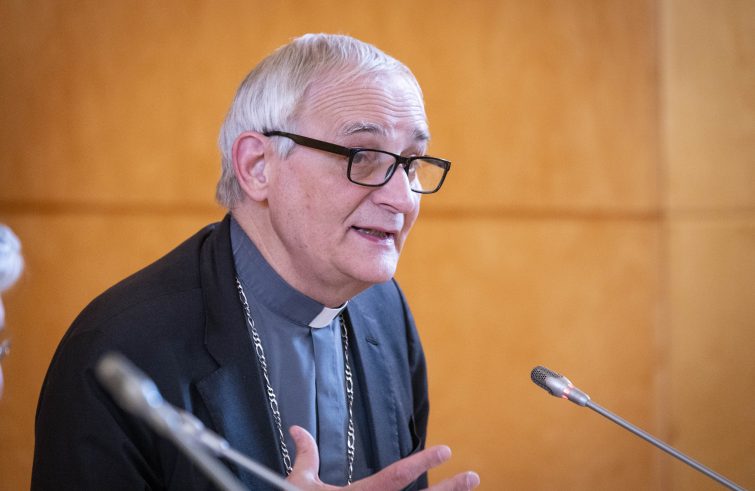
“Nothing from the past is irretrievably lost, and no border is insurmountable.” With these words, Cardinal Matteo Zuppi, Archbishop of Bologna and President of the Italian Episcopal Conference (CEI), embraced the legacy of Gorizia and Nova Gorica, once divided apart by historical circumstances, yet now brought together to share the title of 2025 European Capital of Culture. “Everything can change. It depends on each one of us”, Zuppi observed citing John Paul II’s words during his pastoral visit in 1992 and recalling the prayer vigil for peace scheduled for Tuesday evening. In his address to the Standing Committee, convened in Gorizia until 24 September, Cardinal Zuppi mentioned Slovenia and Italy, highlighting their long-standing cooperation within a European framework. “Many things that before and for a long time appeared impossible have been made possible by a united Europe based on cooperation, in the recognition of a shared destiny of peace among the countries of Europe (previously at war with each other) and the world,” Zuppi observed. “These achievements indicate that Europe is a path to the future, albeit perhaps less evident to citizens due to the distance of EU institutions.”
“Italy, and indeed the whole of Europe, has the potential to become a school of peace”,
is the appeal of the president of the Italian Episcopal Conference: “As President Mattarella recently stated, the world needs Europe in order to restore the primacy of international law that had been shattered and give new impetus to the prospect of cooperative multilateralism.”
“Europe must raffirm its existence, albeit undermined and weakened by nationalisms, sovereignisms, and complex leadership,” said Zuppi. He added, “the instability in its relations with its long-standing American ally, alongside the situation resulting from the Russian invasion of Ukraine, places Europe in an entirely new situation which requires unified solutions if they are to be effective.”
“We, as members of the Italian Church and European Churches, must lend our support to the continent, strengthen it as a beacon of democracy, peace, and freedom, and protect human beings in a world that continues to be so unstable,”
he said, indicating the course to be taken. “Today more than ever, examples such as Gorizia are needed to show that peace is not a utopian dream for the naïve; it is the vocation of Italy, Europe, and every human society worthy of the name,” said the cardinal, echoing John Paul II’s vision of a two-lunged Europe and the desire for a “new Camaldoli” for our continent. “Can we dare to dream that weapons will fall silent and cease to wreak destruction and death?” Zuppi continued. “The need for peace challenges everyone” with concrete projects, starting with the commitment of diplomacy “to build spaces for negotiation aimed at lasting peace with courage and creativity.” The starting point is the awareness that “war is not a phantom of the past; it has become a constant threat”, as Pope Francis denounced in ‘Fratelli Tutti’. Today, after five years,
“Many countries and millions of people have seen their lives made worse by war”,
as in Gaza, where, “Israeli hostages are still being held in inhumane conditions, and the entire population, facing starvation and bombings, is forced into a continuous exodus, experiencing the dramatic suffering that accompanies every exodus.”
The Italian Church echoes the Pope’s heartfelt and impassioned plea for a ceasefire and the release of hostages, as expressed during last Wednesday’s audience. “Let the noise of weapons cease in the name of respect for the inviolable dignity of the human person, of every person. Civilians must be protected from all forms of physical, moral, and psychological violence. Everyone must be guaranteed the freedom to decide where and how to live, with respect for others, in fraternity, and in accordance with the principle of two States — the only solution for the Palestinian people, who are being held hostage by Hamas, while facing the ongoing military offensive.”
“War is the failure of politics and humanity,”
The cardinal continued. “It is happening in Ukraine, despite the recent glimmer of hope for negotiated peace. The future appears to be characterised by military confrontation. There has been a paradigm shift, now widespread, whereby war is being re-evaluated as a political tool or a means of enforcing one’s agenda.”
“We are not only experiencing a crisis of the UN. We are in the age of force.”
The cardinal then went on to call for the resumption of the “dream” of Paul VI, as set out in his famous speech to the UN on 4 October 1965. Reject the “globalisation of powerlessness” and embrace the “culture of reconciliation” to avoid remaining “trapped in polarisation” or “insurmountable walls.”
“Being Christian also means denouncing wars and injustices, supporting diplomatic efforts and offering hospitality to those fleeing conflicts,” he warned, adding that “every parish and community should be a home for the promotion of non-violence and peace.”
The president of the Italian Episcopal Conference renewed his appeal to ensure that palliative care is “universally available and effective in every region. “The thirst for experiences of faith among young people has not been extinguished”, he said recalling the Jubilee at Tor Vergata and the recent canonisations of Pier Giorgio Frassati and Carlo Acutis.
“We must look to the future of our country with a missionary gaze.”
It is the task of the Italian Church after the Jubilee. “In our fractured society, the fabric of fraternity must be rebuilt,” said the cardinal, citing the latest steps of the Synodal Path of the Churches in Italy. The final reformulated text will be voted on by the third Synodal Assembly on 25 October and then presented to the bishops gathered at the General Assembly, which is scheduled to take place from 17 to 20 November in Assisi. “Synodality is still ongoing, but it must transform into a modus operandi and a series of operational, engaging, fraternal and prophetic decisions.”