
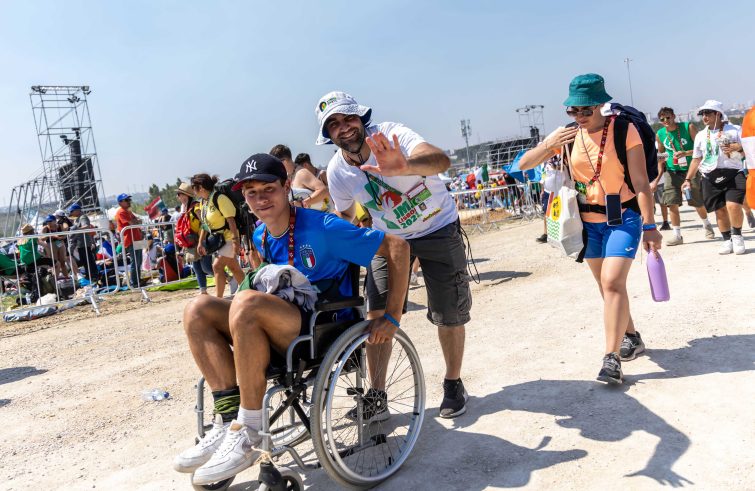
“This is not an optional consideration, but a right. And we have worked to ensure it is upheld.” Giuseppe Napolitano, Director of Civil Protection of Roma Capitale and coordinator of the volunteering and logistics group for the Jubilee, thus summarises the spirit behind the preparations for welcoming persons with disabilities during the Jubilee of Young People. The effort began months ago, built methodically through the active involvement of public institutions, ecclesial bodies, third-sector organisations, and the disability pastoral network.
The organisational core will be the accessible hub located beneath the event’s central stage: an air-conditioned, fully equipped area, staffed by trained personnel, designed to welcome young people with disabilities and their companions in a dignified and safe environment.
Access to this area will be provided via specially equipped shuttle buses departing from Cinecittà, where reserved parking zones have been arranged for buses and private vehicles. Dedicated personnel will be present to assist with reception, orientation, and assisted transfer. “In these cases, it’s the details that make the difference,” Napolitano emphasises. “We sought to build a system in which no one would be forced to forgo participation due to a lack of resources.”
A dedicated parking area for vehicles of persons with disabilities is available on Viale Palmiro Togliatti, near Piazza di Cinecittà. From there, equipped shuttle buses to Tor Vergata will operate on 2 August (6:00–18:00) and 3 August (4:00–7:00 and 11:00–16:00). The service is reserved for persons with disabilities and one companion and is also available from Subaugusta station (Metro A). Assistance points will also be available at Anagnina (Metro A) and Ciampino railway station.
Quiet Zones and Simplified Mobility
In addition to the central hub, three “quiet zones” will be set up — each a 150-square-metre tented structure distributed across the approximately 56-hectare event area. These are peaceful, welcoming, and equipped spaces designed to meet the needs of individuals with sensory, psychological, or motor disabilities who may require calm, rest, or medical and relational support at specific moments. These areas will be managed by trained volunteers, healthcare staff, and specialised caregivers. “Not all disabilities are the same,” Napolitano reiterates. “We must ensure a respectful presence—never intrusive, yet always ready to act.” Surrounding this central provision is a system of auxiliary services: alternative and augmentative communication maps, ground symbols for orientation, simplified routes, and both visual and audio signage.
At key urban hubs—railway stations, bus terminals, tourist sites—“light outposts” will operate: information points staffed by Civil Protection volunteers and Universal Civil Service members.
Logistical coordination will be strengthened by a digital information system integrated with Roma Capitale, providing real-time updates and accessible materials via the institutional website and mobility channels.
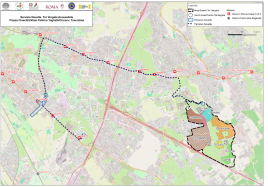
(Foto Comune di Roma)
An Inclusive Model for Major Events
The organisational framework for the Jubilee of Young People is the outcome of a long-term process. Since last Christmas, stable services have been in place: free transport upon reservation for persons with disabilities, the progressive setup of Padef (Advanced Points for Persons with Disabilities and the Vulnerable), and two co-planning and co-designing procedures provided for by the Third Sector Code, involving cooperatives, associations, and professional operators. “We built on positive past experiences,” Napolitano explains, “and scaled them up, making the most of the best expertise available.” Hundreds of individuals will ensure the entire system functions: Civil Protection teams, healthcare workers, civil service volunteers, ecclesial movements, and municipal staff. “It’s a chain of shared responsibility,” he adds, “with each person contributing their resources towards a common goal.” Yet the perspective reaches beyond the immediate future: “If, by January 2026, we can say that this system worked, perhaps Rome will be able to offer the world a model—sober, replicable, respectful—for the inclusive organisation of large-scale events.” A Jubilee that leaves a tangible legacy, capable of fostering a culture.
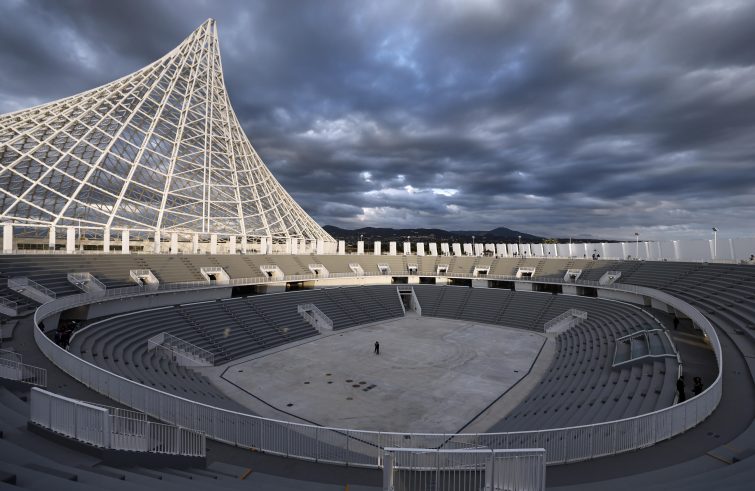
(Foto ANSA/SIR)
A Culture of Encounter Rooted in the Grassroots
A pivotal figure in this process has been Sister Veronica Donatello, Head of the National Service for the Pastoral Care of Persons with Disabilities of the Italian Episcopal Conference. For the Jubilee, Sister Donatello coordinates support activities for disabled and vulnerable pilgrims—from service planning in the Tor Vergata area to the management of the central hub and welcome point at the shuttle car park. “I am grateful to the Lord,” she recounts, “for having lived through an experience that has deeply enriched me. The Jubilee compelled us to move from theory to tangible solutions based on people’s actual needs.”
“A person with disabilities arrives and knows they have options. They can rest in an air-conditioned tent, access adapted toilets, find reclining beds, electric wheelchairs, and stations to recharge medical devices. Everything has been designed with reasonable accommodations in mind.”
The planning was informed by detailed feedback collected from families, dioceses, and associations, shared with the Dicastery for Evangelisation, Civil Protection, and public authorities. “Disability has brought people together,” she observes. “It has created new bonds among volunteers, staff, and organisers. It is proof that a global event can truly be for everyone, without leaving anyone behind.” The nun describes it as a “cultural leap”: an event designed from the outset with accessibility in mind, from sign language to simplified communication. “The greatest gift,” she concludes, “will be to see the Pope surrounded by young people, each with their own fragility and hope. Because when we offer young people an environment where they can thrive, they truly become seeds of the future.”