
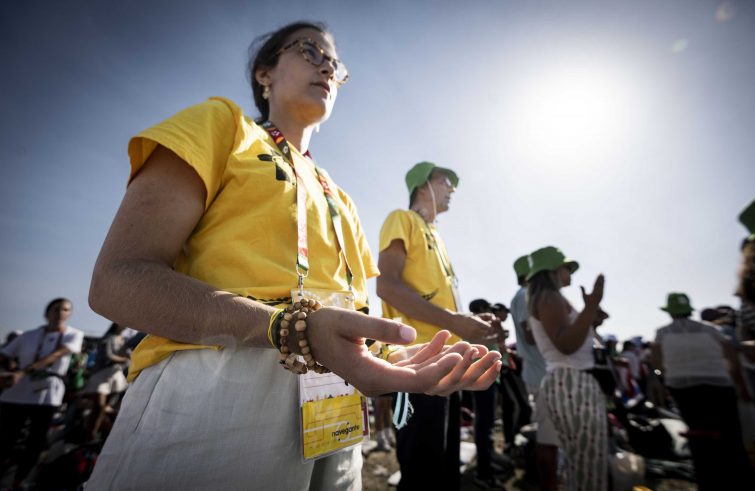
“Spirituality continues to be an important factor in the lives of young people.” Gema Bellido, the coordinator of the new “Footprints” research group at the Holy Cross Research Laboratory, presented an overview of the international project bearing the same name at the Pontifical University of the Holy Cross during the Jubilee for Young People. “Spirituality among young people is not fading; rather, we are seeing a spiritual rebirth,” said Bellido in her closing remarks at the end of the meeting. The event brought together international experts in sociology, education, communication, and big data to review the preliminary results of the survey on youth religiosity that involved nearly 5,000 young people, aged 18 to 29, from eight countries worldwide (including Argentina, Brazil, Italy, Kenya, Mexico, the Philippines, Spain, and the United Kingdom). The survey revealed a surprising spiritual reawakening across the globe, including in the most secularized contexts.
The event featured talks by Jonathan Evans, Senior Researcher at the Pew Research Centre; Rita Bichi, Professor of Sociology at the Catholic University of the Sacred Heart in Milan; and Daniel Moulin, Associate Professor at the Faculty of Education at the University of Cambridge in the UK. The findings of the survey underscored the nuanced interplay between faith and morality, prayer practices among atheists, and the views of young adults on societal issues including war, environmental stewardship, and sexual ethics. The study offered a vital forum for discussing how these evolving trends are reshaping the global landscape of youth religiosity and how researchers and educators can address the changing spiritual needs of younger generations.
“Increased spirituality” among young people
Over the past five years, 50% of young people reported an increased interest in spirituality, while only 15% reported a decline, resulting in a +35% overall increase. However, country-specific differences emerged. In Brazil, Kenya, and the Philippines, for example, the percentage of young people reporting an increase in spirituality exceeds 50% — compared to about 10% reporting a decrease. In all other countries except Italy, which showed no significant change, the increase in interest ranges from 10% to 32%. Therefore, while the study focuses on religion, its data refute the inevitable secularization predicted by studies published in the late 1960s and early 1970s.
Believers and non-believers. The findings show that both groups reject war, political corruption, and environmental damage. Many young Catholics attend Mass, confession, and prayer, but they often do not follow the Church’s teachings on sexual morality, holding views similar to those of non-believers. Differences emerged regarding pornography and surrogacy: while non-believers tend to accept them, believers are more critical. Catholic respondents were less likely than other groups to justify war and rejected the death penalty.
Among nonbelievers who identify as atheists, 48% pray occasionally—62% in times of difficulty, 48% out of gratitude, and 47% for everyday problems. Additionally, 42% believe in life after death and 37% ask believers to pray for them.
Faith and religious practice. The survey results show that Catholics who are knowledgeable about and adhere to the tenets of their faith are distinguished by their regular religious practices, such as daily prayer, attending Sunday Mass, going to confession, and passing on their faith to their children. One finding deserving further consideration at the pastoral level is the relationship between interpretation and Scripture. Specifically, only 25% of young Catholics agree with the Church’s position that interpreting the Bible requires the mediation of Tradition and the Magisterium.
The reawakening of the West. Although Mass attendance and nominal adherence to Christianity have been declining for decades, countries including Italy, Spain, the United Kingdom, Argentina, and Mexico are experiencing a reversal of this trend.
According to the Footprints study, almost 18% of young believers in Spain and 16% in Italy attend religious services or Mass on a daily basis.
These conclusions are consistent with other studies indicating a more intentional lived-out faith. For example, a survey by the Bible Society and YouGov in England and Wales found young adults are newly drawn to Christian beliefs, with Generation Z leading the way. The Pew Research Center’s 2023-2024 Religious Landscape Study indicates that the decline of Christianity in the United States has slowed, potentially stabilizing. Other indicators point to a spiritual awakening among young people. In France, the number of baptized youths aged 18 to 25 increased from approximately 1,000 in 2022 to over 4,000 in 2025. Among 11- to 17-year-olds, the number rose by 33%, reaching over 7,400. More than 10,000 young people attended Flame 2025 at the OVO Arena Wembley in England and Wales on March 15. This major Catholic youth event featured personal accounts, music, and Eucharistic prayer, including a message from the Pope. The 10th National Eucharistic Congress was held in Indianapolis (United States) from July 17 to 21, 2024, with approximately 50,000 participants, most of whom were young people. In April 2025, approximately 50,000 young Italians gathered in Rome for the Jubilee of Adolescents. The event was unfortunately postponed due to the unexpected passing of Pope Francis, and the young people also attended his funeral. These numbers are expected to rise significantly in a few days, when over a million young people will gather in Rome for the Jubilee of Young People.