
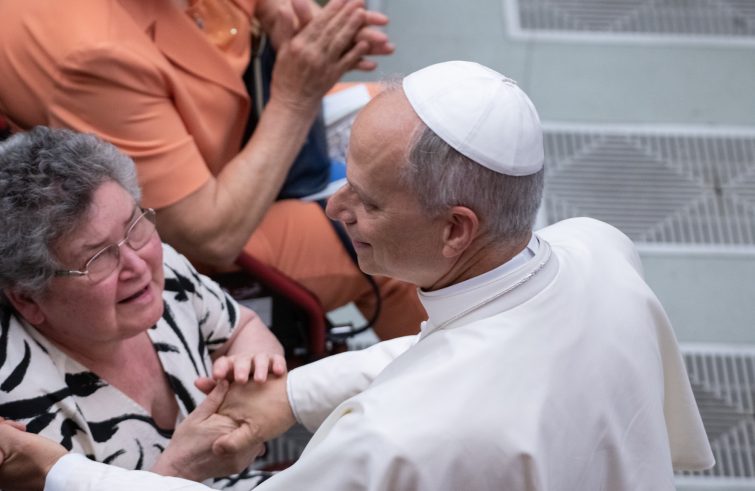
“Visiting an elderly person is a way of encountering Jesus, who frees us from indifference and loneliness.” The message of Pope Leo XIV for the Fifth World Day for Grandparents and the Elderly, to be celebrated on Sunday 27 July under the theme “Blessed are those who have not lost hope,” opens with this powerful call to the concreteness of charity. The Pontiff recalls the biblical figures of Abraham and Sarah, Zechariah and Elizabeth, noting that “old age, barrenness, and decline seem to extinguish the hopes of life and fruitfulness of all these men and women,” yet God always surprises with his saving intervention. Reviewing salvation history, the Pope emphasises how “in the Bible, God often shows his providence by turning to people advanced in years,” such as Moses, who was called to liberate the people at the age of eighty. Quoting Saint Augustine, he writes: “What is this time of old age? – Saint Augustine asks – God answers you here: ‘Oh, let your strength truly fail, so that my strength may remain in you and you can say with the Apostle: When I am weak, then I am strong.’” He observes that the increase in the elderly population is “a sign of the times that we are called to discern, to read well the history we are living.”
Sign of the times
The Pope reflects on the irreplaceable role of the elderly as “first witnesses of hope” and as the living memory of faith, civic virtues, devotion, and perseverance. He recalls the image of Jacob blessing his grandchildren, “urging them to look with hope to the future, as the time of God’s promises.” In the message, Leo XIV underlines how the Jubilee is a time of liberation and invites the Church to a change of pace for the elderly: “God’s fidelity to his promises teaches us that there is a blessedness in old age, an authentically evangelical joy, which asks us to break down the walls of indifference in which the elderly are often enclosed.” He denounces:
“Our societies, in every latitude, are becoming all too accustomed to allowing such an important and rich part of their fabric to be kept on the margins and forgotten.”
For this reason, he asks that every parish, association, and ecclesial group become protagonists of a “revolution of gratitude and care,” creating networks of support, visitation, and prayer capable of restoring dignity to those who feel abandoned.
Hope to transmit
In the concluding part of the message, the Pope invites the elderly themselves not to lose hope, citing Scripture: “Blessed are those who have not lost hope.” And he reminds them:
“We have a freedom that no difficulty can take away from us: that of loving and praying. All of us, always, can love and pray.”
He recalls the words of Pope Francis at the Angelus of 16 March last: “Our bodies are weak but, even so, nothing can prevent us from loving, praying, giving ourselves, being for one another, in faith, shining signs of hope.” Finally, concluding with Saint Paul, he exhorts all to look to the future with confidence: “Even if our outer self is wasting away, our inner self is being renewed day by day.”