
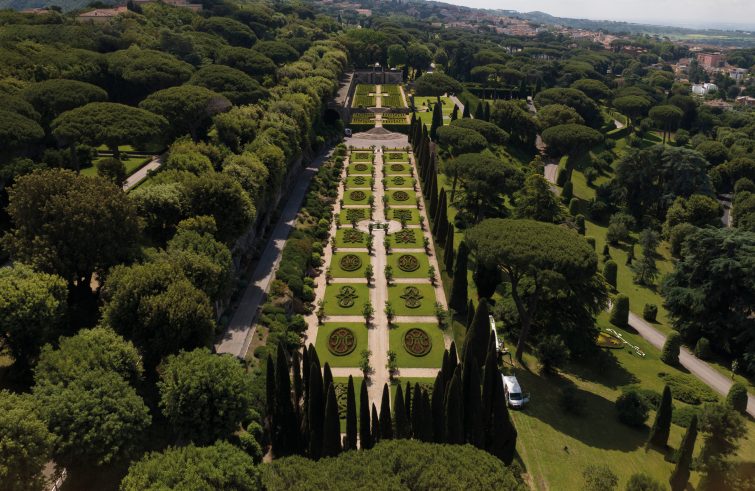
On the 10th anniversary of the publication of Pope Francis’ encyclical Laudato Si’, Leo XIV has promulgated the Decree for the Missa “pro custodia creationis” (“Mass for the Care of Creation”). This new formulary will be added to the Missea “Pro variis necessitatibus vel ad diversa” (“For various needs and occasions”) of the Roman Missal. Leo XIV will celebrate the first Mass for the care of creation using the new liturgical formulary on 9 July at ‘Borgo Laudato Si’, during his vacation at Castel Gandolfo. A verse from the Psalms is chosen as the Entrance Antiphon: “The heavens tell of the glory of God, / the work of his hands announces the firmament”. SIR asked theologian Simone Morandini to comment on the new Mass for the Care of Creation.

Do you view the Mass for the Care of Creation as an important step?
The approval of this votive Mass for Creation is a beautiful sign, particularly as 2025 marks the tenth anniversary of the publication of Pope Francis’s encyclical Laudato Si’ that called on the Catholic Church to commit to a profound reflection on the care of Creation, grounded in sociological, environmental ethical considerations, from a theological perspective, of spiritual reflection and celebration.
Coincidentally, only two months after the encyclical was published, Pope Francis endorsed the proposal originally launched by the Patriarchate of Constantinople and embraced at an ecumenical level to hold a Day of Prayer for the Care of Our Common Home and Creation on 1 September. Pope Francis thereby offered his support to address these issues ecumenically. Therefore, it is highly significant that ten years later, a votive Mass celebrating the Triune Creator and Creation accomplished in Jesus Christ has been included in the Catholic Church’s calendar of celebrations. Alongside the numerous references to Creation already found in other celebrations, this new addition provides a specific moment of celebration that Communities can adopt at the most appropriate times, dedicated precisely to the reality of the Creator and His work of Creation. This is the first aspect to bear in mind.
Alongside an ethic of care for our Common Home, it is important to emphasise the need to celebrate God the Creator, who has entrusted us with this world in need of care.
John Paul II’s message for the 1990 World Day of Peace, “Peace with God the Creator: Peace with All Creation”, is also a source of inspiration.
Indeed, it is. It’s important to remember all these messages.
Concern for the care of creation reached a high point with Laudato Si’, to which Pope Francis dedicated an encyclical, but this concern did not begin with Laudato Si’.
The message of John Paul II for World Peace Day in 1990 is an important milestone, as is the resumption of this theme by Pope Benedict in his 2010 World Peace Day message, “If you want to cultivate peace, protect creation.” Within Catholic teaching, a line can be traced connecting the idea of the Creator as the source of the gift of the world we inhabit. And within this phase, Pope Leo deemed it opportune to add this extremely significant contribution. Ecumenical reflection on this issue began in the 1970s, before John Paul II, ultimately leading to the proposal to establish the Day of Creation and the Season of Creation.
In Sacred Scripture we find multiple passages referring to the work of God the Creation and Creation as a sign of His love…
A variety of Biblical readings can be proposed for the votive Mass as both the Old and New Testaments offer important insights. What unites them is the idea that this world is not our creation, but a gift that predates us: the first great gift of the Creator and the first great sacrament of His love. The New Testament, of course, adds the qualifying reference to the mediation of Jesus Christ. Everything was created through him; he is the Word, the Logos, through whom everything that exists came into being. Pope Francis effectively explains this in Laudato Si’, stating that Creation is ultimately a reality of love, regardless of the dialogue without faith, or philosophical interpretations. What the great biblical texts, from Genesis to the books of the Prophets and Paul’s letters, hand down to us is that
Creation is the first great manifestation of God’s love for his creatures. It is the beginning of a history of salvation; the act of creation itself is imbued with an original blessing.
This is essentially the notion I sought to convey in one of my previous publications, “Credo in Dio, fonte di vita. Una Fede Ecologica”, published by Edizioni Dehoniane. The idea is that the Symbol of Nicaea, which is marking its 1,700th anniversary this year, is rooted in this very confession of God’s creative love, the source of life.
This new Mass is important for precisely this reason: Creation is in danger due to various human behaviours. Leo XIV mentions this risk in his first Message for the World Day of Prayer for the Care of Creation.
Clearly, just as with every element of our confession of faith, confessing God as our Creator also has profound practical implications. It invites us to adopt an ethos of respect and care for the world as God’s Creation, His gift of love and legacy for future generations, who are entitled to inhabit it under the same conditions as our own.
Clearly, Pope Leo wished to approve this liturgical text while relaunching it in conjunction with his Message for the World Day of Prayer for the Care of Creation, following in the footsteps of his predecessors, specifically on the 10th anniversary of Pope Francis’ encyclical. Interestingly, the Pope has adopted a theme proposed by an ecumenical committee for 1 September for many years. In this sense, the approval of the votive Mass for Creation could be seen as an important step in the ecumenical process, as it raises the possibility of the Western Churches celebrating the event of Creation liturgically, either as a feast or a solemnity, as the Orthodox Churches already do. Notably, the Orthodox Churches begin their liturgical year on 1 September. While the West should adopt a different approach, it is interesting to note the harmony between the approval of this votive Mass and this ecumenical dynamic. Some refer to this as the “Assisi process” because several seminars have been held at the ‘Laudato Si’ Citadel’ in Assisi.
Could the introduction of this Mass encourage people to adopt a different approach to the Care of Creation?
Our communities will certainly benefit from understanding the connection between the liturgy and the practical application of Care, embodied in responsible and sustainable lifestyles, community choices and actions, and occasionally even in socio-political engagement. One example of this is the commendable campaign by the National Office for Social Affairs and Labour of the Italian Bishops’ Conference, which promotes the idea of solidarity-based energy communities powered by renewable energy. Reconciliation of the various interrelated aspects is a defining feature of our faith.
While we care for our Common Home to ensure a better future for the next generation, we are also acknowledging that the world, which is in danger and in need of our care, is ultimately a gift from God. It is to Him that we owe the greatness, beauty, and wonder of this gift.
This somewhat recaptures the contemplative gaze that found its loftiest expression in Francis of Assisi’s Canticle of the Sun 800 years ago.