
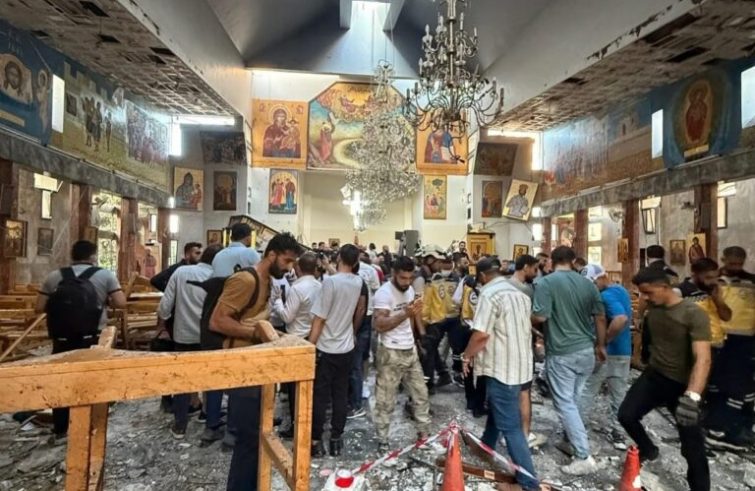
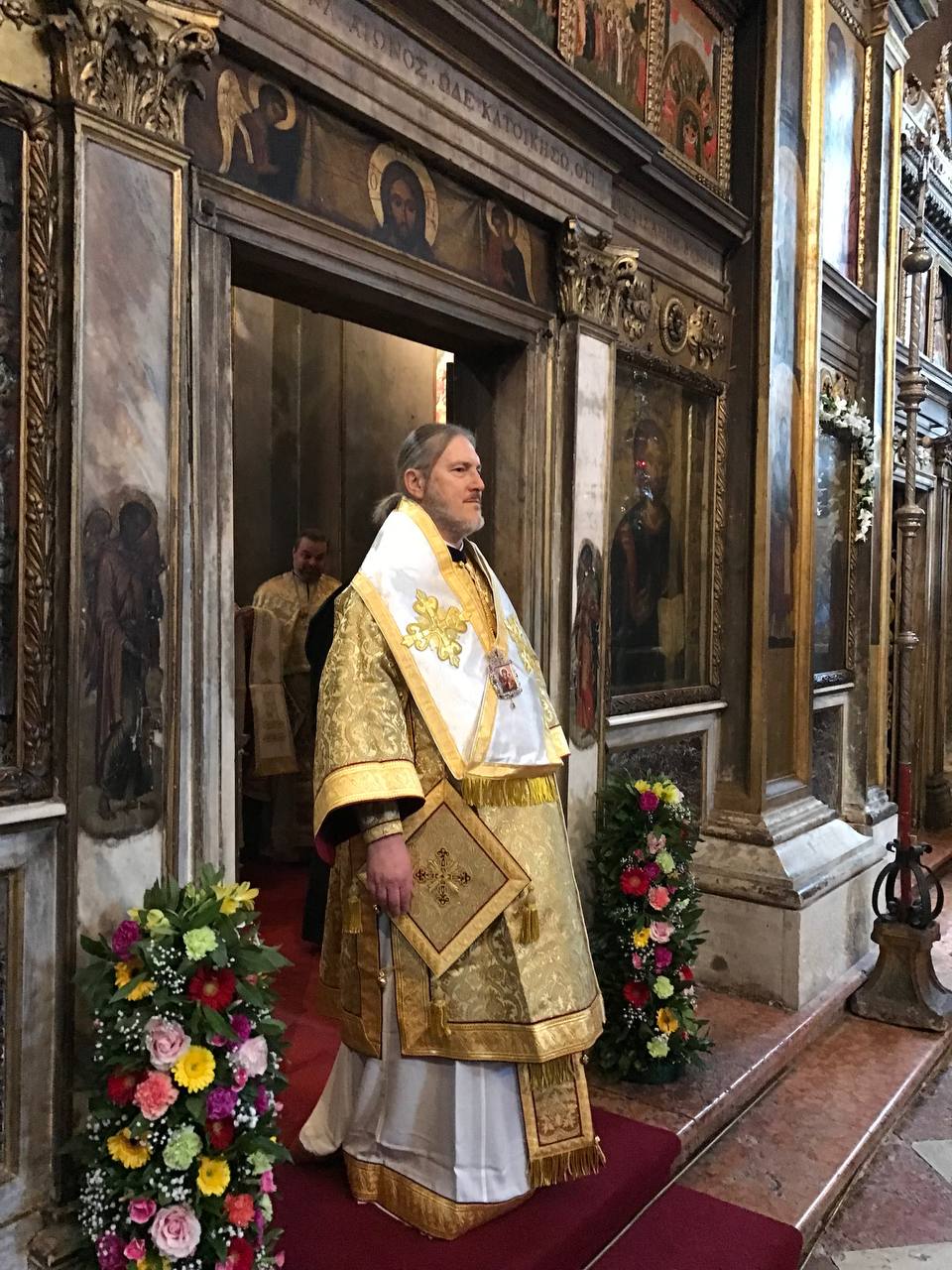
“Such immense suffering. And yet, even in that tragedy, profound Christian witness shone through. All Christian churches stood united in their grief. No Christian looked on from afar as other Christians suffered. It was a family grieving together. Our unity is the greatest testament we can offer to the world.” Monsignor Athenagoras Fasiolo, Bishop of Termae and auxiliary of the Holy Orthodox Archdiocese of Italy (Ecumenical Patriarchate), shares his thoughts on Pope Leo XIV’s catechesis for the Angelus prayer of Sunday, 29 June, reflecting on the ecumenism of blood. He recalled the latest tragic attack on the Greek Orthodox Mar Elias Church in Dweila, on the outskirts of Damascus on 22 June: a man opened fire inside the church and then detonated an explosive vest, killing 25 people and wounding about 60 others. “Even today, throughout the world, there continue to be Christians inspired by the Gospel to be generous and courageous, even to the point of sacrificing their lives”, said the Pope at the Angelus prayer.
Why target the Christian community?
Christians were baptised in blood — the intense persecution and martyrdom experienced by the early Church in its first centuries are testament to this.
Sadly, martyrdom remains a reality today, with many Christians still being killed for their faith.
Indeed, what we are witnessing is an ‘ecumenism of blood’, uniting all Christian Churches. We are targeted not because we are Catholic, Orthodox or Protestant, but because we are Christian. No philosopher or religion in the history of humanity could ever have imagined such a testimony: it is a shocking mystery.
How are we to stop those fanning the flames of war?
I would argue that we are currently experiencing a form of oppression driven by economic interests that blatantly disregards the principle of justice. As we have said repeatedly in various contexts, without justice, there will never be peace. If the economy is used as an instrument of war and oppression, it will inevitably cause the tragic events we are witnessing today. Undeniably, all current conflicts are ultimately economic wars. They are not fought because of hatred between peoples, but because of material interests that range from rare earths to oil.
Instead of serving humankind, some economies are organised around the power of a few over many.
Pope Leo stated the following: “The Church of Rome is committed, by the blood shed by Saints Peter and Paul, to serving in love the communion of all Churches.” What makes these words so important?
They carry great significance as they reflect the role that the Church of Rome has fulfilled for centuries through its service of communion and relatedness. Throughout the first millennium and subsequently in the second, the Christian Churches debated the interpretation of the primacy of the Bishop of Rome. The theological dialogue between our Churches has addressed these occasionally thorny and complex issues. Today, however, we are presented with a different opportunity. Thanks to dialogue, encounter and immediate communication, we can address these issues with a new spirit. This year marks the 1700th anniversary of the Council of Nicaea, where this relationship was solemnly recognised as an image of Trinitarian communion.
Pope Leo XIV embodies a communion that is a relationship, not a supremacy. It is a relationship of service to others, not one of superiority.
Unfortunately, some bilateral dialogues, particularly within the Orthodox world, are currently suspended. This is true for the Patriarchate of Constantinople and the Patriarchate of Moscow. Is it possible to envisage the Churches achieving full communion in the future?
As with the history of humanity, ecumenical dialogue too is subject to ebbs and flows. In my opinion, ecumenical dialogue shows no signs of diminishing. What I do notice within large Christian families, and indeed within all Christian families, is a tendency to want to impose a more radical interpretation – or adherence – to the Gospel compared to others. In the case of the Orthodox Church, for example, this can result in a departure from an authentically Christian understanding of Church unity. This is evident in the relationship between Constantinople and Moscow subsequent to the war. Nationalism, especially in the 19th and 20th centuries when many autocephalous churches emerged, has often posed a significant challenge to Orthodox Christianity. When we prioritise our own particularities, we risk losing sight of the common good. I believe this is precisely what is happening between Constantinople and Moscow.
Maybe we need to wait for new people with the ability to reconnect and recognise each other to emerge. It will take time.
The distancing that has occurred is a clear sign that historical events also affect relations between Churches. Do you think the opposite is also true? In other words, can Churches have an impact on current events?
I not only believe it, I am firmly convinced of it. We must make Christ, who is the way, the truth and the life, the centre of our lives. It is only in this way that Christ becomes love, peace and reconciliation. He embodies the ability to engage in dialogue. In particular, I appreciate the message that Pope Leo is sending out when he speaks of dialogue.
The need for dialogue has been expressed by many, not just us. Dialogue is necessary. It takes nothing away; on the contrary, it is enriching.
While it is true that historical events impact the Church, it is equally true that the Church can impact history. This has happened many times before, and I am convinced we will see it happen again in the future.