
(Foto Siciliani – Gennari/SIR)
During his audience with the Italian bishops, the Pope cited Paul VI, and “the special bond between the Pope and the Italian bishops”. How is that communion being nurtured in our present time marked by social, cultural, and ecclesial transformations?
The Italian Episcopal Conference as we know it today was significantly shaped by Paul VI. The foundations of this bond were laid in 1964 during a meeting with the plenary assembly of Italian bishops. A new statute followed in 1965, and another significant meeting took place in 1966. It was in this context that Paul VI identified a particular bond between the Pope and Italian bishops, citing historical, geographical and spiritual reasons, characterised by fidelity, obedience, collaboration and dialogue with the Pope, who is both the Bishop of Rome and the Primate of Italy.
This bond also applies to the Pontiff’s role with regard to the churches in Italy. How is this perceived today?
As mentioned earlier with regard to Paul VI and his successors, the Pope feels a particular duty to pay close attention to issues relating to Italy. John Paul II referred to his role as a bishop alongside the other bishops in Italy.
It is a responsibility not only institutional, but spiritual and pastoral, akin to a form of “immanence” in the life of the Church in Italy.
Italy is a focal point for reflection within the universal Church. How so?
The Italian Church has assumed special importance due to the presence of Rome. The sheer number of religious orders based in the country’s capital, along with its strategic location in the heart of the Mediterranean and Europe, bear testament to this. Furthermore, Italy has made a significant contribution to the European project, notably through the shared vision of De Gasperi, Schuman and Adenauer.
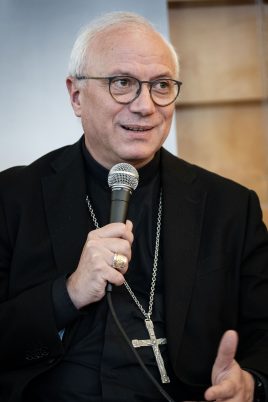
Appointed Metropolitan Archbishop of Cagliari in 2019, Monsignor Baturi has served as Secretary General of the CEI since 2022. Born in Catania in 1964, he is a canon lawyer and has held various pastoral and legal roles within the Catholic Church. From 2012 to 2019, he was the director of the National Office for Legal Issues and Under-Secretary of the Italian Episcopal Conference. He also served as vicar general of the Archdiocese of Catania. Recognising the importance of synodality, he chaired the Committee of the Synodal Path of the Italian Church.
The Italian Episcopal Conference has embraced this vocation through its recent initiatives in the Mediterranean.
Indeed, the ongoing fruitful relationship between the Italian Church and the Pope is demonstrated by this example. The initiatives upheld by Francis and Leo XIV serve as a reminder that the Mediterranean region requires special attention today. In this respect, Leo XIV’s speech was a gesture of encouragement and care.
The Pope also mentioned the diversity of the Italian Church, which is rooted in local communities but challenged by secularisation. How can these two aspects be reconciled?
Italian Catholicism has always been marked by great diversity. The vitality of popular piety is particularly evident in certain areas, where it is expressed through pious devotion, religious celebrations, and shrines. In other areas, however, secularisation has had a more radical impact. This complexity requires a diversified approach and an ecclesial presence capable of renewal.
Pope Leo XIV said he hoped to make the principles of collegiality the inspiration for his ministry. How is this being put into practice today in the CEI and the regional episcopal conferences?
The Second Vatican Council emphasised two complementary aspects: the bishop is the pastor of his diocese and at the same time he is member of the episcopal college. This entails both universal responsibility under the Pope and participation in active communion with other bishops.
Episcopal conferences are the visible manifestation of this collegiality; they are places where joint discernment is practised, shared pastoral paths are identified and ways to improve the effectiveness of evangelisation are sought.
What are the pastoral advantages of experiencing collegiality in an effective – rather than merely affective – way?
When communion is experienced authentically – and thus not only theoretically – pastoral action has a greater impact. The Italian Church alone cannot face the major challenges of our time, such as those concerning young people, anthropological issues and the sanctity of life. These challenges require a collective response from all the Churches in communion.
Is there a connection between collegiality and synodality?
Without a doubt. Pope Leo XIV invites us to practise unity grounded in mutual exchange, open dialogue, and shared discernment. This must all be understood within the broader perspective of synodality: the involvement of the entire People of God in decision-making and pastoral guidance processes.
The Holy Father highlighted the importance of making courageous decisions. In which areas do you feel this shared courage should be demonstrated today?
We are called to act with courage and confidence, showing that the Church is close to people’s lives. Taking care of young people, promoting human dignity and explicitly proclaiming the Gospel in a society that often experiences fragmentation and loneliness come to mind. Courage is not rigidity; it is openness to the work of the Holy Spirit.
In his speech, the Pope also mentions collegiality among the bishops and with the successor of Peter. How can this dual dimension be preserved and strengthened?
It is one and the same process. The bishops are successors to the apostles and they are part of a college united in communion with the Pope and under Peter’s authority.
Our relationship with Christ is also expressed through episcopal communion, the unity of which is the Pope who embodies a ministry of truth and charity.
In this context, what is the significance of Leo XIV’s emphasis on unity and shared pastoral decisions?
The Pope continually encourages us to embrace a unity that harmonises diversity. The Church is enriched with different charisms, ministries, and sensibilities. However, this variety must converge towards communion. The Council teaches us that unity is not uniformity; it is a harmonious blend of faith, charity, and the celebration of the sacraments.
How important are the regular meetings between the Pope and the Italian bishops?
These meetings provide precious opportunities for discussion and guidance, as well as for sharing our discernment with the Pope regarding the pastoral guidelines we are to adopt. The Pope invites us to establish a relationship with him that is both institutional and deeply spiritual. In his voice, we recognise the call to be a Church that is compassionate, welcoming and missionary.
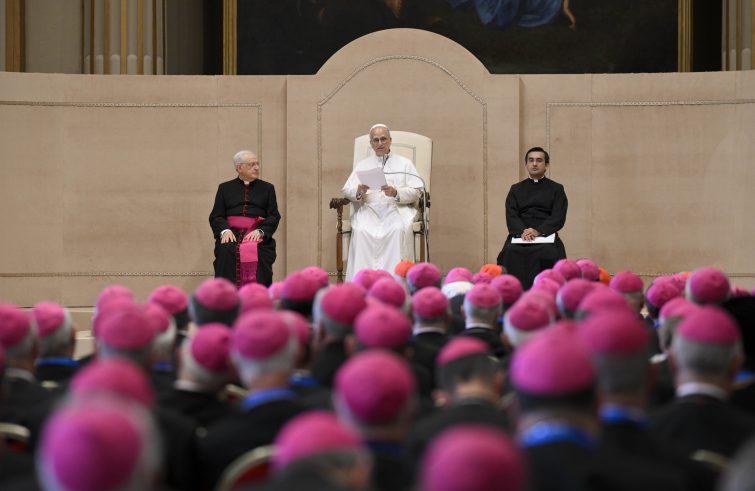
In his address to the Italian bishops on 17 June 2025, Pope Leo XIV reiterated the Council’s vision of episcopal collegiality, recalling the words of Lumen gentium: “The Lord Jesus constituted the Apostles in the manner of a college or stable class, of which he placed Peter, chosen from among them.” He called on the bishops to exercise their ministry in collegiality with one another and with the successor of Peter, in a spirit of effective and affective communion. “Stay united and do not defend yourselves against the provocations of the Spirit,” he said, inviting them to experience synodality as “a mindset, in the heart, in decision-making processes and in ways of acting.”
The Pope’s remarks also touched on the role of the Italian Bishops’ Conference in its relations with the civil authorities. How can the Church reconcile fidelity to the Gospel and ecclesial autonomy in its relations with the State?
The origins of this balanced relationship date back to a significant moment in the Church’s history. During the Second Vatican Council, Paul VI invited the Italian bishops to cultivate a special bond with the Holy See, whilst also pursuing greater autonomy in terms of thought and organisation. The 1984 revision of the Lateran Pacts, followed by the 1985 statute, further strengthened the CEI’s status as a recognised interlocutor with public authorities, dedicated to serving the common good.
What is the mission of the Italian Episcopal Conference (CEI) in contemporary Italian society?
The CEI is tasked with representing the particular churches and contributing reflections and proposals centred on the dignity of the human person and the development of the country.
It is incumbent upon us to engage in public discourse with no hesitation, whilst preserving harmonious unity.
A united Church can offer a credible prophetic witness in a fragmented society.
Can ecclesial unity also stand as a beacon in civil and political life?
Indeed, as it demonstrates that differences do not prevent communion. The diversity of the Italian Church, in terms of its local, cultural and social composition, mirrors a nation dedicated to fostering unity based on human dignity, whether in the workplace, when welcoming others, in citizenship and in the defence of human life.
What message would you like to convey to the Pope on behalf of the Italian Church today?
I believe the Pope’s primary duty is to bear witness to the truth. In this regard, it is important for us to embrace what he has asked of us: shared pastoral actions, living out a personal relationship with Christ and the open proclamation of the Gospel.
To bring Christ into the veins of humanity is a mission that involves us all.
How do you imagine the face of the Church in the future?
A joyful, welcoming Church that is close to the people. One that engages in synodal dialogue and reflects together; one that walks alongside the poor and the most vulnerable in society. A Church that loves. It is more than a wish; it is a certainty that, in discovering the joy of the faith and the ways to proclaim it more radiantly, and embracing the Church as a communion open to all, Leo XIV will be by our side as our father and teacher.