
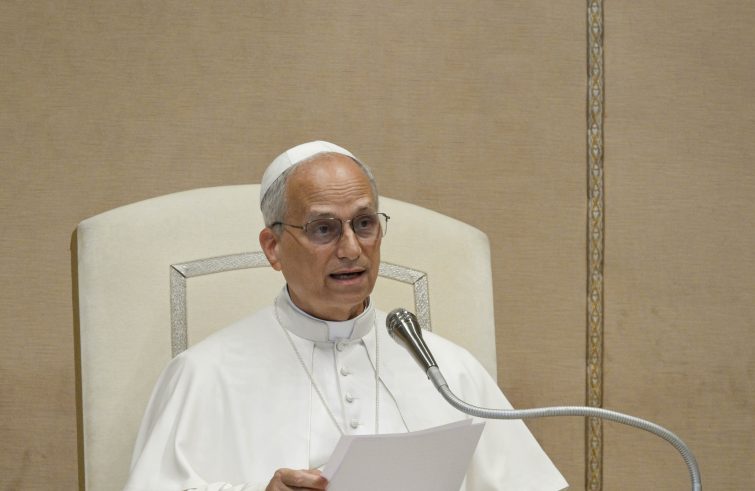
“Today, violent conflict seems to be raging in the Christian East with a diabolical intensity previously unknown.” Leo XIV sounded the alarm in his address to participants in the Plenary Assembly of the Reunion of Aid Agencies for the Eastern Churches (ROACO): “Our hearts bleed when we think of Ukraine, the tragic and inhumane situation in Gaza and the Middle East, ravaged by the spread of war.” “All of us, by virtue of our humanity, are called upon to examine the causes of these conflicts, to identify those that are real and to attempt to resolve them”, the Pope said in his most impassioned plea for peace since the beginning of his pontificate, citing current events: “people cannot die because of fake news.” For Pope Leo, “it is truly distressing to see the principle of ‘might makes right’ prevailing in so many situations today, all for the sake of legitimizing the pursuit of self-interest.”
“It is troubling to see that the force of international law and humanitarian law seems no longer to be binding, replaced by the alleged right to coerce others”,
The analysis of the international situation: “This is unworthy of our humanity, shameful for all mankind and for the leaders of nations. After centuries of history, how can anyone believe that acts of war bring about peace and not backfire on those who commit them? How can we think that we are laying the foundations of the future apart from cooperation and a global vision inspired by the common good? How can we continue to betray the desire of the world’s peoples for peace with propaganda about weapons buildup, as if military supremacy will resolve problems instead of fuelling even greater hatred and desire for revenge?”.
“People are beginning to realize the amount of money that ends up in the pockets of merchants of death; money that could be used to build new hospitals and schools is instead being used to destroy those that already exist!”,
The Pope’s appeal to peoples’ wisdom: “I ask myself: as Christians, in addition to feeling outraged, speaking out and rolling up our sleeves as peacemakers and promoters of dialogue, what else can we do?”, he asked. “I believe that first and foremost we really need to pray”, the first answer: “It is up to us to make every tragic news story, every newsreel that we see, a cry of intercession before God. And then to offer help, just as you do and as many others can do through you.” But before everything else there is witness, our call to imitate Christ, “who conquered evil by the love he showed on the cross, and to show a way of reigning quite different from that of Herod and Pilate. Herod, for fear of being deposed, murdered children, who even today continue to be torn apart by bombs; Pilate washed his hands, as we risk doing every day until we arrive at the point of no return.” “Let us look to Jesus, who calls us to heal the wounds of history solely by the gentle power of his glorious cross, which radiates the strength of forgiveness, the hope of new beginnings, and the resolve to remain honest and transparent in a sea of corruption.” The Pope calls us to “follow Christ, who freed hearts from hatred, and show by our example how to break free of the mindset of division and revenge.”
“You are sowing seeds of hope in the lands of the Christian East, which today, as never before, are devastated by wars, plundered by special interests, and covered by a cloud of hatred that renders the air unbreathable and toxic”,
the Pope said praising the participants’ commitment in his opening remarks: “You provide a breath of oxygen to the Eastern Churches, so worn down by the conflicts in course. For many people, poor in means but rich in faith, you are a light that shines amid the dark shadows of hatred.” “The history of the Eastern Catholic Churches has often been marked by suffering and violence”, remarked the Pontiff: “Sadly, there have also been instances of oppression and misunderstanding within the Catholic community itself.” “In the dark night of conflict, you are witnesses to the light of the East”, said Leo XIV: “I would like this light of wisdom and salvation to be better known in the Catholic Church, where it is still largely unknown and where, in some places, the faith is in danger of becoming lifeless, also because the hope expressed repeatedly by Saint John Paul II has not yet been realized. Forty years ago, he said: ‘The Church must learn once again to breathe with both lungs, the Eastern and the Western’.” “The Christian East, however, can only be preserved if it is loved, and it can only be loved if it is known”, the Pope said in conclusion, noting that “there is also a need for encounter and the sharing of pastoral activity, since Eastern Catholics today are no longer our distant cousins who celebrate unfamiliar rites, but our brothers and sisters who, due to forced migration, are our next-door neighbours. Their sense of the sacred, their deep faith, confirmed by suffering, and their spirituality, redolent of the divine mysteries, can benefit the thirst for God, latent yet at the same present, in the West.”