
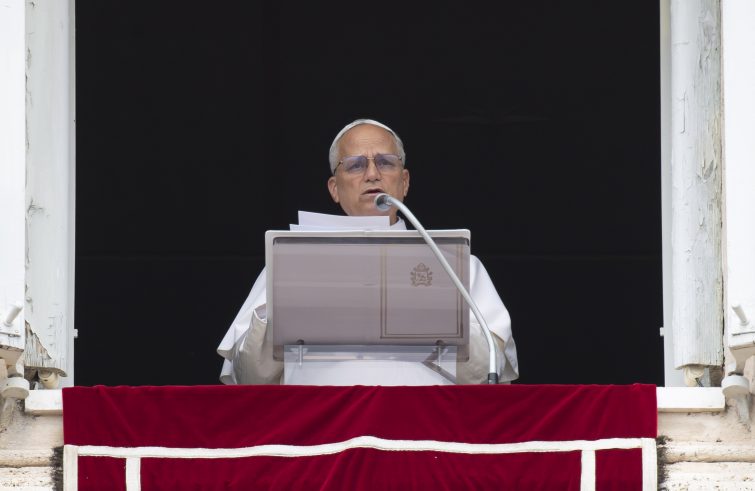
“May diplomacy silence the weapons! May nations shape their future through works of peace, not through violence and bloody conflict!” With these words, spoken at the conclusion of today’s Angelus on the Solemnity of Corpus Christi, Pope Leo XIV made a heartfelt appeal to the international community, drawing attention to the escalating tensions in the Middle East. From the window of the Apostolic Palace, before thousands of faithful gathered in St Peter’s Square, the Pontiff expressed concern over the worsening situation in Iran, Israel and Palestine, warning against the risk that “the daily suffering of the population, especially in Gaza, be forgotten.”
He strongly urged that “the cry of humanity” not be ignored, for it “calls out for peace”, reminding all that “no armed victory can ever compensate for the pain of mothers, the fear of children, the stolen future.”
Leo XIV firmly reiterated that “war does not solve problems; it amplifies them and leaves deep wounds in the history of peoples, which take generations to heal.” Every conflict, he warned, is an “irreparable chasm”, and he called upon “every member of the international community to take moral responsibility for stopping this tragedy.”
💥 US attack on Iran
Overnight, the United States launched targeted strikes on three Iranian nuclear facilities: Fordow, Natanz and Isfahan. President Trump declared that the sites were “completely and totally obliterated” as a measure to halt Iran’s nuclear enrichment programme. The operation – described as a “massive precision strike” – deployed 30,000-pound bunker-busting bombs, reportedly visible even from space, according to US officials. In retaliation, Iran fired a fresh volley of missiles at Israel and vowed to consider “all options” to defend its sovereignty. The US attack drew condemnation from Russia, the UN, and European states, while groups such as Hamas and the Houthi rebels threatened reprisals.
The Eucharist as the logic of sharing
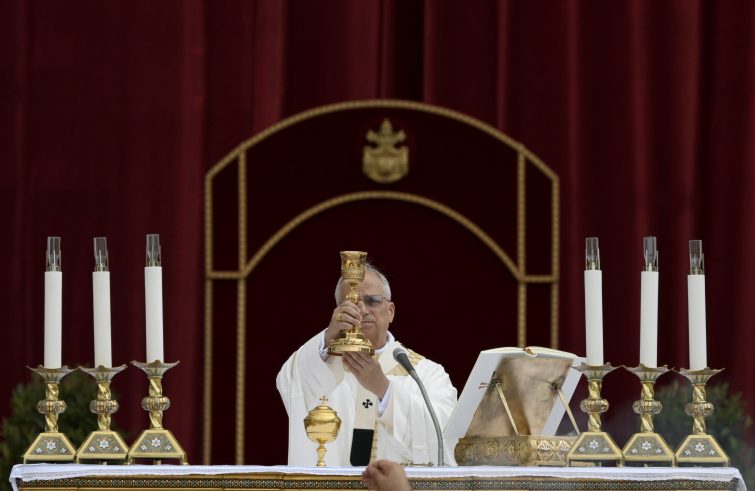
Commenting on the Gospel of the day, which recounts the miracle of the multiplication of the loaves and fishes, the Pope linked Jesus’s gesture to the mystery of the Eucharist: “The gifts of God, even the smallest ones, grow all the more when they are shared,” he said. He reminded the faithful that in the Eucharist God himself becomes a gift, transforming the bread and wine we offer into “the Body and Blood of Christ, a Sacrifice of charity for the salvation of the world.” On this basis, he proposed a reflection on sharing as a Christian way of life, capable of generating communion and peace: “To be bearers of communion,” he explained, “means setting out from the Altar to bring reconciliation and justice into homes, families, and among nations.” In the afternoon, the Pontiff travelled to the Basilica of St John Lateran to preside over the Eucharistic Celebration. In his homily, he emphasised the salvific dimension of the Eucharist: “Christ is God’s answer to man’s hunger, for his body is the bread of eternal life,” he affirmed, adding that “the logic that saves a hungry people is the logic of sharing” – a logic that also challenges today’s economic and social structures.
“Today, in place of the crowds in the Gospel, there are entire peoples humiliated more by the greed of others than by their own hunger.”
-
- (Foto Vatican Media/SIR)
-
- (Foto Vatican Media/SIR)
A Church walking with hope
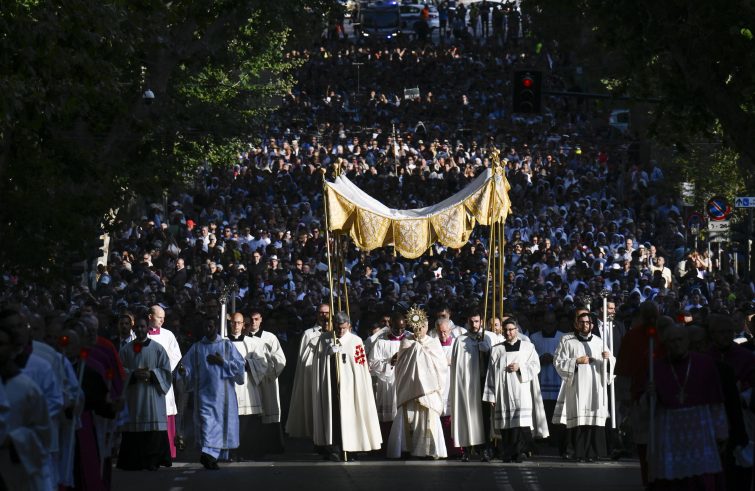
At the end of the Mass, the Holy Father led the traditional Corpus Christi procession along Via Merulana, culminating in the Eucharistic Blessing before the Basilica of St Mary Major. Thousands of faithful took part with hymns, prayers, and signs of devotion. “The procession,” he said, “is a sign of our journey: together, shepherds and flock, we nourish ourselves with the Most Holy Sacrament, adore it, and carry it through the streets.” The gesture was also a visible sign of hope: “We bring Jesus to everyone’s heart,” explained Leo XIV, “for Jesus involves everyone in the work of salvation, inviting each person to partake at his table.” The Pope concluded the intense liturgical day by exhorting Christians to be “credible witnesses of the love received” and “concrete signs of a Church that walks together, bringing to the world the light of the Eucharist, the bread of unity and instrument of peace.” According to the competent authorities, around 20,000 people attended the various moments of the celebration for the Solemnity of the Most Holy Body and Blood of Christ in the afternoon.