
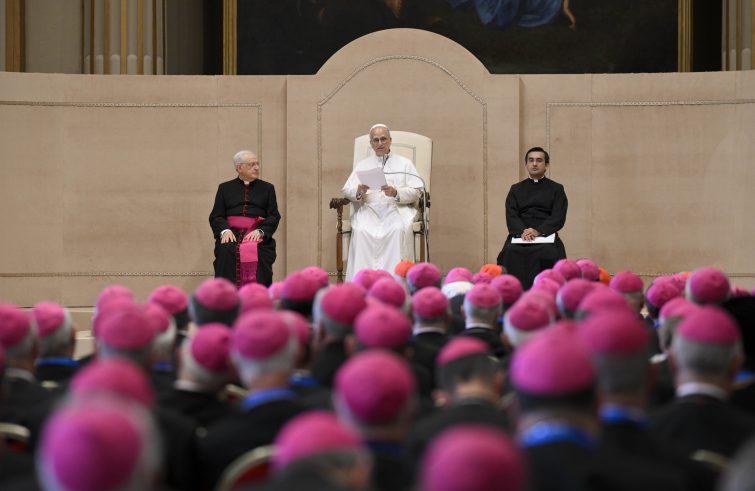
“I thank you for your prayer and for that of your communities: I am in great need of them!” Leo XIV addressed the Italian bishops, whom he met for the first time and greeted individually, in the Hall of Benediction, including the bishops emeritus. “Eighty years have passed since the end of the terrible Second World War. “Confronted with wars that shed Abel’s blood today, we assure you of our closest support in your personal commitment to ensuring the dissemination of peace”, Cardinal Matteo Zuppi, Archbishop of Bologna and President of the Italian Bishops’ Conference, said in his address to the Pope at the start of the audience.
“Collegiality among yourselves and collegiality with the successor of Peter”,
is the Pope’s first guidance for the exercise of a ministry, such as that of the bishop, which includes “a healthy cooperation with civil authorities.”
“The proclamation of the Gospel, peace, human dignity, dialogue”,
these are the coordinates of a Church called “to go forward in unity, thinking especially of the synodal path.” “Stay united and do not defend yourselves against the provocations of the Spirit”, the Pope’s exhortation, quoting Saint Augustine:
“Synodality becomes a mindset, in the heart, in decision-making processes and in ways of acting.”
“Look to tomorrow with serenity, and do not be afraid to make courageous choices! No-one can prevent you from being close to the people, sharing life, walking with the last, serving the poor!”, the Holy Father said, extending his gaze to future challenges: “No-one can prevent you from proclaiming the Gospel, and it is the Gospel that we are invited to bring, because it is this that everyone, ourselves first, need in order to live well and to be happy.” “Take care that the lay faithful, nourished with the Word of God and formed in the social doctrine of the Church, are agents of evangelization in the workplace, in schools, in hospitals, in social and cultural environments, in the economy, and in politics”, the Pope’s counsel for pastoral ministry:
“Let us walk together, with joy in our heart and song on our lips. God is greater than our mediocrity: let us allow ourselves to be drawn to Him! Let us trust in his providence.”
“The Italian Episcopal Conference is indeed a space for discussion and the synthesis of the bishops’ thought regarding issues most relevant for the common good”, Leo XIV said in the opening lines of his address to Italian bishops. He went on to quote Benedict XIV, who in 2006 “described the Church in Italy as a lively reality, which conserves a capillary presence in the midst of people of every age and level and where Christian traditions often continue to be rooted and to produce fruit.” The new challenges that Christian communities face today are
“linked to secularism, a certain disaffection with the faith, and the demographic crisis”,
the Pope remarked. He quoted Pope Francis who observed that “prophecy does not exact wrenches but courageous choices, proper for a true ecclesial community: they lead us to allow ourselves to be ‘troubled’ by events and persons and to enter into human situations, animated by the healing spirit of the Beatitudes.”
“Placing Jesus Christ at the centre and, following the path indicated by Evangelii gaudium, helping people to live out a personal relationship with Him, to discover the joy of the Gospel.”
The first instruction to the Italian Church concerns evangelisation. In a time of great fragmentation, the first major commitment is to bring Christ “into the veins” of humanity with pastoral actions capable of reaching those who are most distant and with tools suitable for the renewal of catechesis and the languages of proclamation.” The second is to become
artisans of peace “in everyday life.”
“I am thinking of parishes, neighbourhoods, areas within the country, the urban and existential peripheries. There, where human and social relationships become difficult and conflict takes shape, perhaps subtly, a Church capable of reconciliation must make herself visible.” Drawing on St. Paul, Leo XIV expressed the hope that “every diocese may promote pathways of education in non-violence, mediation initiatives in local conflicts, and welcoming projects that transform fear of the other into an opportunity for encounter.” “May every community become a ‘house of peace’, where one learns how to defuse hostility through dialogue, where justice is practiced and forgiveness is cherished”, the Pontiff’s recommendation. “Peace is not a spiritual utopia – he said – it is a humble path, made up of daily gestures that interweave patience and courage, listening and action, and which demands today, more than ever, our vigilant and generative presence.”
“Artificial intelligence, biotechnologies, data economy and social media are profoundly transforming our perception and our experience of life”, the Pope said with reference to the anthropological question: “In this scenario, human dignity risks becoming diminished or forgotten, substituted by functions, automatism, simulations.”
“But the person is not a system of algorithms: he or she is a creature, relationship, mystery”, he denounced, recalling the” challenges that call into question respect for the dignity of the human person.”
“Without lively reflection on the human being – in its corporeality, its vulnerability, its thirst for the infinite and capacity for bonding – ethics is reduced to a code and faith risks becoming disembodied”,
the Pope warned, and recommended “cultivating a culture of dialogue.”: “It is good for all ecclesial realities – parishes, associations and movements – to be spaces of intergenerational listening, of comparison with different worlds, of caring about words and relationships. Because only where there is listening can communion be born, and only where there is communion does truth become credible.”