

The network is more widespread, better prepared and more secular. However, it is still largely confined within its own boundaries. These are the findings of the Third Survey on the ecclesial network for the Protection of Minors and Vulnerable Adults, published in April 2025 by the National Service of the Italian Bishops’ Conference (CEI). Notably, in 2024, the support centres received 373 requests for assistance. There were 38 in 2020. The number of reports is increasing, as is trust. The number of formation activities is growing, as are the number of contact persons and teams, with lay people now outnumbering clerics. However, relations with the outside world – civil authorities, media, associations – remain fragmented. The Italian Church is called to transform protection into a style that is permanent, visible and reliable, and that permeates every area of ecclesial life.
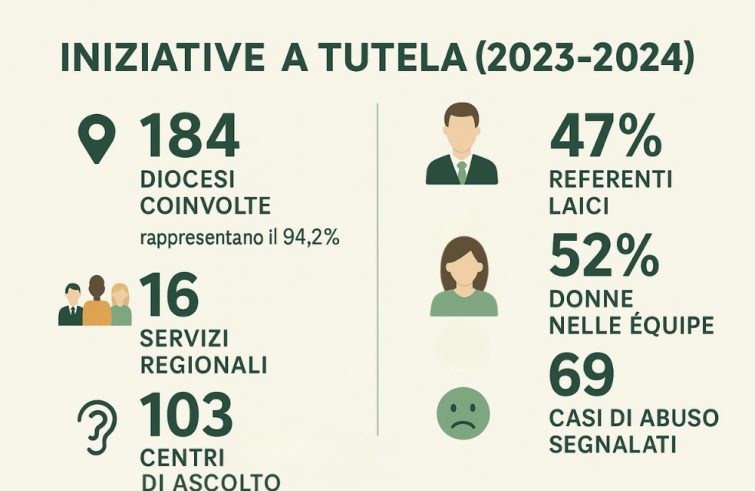
An expanding, more skilled and diverse network.
The research, was conducted using participatory action methods across 184 out of 194 dioceses (94.2%), 16 regional services, and 103 active counselling and support centres. According to the findings, the number of laypeople involved in services is growing: 46.7% of counsellors are non-clergy members, while clergy members account for 46.2%. Women make up 52% of counselling teams and 70.6% of counselling centre coordinators.
Professional profiles are also diverse, with psychologists (24.3%), lawyers (18.1%), educators, canon lawyers, pastoral workers, and communication professionals representing an interdisciplinary composition. Formation activities continued to play a key role, with 781 meetings involving 22,755 participants taking place in 2024, including pastoral workers, priests, members of religious orders, educators, and members of associations.
Including the figures for 2023, 42,486 people participated in these activities during the two-year period, representing a 295% increase compared to 2020. The National Day of Prayer, celebrated by 85% of dioceses on a regular basis, has become a well-established event taking place on 18 November. Emerging focus areas include spiritual abuse, relational ethics, good educational practices and human dignity.
Systemic vulnerabilities, alongside poor external relations.
The survey identified areas of progress alongside structural weaknesses. Only 18% of dioceses have collaborated with public bodies, and just 10.3% have participated in roundtable discussions with representatives of institutional bodies. Respondents gave an average rating of 2.6 out of 10 when asked to rate relations with local authorities, and 2.2 when asked to rate relations with non-ecclesial associations.
Even within the Church, integration with pastoral departments is sporadic, there is a lack of communication concerning initiatives, and collaboration with movements and associations is limited. Relations between diocesan representatives and regional services received a more positive average rating of 8.2.
Awareness of external associations is also growing, increasing from 3.6 in 2022 to 5.9 in 2024. Nevertheless, overcoming fragmentation and self-referential tendencies remains crucial to accelerating the development of coordinated safeguarding efforts.
Key figures: listening, guidance and trust
The data collected by the counselling centres provides a valuable additional insight: people are seeking help and guidance, and want to be heard. In 2024, 69 cases of alleged abuse were reported, some relating to the past and some relating to the present day. These cases involved 67 alleged perpetrators: 44 clerics, 15 members of religious orders, and eight lay people. Most of the reports concerned the parish environment (27 cases).
The majority of alleged victims were male minors, with a higher percentage in the 10–14 age group. Compared to the previous two-year period, the average age of the alleged perpetrators increased from 43 to 50. Of the requests received by the Centres, 15.2% were from people identifying as victims, and 35.4% concerned abuse in an ecclesial setting.
A total of 12 spiritual accompaniment services and 11 psychotherapeutic support services have been set up. The survey concludes with the priorities indicated by the counsellors: ongoing training, shared protocols, competent accompaniment and transparent communication. The focus is shifting from reaction to proactive action in order to build a trustworthy Church that can protect and generate trust. The credibility of the entire ecclesial community is at stake.