

“The Pope is not an autocrat, and it is not efficiency that counts in the Church, but the fruit of the Holy Spirit.” Cardinal Marcello Semeraro, Prefect of the Dicastery for the Causes of Saints, reflects on Pope Francis’ period of convalescence following his discharge from the Gemelli Hospital in Rome on Sunday. “The Pope is going through a delicate period, which he is facing with faith and in a spirit of service.” Quoting John Paul II, the Cardinal underlined the value of human frailty in the Gospel: “One does not come down from the cross.”
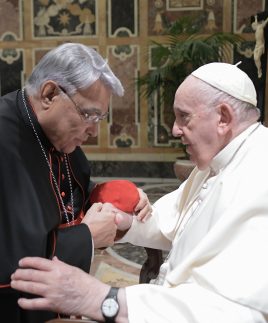
Your Eminence, during his hospitalisation, Pope Francis suffered two life-threatening crises. The news was met with comprehensible anxiety by the faithful. How did you personally experience these difficult weeks for the Holy Father?
The medical reports had mentioned some critical events, but now they were explicitly described as “life-threatening”, to which I reacted in two ways: the first was a feeling of gratitude to the Lord for having heard our prayer: “conservet et vivificet eum”. The second was a feeling of joy because my trust in his inner and spiritual strength was confirmed.
The Pope has been discharged from hospital and is back in Santa Marta, but the doctors have insisted on a ‘protected convalescence’ of at least two months, with considerable restrictions on his ordinary activities. How does Pope Francis, who has embraced the Petrine ministry as an unceasing service and a complete, unlimited gift of self, live out these new circumstances?
The “gift of self” does not amount to an “activity.” For Jesus, the cross was the perfect “self-gift.”
In a few days we will commemorate the 20th anniversary of the death of John Paul II. Cardinal Stanislaw Dziwisz remembered his words: “One does not come down from the cross.”
Certainly, the Pope is not an autocrat in his governance and guidance of the Church. In Praedicate Evangelium, Francis wrote, quoting the Second Vatican Council, that the Pope “in the exercise of his supreme, full and immediate power over the whole Church, avails himself of the Dicasteries of the Roman Curia, which therefore carry out their work in his name and by his authority, for the benefit of the Churches and in the service of the sacred pastors”.
The Pope continued to work even during his hospitalization, adapting his work to the state of his health. In your opinion, could it be said that this is a new way of carrying out the Petrine ministry, one that shows that age and physical challenges are not an obstacle, but rather a way of leading the Church according to the Gospel?
A first answer to this question can be drawn from what I have just said. Moreover, in the Church in particular, modes of governance do not per se reflect the corporate ‘efficiency’ criteria. The criteria must be sought elsewhere. What Francis said about the elderly on 28 September 2014 also applies to himself in his state of fragility: “They are like trees that continue to bear fruit even under the weight of the years.”

(Foto ANSA/SIR)
Yesterday, after the Angelus was published in written form, Pope Francis appeared for a brief greeting and blessing. What is the meaning of this gesture for you and for the Church? Is it only a way of expressing his gratitude to the hospital and to those who have prayed for him, or is it also a way of testifying that the ministry of the Bishop of Rome is not suspended even in a state of illness?
There is always a risk that a state of ill-health may cause us to withdraw into ourselves.
Even in his human fragility, Francis shows us that face of the Church that is “outgoing” and a “field hospital”, which he so often refers to.
When, on the evening of 6 March, before praying the Rosary with the faithful gathered in St Peter’s Square, I heard his voice say: ‘I will accompany you from here’, I was deeply moved: we were accompanying him with our prayers, and at the same time he was accompanying us.
The Pope’s illness has focused public attention on the question of the fragility of the Petrine ministry. In your opinion, how does the Church manage to maintain serenity and faith when the Successor of Peter is afflicted by suffering?
Not without some irony, St Ambrose considers the contrasting situations of those who trust in a state of perfect health (there are even today such figures!) and those who, on the contrary, allow themselves to be crushed by ailments and illnesses, and compares them with what the Apostle writes: “For when I am weak, then I am strong” (2 Cor 12:10). This principle also applies to the Petrine ministry. As I have already mentioned. His strength and power are elsewhere.