
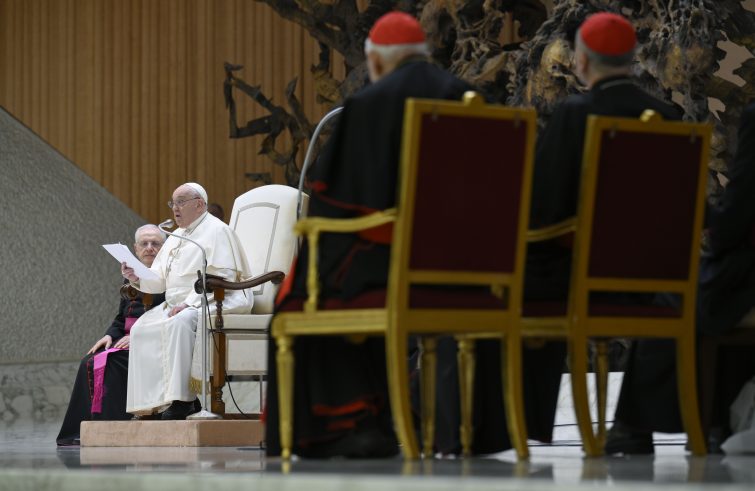
“Child abuse, of whatever nature, is a despicable act, it is a heinous act. It is not simply a blight on society, no, it is a crime! And it is a gross violation of God’s commandments”, Pope Francis said in his catechesis for the weekly general audience in Paul VI Hall that he dedicated to children, as he had done for last Wednesday’s general audience.
“No child should be abused. Even a single case is one case too many”,
remarked the Pope, for whom “it is necessary to awaken our consciences, to practice closeness and genuine solidarity with abused children and young people, and at the same time to build trust and synergies between those who are committed to offering them opportunities and safe places in which to grow up serenely.” The Holy Father concluded his catechesis with a renewed request to pray for peace in war-torn countries, and for the conversion of the hearts of arms manufacturers. In his greeting to the Italian-speaking faithful, which traditionally brings the Wednesday Audience to a close, the Holy Father enjoyed a performance by the Roni Roller Circus, following the performance by CircAfrica last Wednesday, and once again praised the “artistic work” of the circus performers.
“Even today in the world, hundreds of millions of minors, despite not being of the minimum age to undergo the obligations of adulthood, are forced to work and many of them are exposed to particularly dangerous work”,
Francis denounced in his catechesis: “Not to mention the boys and girls who are slaves to trafficking for prostitution or pornography, and forced marriages.” “And this is rather bitter”, he commented off-text: “In our societies, unfortunately, there are many ways in which children are abused and mistreated.” “I know a country in Latin America, where a special fruit grows, very special, which is called arándano”, he continued in unscripted remarks: “Harvesting the arándano requires tender hands, and they make children do it, they enslave them as children to harvest it.”
“Widespread poverty, the shortage of social support tools for families, the increased marginality in recent years along with unemployment and job insecurity are factors that burden the youngest with the highest price to pay”,
the Pope’s analysis: “In the metropolises, where the social divide and moral decay “bite”, there are children engaged in drug dealing and the most diverse illicit activities”: “How many of these children have we seen fall as sacrificial victims! Sometimes tragically they are induced to become “executioners” of their peers, as well as damaging themselves, their dignity and humanity.” “And yet, when on the street, in the neighbourhood of the parish, and these lost lives present themselves before our eyes, we often look the other way”, Francis said. He added: “There is also a case in my country: a boy called Loan has been abducted and his whereabouts are unknown. And one of the theories is that he has been sent to have his organs removed, for transplants. And this happens, as you well know. This happens! Some return with a scar, others die. This is why today I would like to remember this boy Loan.” “It pains us to recognize the social injustice that drives two children, perhaps living in the same neighbourhood or apartment block, to take diametrically opposed paths and destinies because one of them was born into a disadvantaged family”, the Pope remarked, denouncing an “unacceptable human and social divide: between those who can dream and those who must succumb.”
“Stop and listen to the suffering of the voiceless, the uneducated”,
the Pope’s appeal, starting with the awareness that “fighting exploitation, especially child exploitation, is the way to build a better future for the whole of society.” “Some countries have had the wisdom to put children’s rights in writing”, he added off text: “Look yourselves on the internet to find out what children’s rights are.”
“If we want to eradicate child labour, we cannot be complicit in it”,
he cautioned: “And when is this the case? For example, when we purchase products that involve child labour. How can we eat and dress, knowing that behind that food and those garments there are exploited children, who work instead of going to school? Awareness of what we purchase is a first act in order not to be complicit. Find out where those products come from. Some will say that, as individuals, we cannot do much. True, but each one can be a drop that, together with many other drops, can become a sea.”
Institutions, including church institutions, and companies “can make a difference by shifting their investments to companies that do not use or permit child labour”:
“Many states and international organizations have already enacted laws and directives against child labour, but more can be done.” “I also urge journalists to do their part”, Francis said: “they can help raise awareness of the problem and help find solutions. Do not be afraid, denounce these things!”. “Saint Teresa of Calcutta, a joyful worker in the vineyard of the Lord, was a mother to the most disadvantaged and forgotten girls and boys”, the homage of the Pope: “With the tenderness and attention of her gaze, she can accompany us to see the invisible little ones, the too many slaves of a world that we cannot abandon to its injustices. Because the happiness of the weakest builds the peace of all.” Francis concluded his catechesis with a quotation from Mother Teresa that gives voice to children: “I ask for a safe place where I can play. I ask for a smile from someone who knows how to love. I ask for the right to be a child, to be the hope of a better world. I ask to be able to grow as a person. Can I count on you?”.