
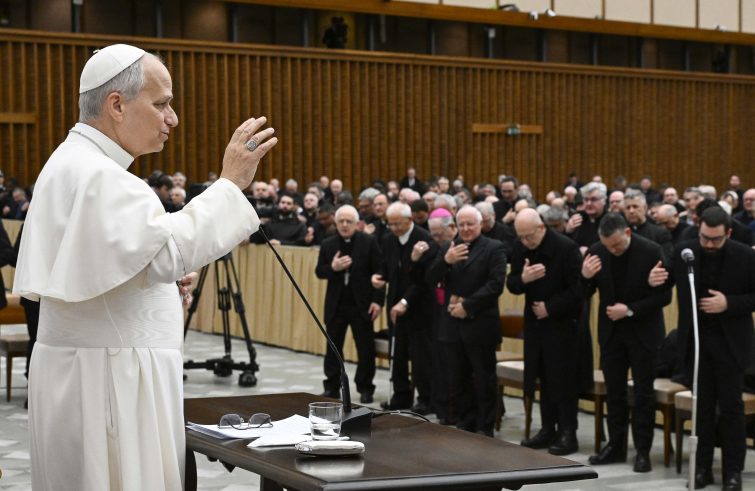
“Church of Rome, remember to rekindle the gift of God!”. This was the first invitation, echoing Saint Paul, addressed by Pope Leo XIV to his diocese in the address delivered during the meeting with the Roman clergy in the Paul VI Hall. “Pressed by rapid cultural changes and the scenarios in which our mission unfolds, at times assailed by weariness and the weight of routine, or discouraged by a growing detachment from faith and religious practice, we feel the need for this fire to be nourished and rekindled”, the Pope observed. He outlined the current situation by referring to the “cultural and anthropological changes” in recent decades that have led to a “growing erosion of religious practice”.
“It is urgent that we return to proclaiming the Gospel: this is the priority”,
was the appeal of Leo XIV, who maintained that “with regard to the relationship between Christian initiation and evangelisation, we need a clear change of direction”.
Proclamation first. Ordinary pastoral activity, the Pontiff affirmed, “is structured according to a classical model that is primarily concerned with ensuring the administration of the sacraments, but such a model presupposes that faith is in some way also transmitted by the surrounding environment, by society as well as by the family setting”.
“With humility, yet without allowing ourselves to be discouraged, we must recognise that some of our baptised people do not experience their belonging to the Church, and this invites us to be vigilant also regarding a sacramentalisation without other forms of evangelisation”,
was his assessment of the present moment. “Like all major urban centres, the city of Rome is marked by constant mobility, by a new way of inhabiting the territory and living time, and by increasingly diverse and at times fragmented relational and family networks”, he said, giving a snapshot of the capital. “Therefore, it is necessary for parish pastoral care to refocus on proclamation, in order to seek ways and means that help people to reconnect with the promise of Jesus”. In this context, Christian initiation, “often structured according to school timetables, needs to be rethought”, the Pope proposed. “We need to look for other ways of transmitting the faith, also outside the traditional paths, in order to involve children, young people and families in new ways”.
No to self-referentiality. “The parish alone is not sufficient to set in motion paths of evangelisation capable of reaching those who are unable to experience adequate participation”, Pope Leo maintained. “To give primacy to evangelisation in all its many forms, we cannot think and act in isolation”, he warned. “In the past, the parish was more stably linked to the territory and all who lived there belonged to it. Today, however, models and lifestyles have shifted from stability to mobility, and many people, in addition to work-related reasons, move for various experiences, living their relationships beyond territorial and cultural boundaries”.
“In a territory as vast as that of Rome, we must overcome the temptation of self-referentiality, which generates excessive strain and dispersion,
in order to work ever more closely together, especially among neighbouring parishes, sharing charisms and potential, planning together, and avoiding overlapping initiatives”, was the direction indicated by Pope Prevost. In his view, “greater coordination is needed which, far from being a pastoral expedient, is intended to express our priestly communion”.
Listening to young people. Many young people “live without any reference to God or to the Church”, the Pope warned. It is necessary “to grasp and interpret the profound existential unease that inhabits them, their disorientation and their many difficulties, as well as the phenomena that involve them in the virtual world and the signs of a
worrying aggressiveness that sometimes leads to violence”.
“I know that you are familiar with this reality and are committed to addressing it”, he said, encouraging the clergy of his diocese. “We do not have easy solutions that guarantee immediate results but, as far as possible, we can remain attentive to young people, make ourselves present, welcome them and share a part of their lives. At the same time, since these issues affect various dimensions of life, let us also seek, as parishes, to engage in dialogue and interaction with the institutions present in the area, with schools, with specialists in the field of education and human sciences, and with all those who have at heart the destiny and future of our young people”. The Pontiff finally addressed
“a word of encouragement to younger priests,
who often experience firsthand both the potential and the burdens of their generation and of this era”: “In a more difficult and less gratifying social and ecclesial context, there is a risk of quickly exhausting one’s energies, of accumulating frustration and of falling into loneliness”. “I urge you to daily fidelity in your relationship with the Lord and to work with enthusiasm even if you do not now see the fruits of your apostolate”, Pope Leo said. “Above all, I invite you never to close in on yourselves: do not be afraid to speak openly, even about your weariness and your crises, especially with those brother priests whom you believe can help you”.