
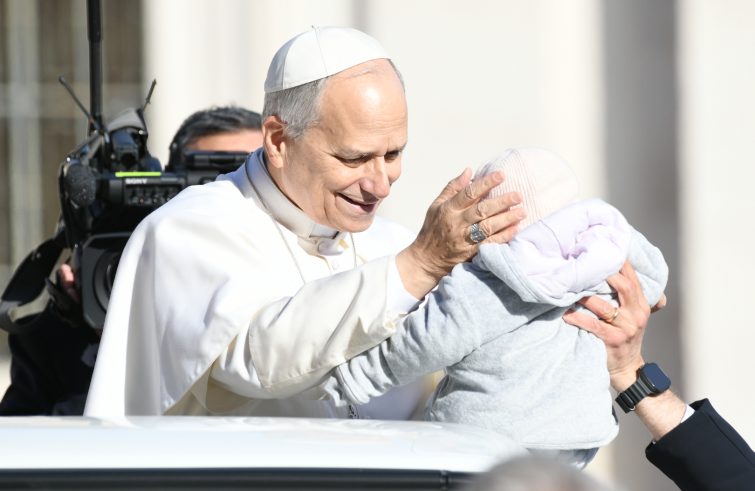
The Church is not “something obscure or incomprehensible, as is commonly thought when the word ‘mystery’ is heard”, but is “exactly the opposite”, namely “a reality that was previously hidden and is now revealed”. Leo XIV explained this in his catechesis at today’s Audience, which returned to St Peter’s Square. Continuing the cycle of catechesis on the Second Vatican Council, he reflected on the Dogmatic Constitution on the Church Lumen gentium, which, drawing on the Letters of Saint Paul, uses the term “mystery” to describe the Church. This afternoon, on the Aventine Hill, the penitential procession and the Ash Wednesday Mass will take place.
To unite humanity. This is God’s plan, which has a purpose: to bring all creation into unity through “the reconciliatory action of Jesus Christ, an action that was accomplished in his death on the Cross”, the Pope observed in his catechesis. “This is experienced first of all in the assembly gathered for the liturgical celebration: there, differences are relativized, and what counts is being together because we are drawn by the Love of Christ, who broke down the wall of separation between people and social groups”. “For Saint Paul, mystery is the manifestation of what God wanted to achieve for the whole of humanity, and is made known in local experiences, which gradually widen to include all human beings and even the cosmos”, the Pontiff recalled:
“The condition of humanity is one of fragmentation that human beings are unable to repair,
even though the tendency towards unity dwells in their heart. The action of Jesus Christ enters into this condition through the power of the Holy Spirit, and overcomes the powers of division and the Divider himself”.
Mystery and sacrament. “The Church is an expression of what God wants to accomplish in the history of humanity; therefore, by looking at the Church, we can to some extent grasp God’s plan, the mystery. In this sense, the Church is a sign”, Pope Leo continued. “Gathering together to celebrate, having believed in the proclamation of the Gospel, is experienced as an attraction exerted by the cross of Christ, which is the supreme manifestation of God’s love”, he said, referring to liturgical participation: “it is feeling called together by God: this is why the term ekklesía is used, that is, an assembly of people who recognise that they have been summoned together”. There is “a certain coincidence between this mystery and the Church: the Church is the mystery made perceptible”, he observed. “This convocation, precisely because it is brought about by God, cannot however be limited to a group of people, but rather is destined to become the experience of all human beings”. For this reason, the Second Vatican Council, at the beginning of Lumen gentium, states that “the Church is in Christ like a sacrament or as a sign and instrument both of a very closely knit union with God and of the unity of the whole human race”.
The Church “lives as a sanctifying presence in the midst of a still fragmented humanity, as an effective sign of unity and reconciliation among peoples”,
the closing image of the catechesis. “When God works in history, he involves in his activity the people who are the objects of his action”, the Pope emphasised. “It is through the Church that God achieves the aim of bringing people to him and uniting them with one another”. “Union with God finds its reflection in the union of human beings”, Leo XIV concluded. “This is the experience of salvation”. The Church, therefore, is the “universal sacrament of salvation”: hence “the relationship between the unifying action of the Pasch of Jesus, which is the mystery of the passion, death and resurrection, and the identity of the Church.