
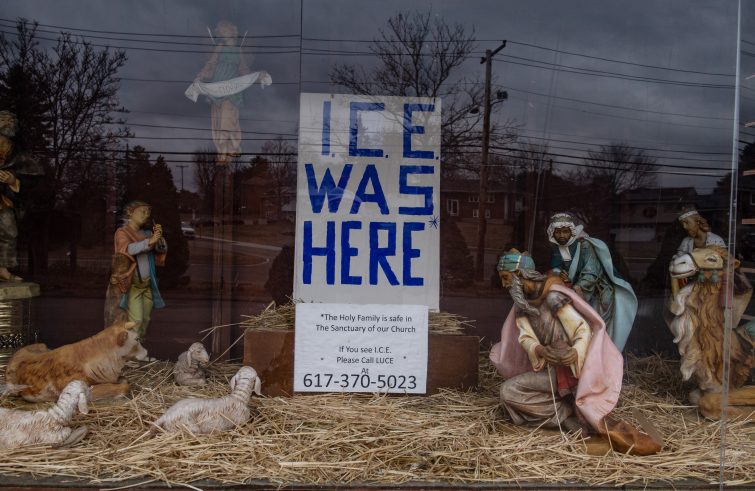
A mixed assessment. The Annual Report on the State of Religious Liberty in the United States, published by the Committee for Religious Liberty of the U.S. Conference of Catholic Bishops (USCCB), presents the picture of a country in which protection under the First Amendment has seen significant advances, but also new and troubling vulnerabilities. “While there were positive developments for religious liberty in the past year, there have been worrying developments as well,” writes Archbishop Alexander K. Sample, chairman of the Committee, in the Foreword. The document reviews the legislative activity of the 119th Congress, the actions of the executive branch, rulings of the Supreme Court and the cultural trends of 2025, a year in which political polarisation “appears to be devolving into a cycle of attack and retribution.” The Supreme Court issued decisions favourable to religious liberty in Catholic Charities Bureau, Inc. v. Wisconsin Labor & Industry Commission and Mahmoud v. Taylor, while in U.S. v. Skrmetti it declined to hold that people identifying as transgender are a protected class under the Equal Protection Clause. On the legislative front, Congress approved the Federal Scholarship Tax Credit to expand parental choice in education, though without the religious liberty protections requested by the bishops.
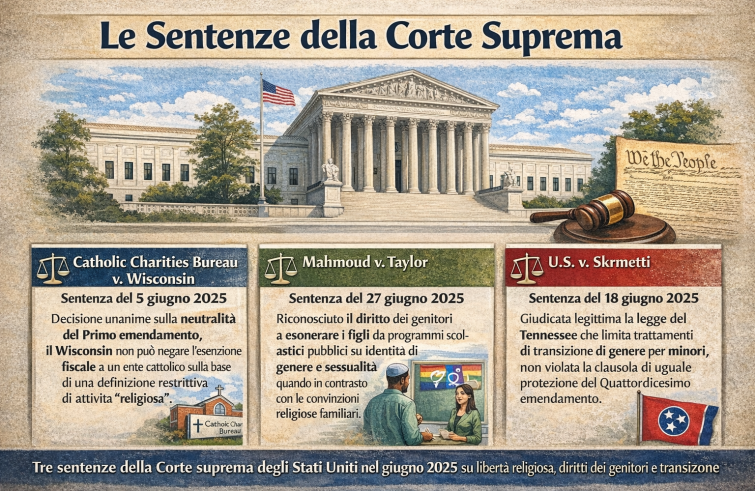
(Foto AI/SIR)
Trump administration: opportunities and pressure on religious organisations
The report acknowledges that the Trump administration has taken significant action in support of religious liberty: the establishment of a Religious Liberty Commission, with Cardinal Timothy Dolan and Bishop Robert Barron serving as members or advisers; the creation of the White House Faith Office; and an executive order directing federal agencies to repeal rules that prevent religious organisations from fully participating in programmes that serve the common good, in light of recent Supreme Court decisions including Carson v. Makin, which makes clear that governments may not exclude religious organisations from participation in government programmes because they engage in religious activity. The administration has also acted to combat gender ideology, rescinding executive orders from the Biden era and directing agencies to enforce sex-based distinctions in accordance with “the biological reality of sex” and not “gender identity.” At the same time, the Committee notes that “a countervailing effort on the part of the Trump administration, however, has been to apply pressure on nongovernmental organizations, including religious organizations, through changes made to federal programs.” The Department of Homeland Security rescinded guidance that required approval before immigration enforcement actions could be carried out in or near protected areas, such as hospitals, schools and churches.
Five bishops have taken the extraordinary step of dispensing Catholics from their Sunday obligation if they fear that going to Mass puts them at risk of being detained.
Some dioceses have felt unable to proceed with liturgical celebrations and religious festivals popular among immigration communities, including those linked to devotion to Our Lady of Guadalupe. “Creating a climate of fear around the right to go to church damages the conditions necessary to foster the religious life of the nation,” wrote Bishop Kevin C. Rhoades, chairman of the Committee for Religious Liberty.
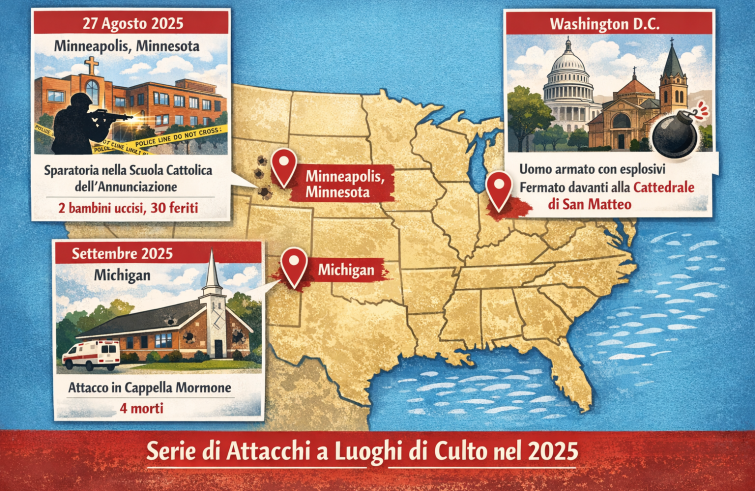
(Foto AI/SIR)
Anti-religious violence and six critical areas for 2026
Perhaps the most alarming aspect of the report concerns the rise in politically and religiously motivated violence. On 27 August 2025, a gunman opened fire during Mass at a Catholic school in Minneapolis, killing two children and injuring thirty others. A man armed with explosive devices was stopped outside the Cathedral of St Matthew the Apostle in Washington before the traditional Red Mass. In September, an attack on a Mormon chapel in Michigan left four people dead.
The report identifies six areas of critical concern for 2026:
political and anti-religious violence; unjust terms and conditions on federal grants and the unreliability of government; access to the sacraments for ICE detainees and immigration enforcement at houses of worship; school choice and the Federal Scholarship Tax Credit; repeal of provisions that prevent religious organisations from participating in government programmes; and further repudiation of gender ideology. “Too much of our national life is marked by enmity and strife,” Archbishop Sample warns. “As we practice the ‘pious custom’ of consecrating our nation to the Sacred Heart, we do so with the confidence that the Lord will pour out his grace on the United States.”