
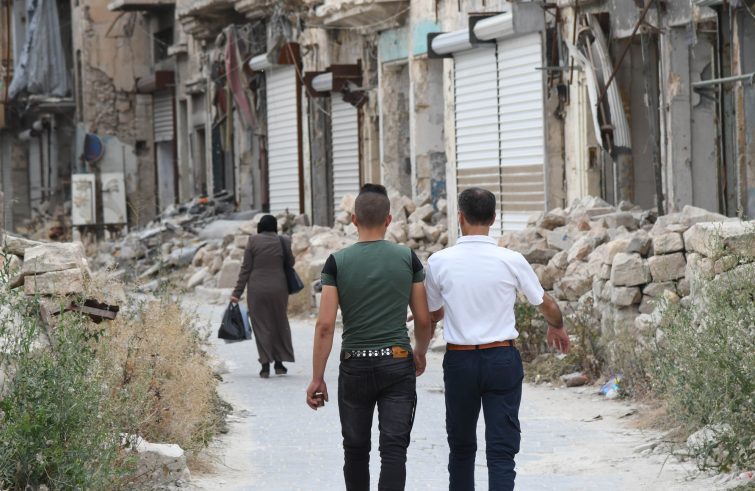
Last 2 February, Cardinal Mario Zenari left the apostolic nunciature in Damascus, thus bringing to a close one of the Holy See’s most difficult diplomatic missions in the Middle East.
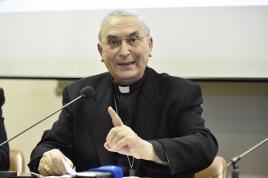
(Foto Siciliani-Gennari/SIR)
After 18 years, Cardinal Mario Zenari looks back with SIR news agency over the stages of his mission in Syria, marked by war, destruction and political upheaval. Among the faces of the victims are the memories of pastors and friends who disappeared – such as Fr Paolo Dall’Oglio – and the Church’s closeness to the population, also through projects such as “Open Hospitals”, promoted with the AVSI Foundation. From this experience emerges an appeal to rebuild the country by investing in development, unity and reconciliation. A “martyred” Syria, as Pope Francis repeatedly called it, yet still capable of cherishing in its heart the desire for peace and coexistence.
Your Eminence, you arrived in Syria in 2008. You lived through the years of civil war up to the latest political turning point. Is there a face, an episode, that best sums up these seventeen years in Damascus?
I had the opportunity to live through three very distinct periods in Syria’s contemporary history. Seventeen years ago, when I arrived, it was Syria two years before the war. Then came fourteen years of a very brutal conflict. Finally, for the past year, I have experienced a new phase. The Syria I left ten days ago is not the Syria I encountered when I arrived.
When you ask me about faces, I carry several in my heart. The faces of suffering children, with limbs amputated by shrapnel, whom I visited in the hospitals of Damascus. I carry the names of those who disappeared: the two Orthodox metropolitans of Aleppo, Yohanna Ibrahim and Boulos Yazigi, respectively Syriac Orthodox and Greek Orthodox; our dear Fr Paolo Dall’Oglio; other priests; and many people whose families I am still in contact with.
This is what I carry in my heart. I left with heavy suitcases, but the weight of emotions is far greater than that of the luggage.
You have often spoken of a “martyred” Syria, to quote Pope Francis, struck not only by bombs but also by an “economic war” waged through sanctions, inflation and the lack of prospects. With the change in leadership, do you see concrete signs of change? And how should the international community act?
I left behind a Syria that is still devastated and humiliated. The sense of humiliation weighs heavily.
Some see the glass as half full, others as half empty. The hopeful aspect is the political, and in part economic, support of the international community. The new course is supported also because the alternative would be chaos. This was evident from the reception given to the new president at the United Nations and in meetings with various Heads of State. The other side of the coin is a devastated Syria that is struggling to find national unity. The main groups – Sunnis, Kurds, Alawites, Druze, Christians – must rediscover cohesion. There are still many unknowns here. When, a year ago, people repeated “Wait and see”, I replied “Work and see”: let us work and then we shall see. One cannot ask those who have one hour of electricity a day to wait. We must roll up our sleeves. I recall the words of Paul VI in Populorum Progressio of 1967: “Development is the new name for peace”. If we want peace in Syria, we must rebuild hospitals, schools and provide electricity. Development is the new name for peace.
A moment ago, you mentioned the need for all the components of the country to find new cohesion. Christians too. Sadly, many have left the country. Does Syria risk being completely emptied of Christians?
A few days ago, I met Pope Leo XIV and among the first pieces of information I gave him was this, obtained from reliable sources: 80% of Christians – Orthodox, Catholics, Protestants – have left Syria over the past fifteen years. And unfortunately, others are still preparing to depart. It is an extremely grave wound for the Eastern Churches and for society.
I see a mission: Christians could serve as a unifying element, as a bridge between the various groups. Even though we are few, this could be our vocation. It cannot be improvised: preparation is required, but we must begin.
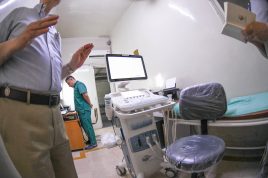
Ospedali Aperti (Foto Calvarese/SIR)
The Church has always been at the forefront in providing assistance and support to the entire Syrian population. In this regard, I would also like to recall the project you strongly promoted, called “Open Hospitals”, launched with the AVSI Foundation, to provide free medical care to the poorest Syrians…
For two thousand years, the Church has contributed to the development of the country in many sectors: education, healthcare and also public life. The Church sought to respond to an enormous humanitarian emergency. I think of the work of Caritas Syria, the soup kitchens, medical assistance, and the “Open Hospitals” project, which lasted seven years and was open to all regardless of religious affiliation. In recent years, together with the six “Dispensaries of Hope”, around 180,000 poor sick people have been treated. It is a drop in the ocean, but we did what we could.
You have often spoken of a “proxy war” fought on Syrian soil by many regional and international powers. Do you fear that Syria could still lose its territorial integrity?
It is a sensitive issue. Territorial integrity and independence remain fragile. There have been, and to some extent there still are, foreign military presences with differing interests. Until recently, there was talk of five powerful foreign armies operating in Syria. Here too, there are two sides to the coin: promises of international support on the one hand, uncertainty regarding unity and independence on the other. Yet these fragilities too can be mitigated through development. Syria has an urgent need for electricity, hospitals, schools and factories.
Development remains the surest path to peace.
What does Syria leave in your heart as a pastor?
When I departed from Damascus, I told the authorities that until now I have been an ambassador in Syria, but from now on, I shall feel like an ambassador for Syria.
I shall continue to plead its cause: development, peace, unity. The dearest part that I carry in my heart is Syria as a mosaic of coexistence, respectful for and tolerant of ethnic and religious groups. The war has cracked this mosaic. There have been painful episodes and victims among different communities. I would like Syria to return to being that mosaic. I carry in my heart two symbolic expressions: at Christmas, Muslims greet Christians with “Merry Christmas, milad Majid!”; at the end of Ramadan, Christians say “Ramadan Karim”, happy Ramadan. I would like these words to resound continually in Syria once more: a sign of tolerance and coexistence.