
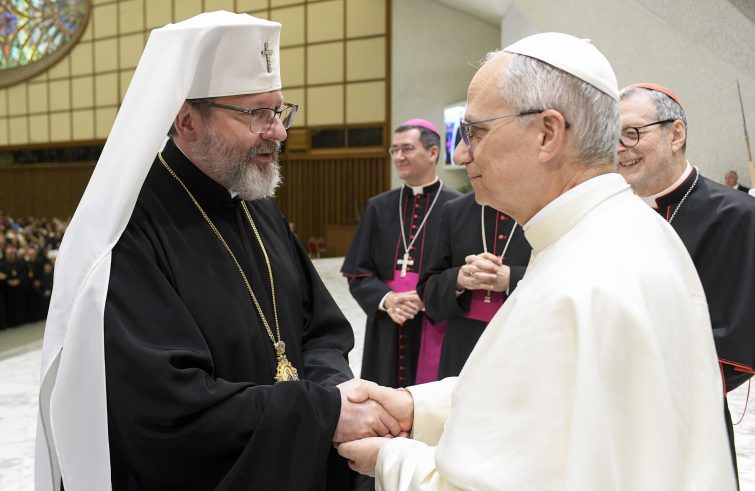
“I handed over a list, once again: almost 400 names. I said: ‘Holy Father, this is not a collection of names taken from the media’. Every time I visit a town, a community, a parish, mothers come without cease, women who have lost their husbands or their sons, and they ask me: ‘Help us’. The only thing I can do is collect the names and present them to you, Holy Father”. His Beatitude Sviatoslav Shevchuk, Major Archbishop of the Ukrainian Greek Catholics, spoke to SIR news agency about the audience he had yesterday morning, 12 February, with Pope Leo XIV. During the meeting, Sviatoslav Shevchuk was able to describe the situation in Ukraine and once again renewed his invitation to visit the country. He also handed over a new list of prisoners of war. “For the families”, he explains, “to know that the names of their loved ones are in the hands of the Pope is important. It is like an icon: they are in God’s hands”. He adds: “We are certain that these names are examined. It is not a formality: the Holy Father considers them with great attention. In fact, he leafed through all the pages with the names and asked me specific questions. He did not simply take the envelope and set it aside. He opened it, looked through it and also asked how the prisoner exchange process was progressing”.
Could you tell us how the audience went?
For me, it was an encounter with a father who wished to listen to his son. At the beginning he said: “I am with you, Ukraine is in my heart, I think of you, I pray for you, but I want to listen to you”. For me, it was a gift, a blessing, because to be listened to means to begin to heal. We are all traumatised by this war. I told the Holy Father how we try to be Christians in the midst of war.
In a meeting, the Mayor of Kyiv repeated to me the same phrase he had said at the beginning of the war: more than humanitarian aid, we need a word of hope from the Church. The aim of these missile attacks is to discourage people, to destroy their will to continue and to resist. I remember a visit to a hospital where a young soldier who had lost his legs said to me: “Father, bless me”. And then:
“it is not so painful to have lost my legs as it is not to know why”.
Is there hope for the hundreds of people, soldiers but also civilians, detained in Russian prisons?
I told the Pope a somewhat curious story. Recently, there was a prisoner exchange that brought home 157 soldiers. Among them was one man from a village near Lviv who had been declared dead in September 2022. A DNA test had been carried out and he had officially been declared deceased. His funeral had been celebrated and his family had received compensation for his death at the front. And yet he reappeared alive. This means that there is hope. Always.
President Zelensky has announced a new round of dialogue and negotiations in the United States next week. Talks will focus on the issue of the Donbas territories and a ceasefire. Do you still believe in peace? And what kind of peace do you believe in?
I am convinced that peace must be sought and built.
Yes, we believe in the God of peace, but we cannot remain inactive: we must act.
Each person must act, within his or her own sphere, and within the limits of his or her responsibility. I believe that there must be a way out. We are approaching the sad anniversary of the fourth year of war: it is a disgrace for the humanity of the third millennium not to be able to stop the aggressor. We hope that the agreements currently under discussion will bring the true intentions to light. Often, in the first meetings, each side conceals its real intentions, seeking to prevail or to manipulate the discussion. If the meetings continue, this process gradually makes everyone’s positions clear.
What about the occupied territories of the Donbas?
The occupied territories have become deserts. To give up territories in these conditions would mean abandoning the people. It would be another humanitarian catastrophe. Before any agreement on territories, the human rights of the people who live there must be respected. We must think not of territories, but of people. For Ukraine, moreover, security guarantees are essential. If the defensive lines built over these four years in the Donbas were to be abandoned, the road to Kyiv and Kharkiv would be open. Who can guarantee that they would stop at the borders of the Donbas? These are existential questions that must be answered. Finally, it is important to reiterate that Ukraine wants peace. We have often been accused of not being flexible enough. That is not true. Ukraine is doing everything possible to stop this war, but certain conditions must be respected. The President, moreover, does not have direct authority to give up land. Surrendering land is a matter for a referendum: the people must express their will.
What do you think about the possibility of holding elections in Ukraine?
I believe that elections will be held, but only after martial law has been lifted, that is, after a ceasefire. In these conditions, with continuous night-time attacks, destruction and people forced to flee, it is physically impossible to organise elections or referendums. It is necessary to guarantee the real possibility and the highest level of security for people to express their will. If there is not even minimal space for a free decision, who could trust the results? Another important aspect is that, in our view, Russia is insisting on the issue of elections, but not to safeguard the right of Ukrainians to elect their president. It would not recognise any president in any case, because it does not want Ukraine to exist. For this reason, the issue cannot be included in the agreements. Only when the war ends will there be a democratic and free process, and Ukrainians will know how to choose a good president.