
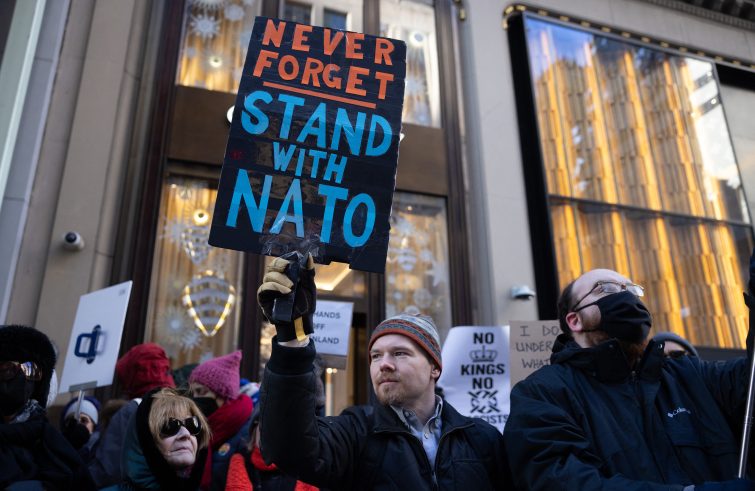
(From New York) Exactly one year after Donald Trump’s inauguration for his second term at the White House, America has taken to the streets once again. More than 800 protests, strikes and demonstrations have crossed the country from north to south, forming a map of dissent that speaks more clearly than any opinion poll to the state of tension running through US society.
The initiative, dubbed the “Free America Walkout”, called on citizens and workers to leave schools, offices and businesses at around 2 p.m. local time. “A free America begins the moment we refuse to cooperate”, the movement’s website reads. “This is not a request. This is a rupture. In the face of fascism, we will be ungovernable”.
The rift does not concern political opposition alone, but also runs through the electorate that had supported the president. “I am ashamed to be American”, bursts out Gail, a lifelong Republican, commenting on immigration agency operations in Minneapolis, where a white woman, a US citizen, was killed while trying to escape a roadblock. After sixty years of loyalty to the party, she now struggles to recognise herself in a president who, in her view, no longer embodies its values.
Tim – a fictitious name –, the owner of a mechanical workshop in Ohio, is also disillusioned. ICE agents arrested two of his employees, both with regular status.
“I voted for Trump to stop criminals”, he says, “not to take away my workers whose only fault is being South American”.
The workshop has closed: no US technicians willing to step in, no Latin Americans willing to risk arrest.
The migration front is not the only cause for concern. The Military Ordinary of the United States, Archbishop Timothy Broglio, said it would be “morally acceptable” for soldiers to disobey orders contrary to their conscience. The statement came in the same week that Trump ordered the capture of Venezuelan President Maduro and his wife, renewed threats over Greenland and announced new tariffs against allied European countries. Senator Mark Kelly, a former Navy officer and astronaut, took a similar line and was punished with demotion and the loss of his military pension.
The first year of Trump II has been marked by 229 executive orders, ten states of emergency and a progressive erosion of the role of Congress. Energy, immigration, trade policy, the International Criminal Court: every dossier has become a field for strengthening executive power.
Federal agents and the National Guard have been deployed in cities against the will of local authorities; independent officials have been removed; the Department of Justice bent to the logic of political revenge. Cuts to scientific research and diplomacy have further weakened the country’s institutional foundations.
According to an analysis by the Wall Street Journal, the president’s social media account published more than 6,000 posts in a year. Of these, over 2,700 text messages conveyed policy directives: from interest rates to artificial intelligence, from global trade to industrial policy, bypassing institutional channels. While unpredictability can be a geopolitical tactic, it requires strategy. Trump’s shifting impulses, amplified by social media, have instead produced a level of chaos that unsettles even those who once supported him. So much so that today, paradoxically, some Americans are looking abroad for a check on their own president.