
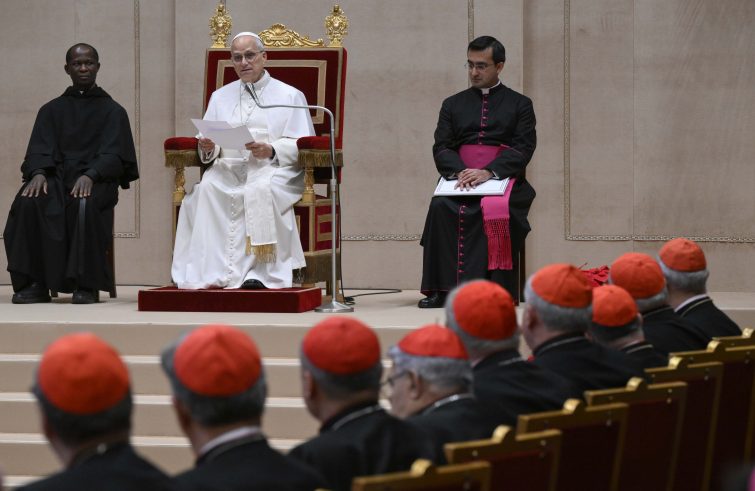
“We need an ever more missionary Roman Curia, in which institutions, offices and tasks are conceived in light of today’s major ecclesial, pastoral and social challenges, and not merely to ensure ordinary administration.” These were the words of Leo XIV regarding the ad intra mission of the Roman Curia, in the traditional Christmas address – his first as Pontiff – delivered in the Benediction Hall. The Pope began his address with a tribute to his “beloved predecessor”, Pope Francis, who “this year concluded his earthly life”. “His prophetic voice, pastoral style and rich magisterium have marked the Church’s journey in recent years, encouraging us above all to place God’s mercy at the center, to give renewed impetus to evangelization, and to be a joyful Church, welcoming to all and attentive to the poorest.”
To become a “prophetic sign”, in a world “wounded by discord, violence and conflict, where we also witness a growth in aggression and anger, often exploited by both the digital sphere and politics”,
is the ad extra task entrusted to the Pope’s closest collaborators.
They were warned against the “forces of division” that may act “beneath an apparent calm” and lead to the temptation of “swinging between two opposite extremes: uniformity that fails to value differences, or the exacerbation of differences and viewpoints instead of seeking communion”.
At the conclusion of his address, the Pope presented those present with The Practice of the Presence of God by Brother Lawrence of the Resurrection.
A synodal Church. “Structures must not weigh down or slow the progress of the Gospel or hinder the dynamism of evangelization; instead, we must ‘make them more mission-oriented’.” Leo XIV then addressed interpersonal relationships and internal dynamics within offices and roles, warning against the risk of “falling into rigidity or ideology, with their consequent conflicts”. “We are the Church of Christ, his members, his body. We are brothers and sisters in him. And in Christ, though many and diverse, we are one: In Illo uno unum.” “We are called, especially here in the Curia, to be builders of Christ’s communion, which is to take shape in
a synodal Church where all cooperate in the same mission, each according to his or her charism and role.” No to the “desire to prevail” and to the “pursuit of personal interests”.
“Is it possible to be friends in the Roman Curia? To have relationships of genuine fraternal friendship?” the Pope asked. Communion, he said, is built “not so much through words and documents as through concrete gestures and attitudes that ought to appear in our daily lives, including in our work”. Quoting Saint Augustine, Leo XIV recalled: “In all human affairs, nothing is truly cherished without a friend.”
Yet the Bishop of Hippo also asked, “with a note of bitterness”: “But how seldom in this life is such a person found whose spirit and conduct may be trusted with full confidence?”.
“At times this bitterness finds its way among us as well, when, after many years of service in the Curia, we observe with disappointment that certain dynamics – linked to the exercise of power, the desire to prevail, or the pursuit of personal interests – are slow to change,”
the Pope noted. By contrast, “amid daily toil, it is a grace to find trustworthy friends, where masks fall away, no one is used or sidelined, genuine support is offered, and each person’s worth and competence are respected, preventing resentment and dissatisfaction”. Such relationships, he added, require “a personal conversion, so that Christ’s love, which makes us brothers and sisters, may shine through”.
We are not mere gardeners tending our own plot. “The Lord’s birth brings the gift of peace and invites us
to become its prophetic sign in a human and cultural context that is too fragmented,”
Leo XIV said. For this reason, “the work of the Curia and of the Church as a whole must be conceived within this broader horizon:
we are not mere gardeners tending our own plot,
but disciples and witnesses of the Kingdom of God, called in Christ to be leaven of universal fraternity among different peoples, religions and cultures”. This, he stressed, happens “if we ourselves live as brothers and sisters and allow the light of communion to shine in the world”. “Mission and communion are possible if we place Christ at the center,” the Pope reaffirmed. The Jubilee, he recalled, reminded us that “he alone is the hope that does not disappoint”. During the Holy Year, two major anniversaries were also commemorated: the Council of Nicaea, “which brings us back to the roots of our faith”, and the Second Vatican Council, which “strengthened the Church and sent her forth to engage the modern world, remaining attentive to the joys, hopes, griefs and anxieties of the people of our time”. Finally, Leo XIV recalled that fifty years ago Saint Paul VI promulgated the Apostolic Exhortation Evangelii Nuntiandi. “It is the whole Church that receives the mission to evangelize, and the work of each individual member is important for the whole,” the document states. Moreover, “the first means of evangelization is the witness of an authentically Christian life, given over to God in a communion that nothing should destroy and at the same time given to one’s neighbor with limitless zeal”. “Let us remember this also in our curial service,” the Pope concluded. “The work of each is important for the whole, and the witness of a Christian life, expressed in communion, is the first and greatest service we can offer.”