
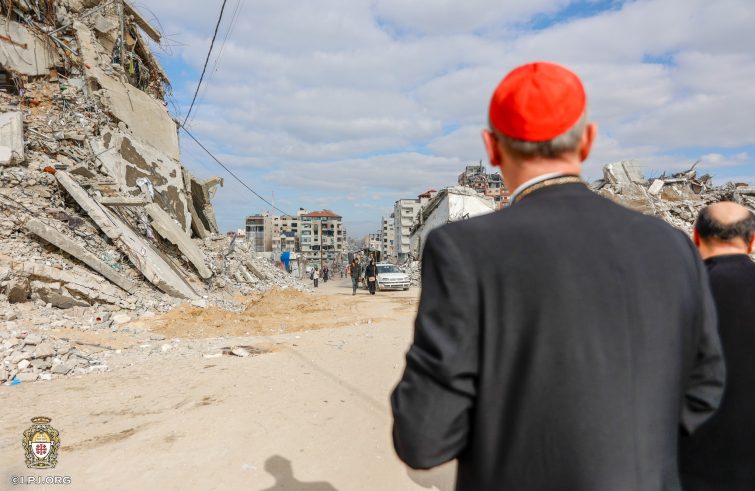
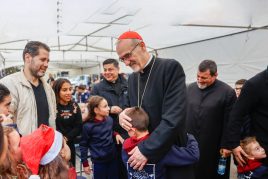
The “Christmas” visit of Cardinal Pierbattista Pizzaballa to Gaza concluded yesterday. Just over two days of meetings, visits and prayers enabled the Patriarch of Jerusalem to assess the conditions of the small local Christian community and of the population as a whole. On the sidelines of the visit, SIR news agency interviewed the Cardinal on the eve of the Christmas celebrations, which will see him preside at the Midnight Mass in Bethlehem, which the Palestinian President Abu Mazen is also expected to attend.
 Your Eminence, you have just returned from Gaza. What atmosphere did you find compared with the past few months?
The atmosphere has changed a great deal. There is no longer an active war. Even though sporadic attacks still occur, the war is over. There is a clear sense of a desire to resume life, to start living again. You see more people around, food is available. It must be acknowledged that aid is now coming in, mainly commercial rather than humanitarian, but it is entering nonetheless. There is no hunger, and this needs to be said. For the rest, however, the situation remains very difficult: people are still living in tents, with nothing. With the cold, there is a lack of blankets and protection from the rain, and conditions remain poor. There are many children on the streets, without schooling. The war is over, but everything needs to be rebuilt.
At the beginning of your visit to the small Christian community in Gaza, you said: “This is where our roots are and this is where we will remain.” Was this a message only for them, or also for Christians in the Holy Land?
Both. Gaza today is a symbol, whether we like it or not. It is the symbol of the conflict we are experiencing, of the difficulty of remaining, and of the temptation to flee. To say “we remain” means to affirm: this is who we are and this is who we will be. That small community has been exemplary in this. We are witnesses. It is a community that has borne witness to faith.
Last Christmas you said: “To believe or to leave”, a decisive choice, or “to inhabit this land of ours and live this history of ours, or to go our own way”. Has anything changed since then?
Life remains what it is. But this year the emphasis is on the courage to take on this reality and live in it while looking ahead. Not to withdraw solely into pain, but to begin again, to start afresh. Christmas reminds us that God enters history as it is; He does not enter an ideal or perfect history. He enters our concrete history and changes it, also showing us how to live in it.
What meaning, then, does “Emmanuel”, God with us, have for those who live in daily fear and uncertainty?
God does not erase the night, but He illuminates it. The night remains, with all that it brings with it, but it is no longer total darkness.
Daily fear and uncertainty also envelop the West Bank, increasingly marked by occupation and by settler attacks against
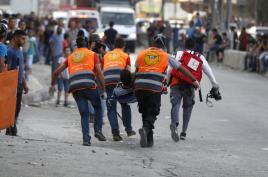
Palestinian properties and villages. Why does this conflict find so little space in the media?
It is little discussed because it gets little media coverage. We speak about it, as a Patriarchate and as Churches; we have spoken about it so many times.
The situation is truly serious, above all because of the impunity with which these settlers act.
I can only reiterate what we have already publicly denounced on several occasions.
What do you think of the role of the international community in this conflict? And of the recognition of Palestine?
It depends on what we mean by the international community. Civil societies have been very close and continue to be so. Multilateral bodies, on the other hand, have shown all their weakness. Recently, however, I see them as less timid than in the past.
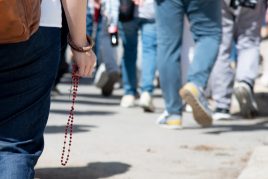 Pilgrimages are slowly resuming. How important are they today?
Pilgrimages are a very concrete “gesture” and a real expression of solidarity and closeness to the Christian community and to other communities.
Without pilgrims, the Holy Land is not complete.
They bring material benefit, which is necessary for many families, but above all they bring the embrace of the world, which we deeply need.
Are there concrete gestures of peace that the Patriarchate can propose today?
It is not yet the time. It is too soon. After such immense violence, there are deep wounds. Gestures must be genuine, and to be genuine they need time. But we are here and we will remain.
Is there an appeal that, for this Christmas, you wish to address to Christians around the world and to the international community?
Peace is not a slogan. It is a responsibility that involves everyone: from the powerful of the world to the simplest people. The Gospel begins with Caesar Augustus and ends with the shepherds. This responsibility is entrusted to all of us. Peace must be built together, day after day.
Daniele Rocchi