

The 1700th anniversary of the Council of Nicaea offers the Church an opportunity to return to the heart of its faith. The Apostolic Letter In unitate fidei, published a few days before the Apostolic Journey to Türkiye and Lebanon, situates the memory of Nicaea within a contemporary framework marked by international tensions, political fragility, and conflicts in the Mediterranean. The Pope immediately clarifies the document’s perspective: “I wish to encourage a renewed zeal for the profession of faith throughout the Church,” recalling that the truth proclaimed in the Creed “deserves to be professed and explored in ever new and relevant ways.” The decision to publish the Letter on the eve of the visit to the places where early Christianity took shape lends the text symbolic significance.
Nicaea, today İznik, a city in present-day Türkiye, is not only a historical reference but a point of contact between Eastern and Western Christian traditions.
The Pope recalls that the Nicene heritage is shared by all Churches and affirms that the profession of faith “offers hope in the difficult times we are experiencing.” In this sense, the Creed becomes a language capable of speaking to the communities he will encounter during the journey, in an area where political and religious tensions demand gestures of reconciliation and openness to dialogue.
Convened by Emperor Constantine in 325, it was the first ecumenical council in the history of the Church. Around 318 bishops took part, most of them from the East. The Council addressed the Arian controversy, which denied the full divinity of the Son. The conciliar Fathers formulated the Symbol of Faith by declaring the Son “begotten, not made, consubstantial with the Father.” Thus, Nicaea established the Christological foundation of orthodoxy, defining the relationship between the Father and the Son and ensuring the coherence of faith with the Gospel revelation. The Council also set disciplinary and liturgical norms, becoming a point of reference for the entire ecclesial tradition.
The Nicene Definition and Its Significance for a Wounded Mediterranean
The Letter re-examines the Arian controversy and the conciliar Fathers’ commitment to defining Christ as “begotten, not made, consubstantial with the Father.” The Pope explains that this formulation was not intended “to replace biblical affirmations with Greek philosophy,” but to safeguard the truth of the Incarnation against reductive interpretations. The Nicene definition thus becomes both a theological and pastoral criterion: only if the Son is true God and true man can humanity recognise in the Gospel the face of a God who draws near. The Letter quotes Saint Athanasius, according to whom the Son, descending from heaven, “made us children of the Father and, becoming man himself, deified humanity.” The Incarnation, the Pope observes, reveals a God who “became flesh and dwelt among us,” assuming the whole human condition. In view of the journey, this connection between faith and history takes on special significance.
In Türkiye, land of the early Councils and today a crossroads of cultures and religions, and in Lebanon, a country marked by institutional fragility and social tensions, the confession of the Son as “Light from Light, true God from true God” becomes an invitation to recognise the dignity of every person and to promote coexistence.
The Letter emphasises that “the liturgy and Christian life are firmly anchored in the Creed,” and that this stability provides a reference point for communities called to live in complex contexts. The memory of Nicaea, preserved through centuries of controversies and reconciliations, thus becomes a sign of perseverance in the quest for unity.
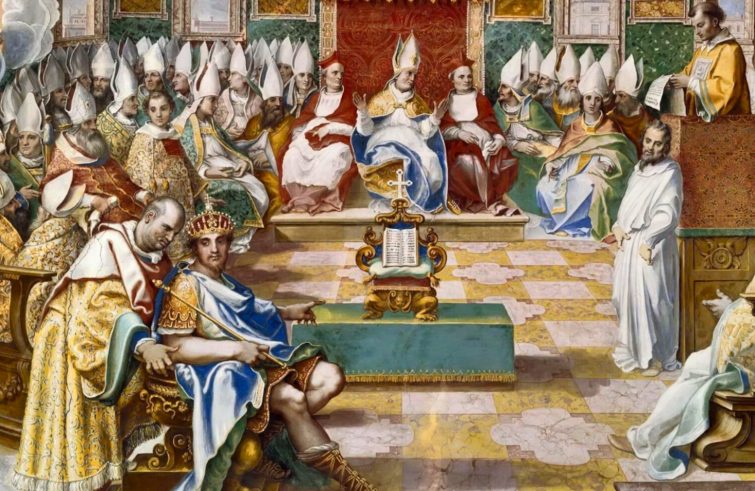
(Foto Biblioteca Apostolica Vaticana)
Ecumenism, Dialogue, and the Horizon of the Journey
The third focus of the Letter concerns Christian unity. The Pope recalls that “what unites us is much greater than what divides us” and proposes an ecumenism “oriented towards the future, of reconciliation on the path of dialogue.” This perspective resonates particularly in view of the imminent journey to Türkiye and Lebanon, where the presence of Eastern Catholic Churches, Orthodox communities, and Protestant traditions highlights the need for common paths.
The Letter calls for overcoming “theological controversies that have lost their raison d’être,” identifying the Nicene profession as a shared foundation upon which to build concrete steps.
Alongside inter-Church dialogue, the Pope proposes an ecclesial examination of conscience: to ask what it means today to profess belief in a creator God in a world marked by environmental and social imbalances, or to confess Jesus Christ as Lord in societies plagued by violence and injustice. The Letter concludes with a prayer to the Holy Spirit: “Come, divine Comforter… to unite the hearts and minds of believers.” This invocation expresses the intention of the Apostolic Journey: to make the Creed not only a shared memory but a force of unity for the Churches of the Mediterranean, called to bear witness to the Gospel through reconciled relationships and a shared commitment to peace.