
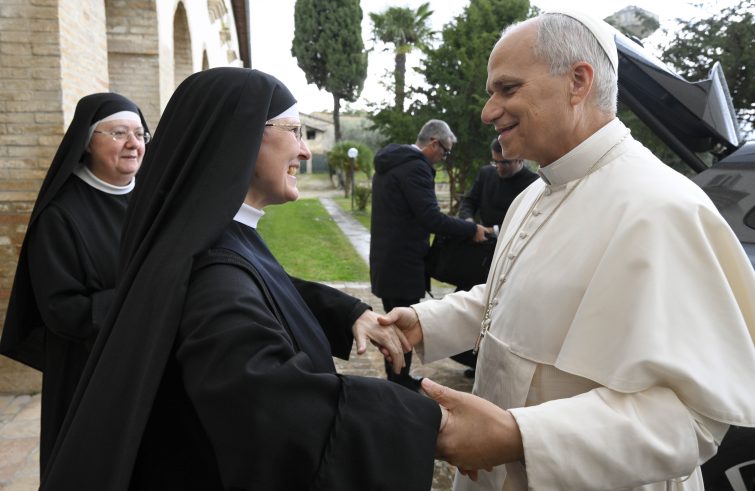
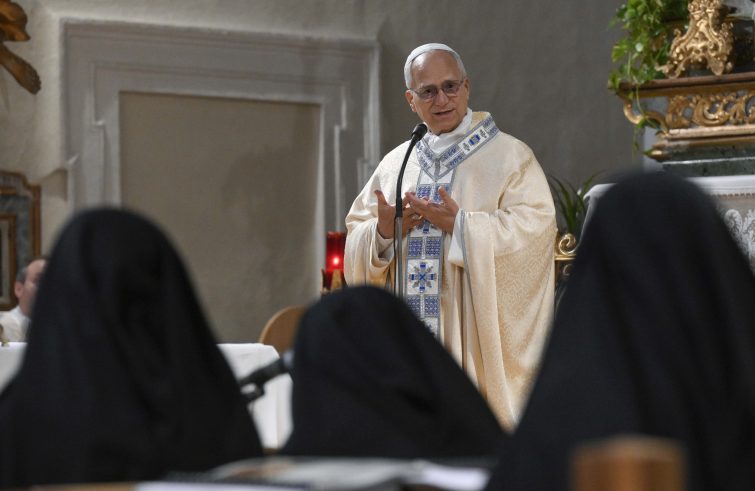
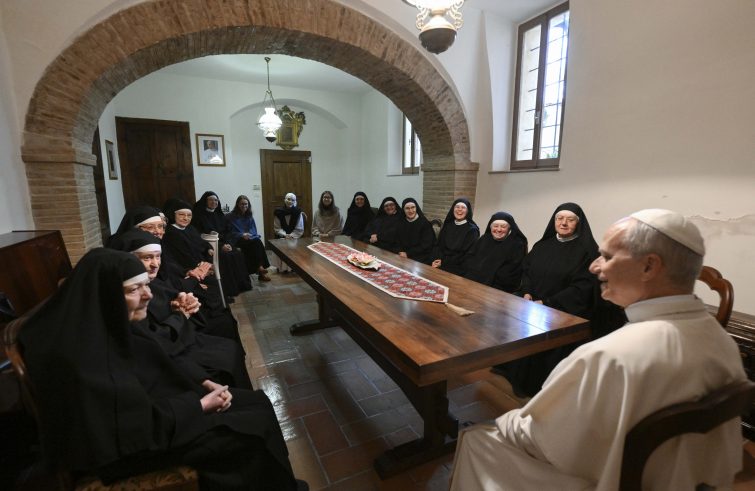
It was an intimate and familial visit. After meeting with Italian bishops in Assisi, Pope Leo XIV traveled to the Augustinian monastery in Montefalco to spend a few hours with the nuns who preserve the memory of Saint Clare of the Cross. He celebrated Mass, had lunch with the community, and shared a moment of simple and fraternal dialogue. Sister Maria Cristina Daguati, mother prioress, recounts the experience: “There was disbelief and then an outburst of collective joy. Few words, much enchantment”.
How did you react to the Pope’s arrival?
With great astonishment! Before entering the Spiritual Exercises, I shared the news of the Pope’s visit with the community, as it was to be kept secret. I was certain that this auspicious time would help us maintain the secrecy—we are in absolute silence—and that the visit would be welcomed in the heart of prayer.
What happened in the community at that moment?
There was disbelief, followed by an outburst of collective joy. Few words, but so much enchantment.
What is the connection between Saint Clare of the Cross and your life today?
Saint Clare of the Cross, with her heart inhabited by the crucified Christ, tells us that
the joyful adventure of life is to let love steal your heart.
If we allow him, Christ then does a twofold work in Clare and in us: he enters the heart and opens it, making us receptive to the events of our time.
How does this fit into the Pope’s message?
We try to put into practice the beautiful message that the Pope delivered extemporaneously to the faithful gathered outside the vegetable garden gate.
How does the contemplative life respond to this call?
The contemplative life seeks to respond to this Absolute of God in our lives and to relay it in love for our brothers and sisters who join us, but also for all those who do not even know that monasteries exist. When we are loved freely, we respond with free love through prayer and hospitality.
Monasteries are green spaces that refresh the souls of those seeking God.
Was there a gesture or a word from the Pope that particularly struck you?
By virtue of my current role as mother prioress in the community, I had the privilege of accompanying the Holy Father to a cell prepared in the corridor of our cloister.
What does welcoming someone into cloistered life mean to you?
Welcoming someone into cloistered life means welcoming them into the intimate life of our home. During this silent and natural encounter, I felt a powerful message in my heart: “Zacchaeus, I want to stay at your house today”.
What did this moment mean to you?
The Holy Father really stopped by, and with his visit he reminded us of the encounter with Jesus. I imagine the coming of the Lord at the end of time as a festive banquet. It is a delicate and profound joy that surpasses the excellent Sagrantino di Montefalco wine offered by the city’s wineries for the occasion.
How would you describe the relationship between cloistered life and the outside world?
Pope Leo XIV wonderfully embodies the union of interiority and service. When prayer is authentic,
The world becomes the other side of the coin depicting the Savior.
What is the profound calling of a contemplative?
The passion of a contemplative is twofold: Christ and the world. According to the form of enclosure embraced by the monastery, prayer gives rise to creativity in welcoming others.
What mark will this visit leave on your community?
The mother prioress who welcomed me to the monastery often repeated this phrase: “The Church is a repository of affection.” We came together in love, and in prayerful love, we remain united with the Holy Father, knowing that it was an immeasurable gift.