

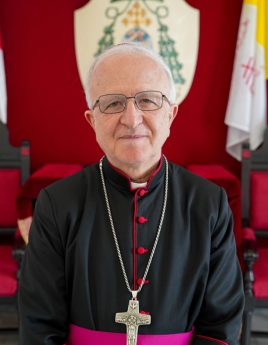
In recent years, but especially since 7 October 2023, attacks by Israeli settlers against Palestinians in the occupied West Bank have increased significantly and are becoming increasingly aggressive: arson, physical assaults, damage to property, use of live ammunition, destruction of olive trees and systematic intimidation. In some cases, settler-related violence has led to forced displacement, with Palestinian families forced to abandon their land or emigrate, while ‘settlement expansion‘”’ is accompanied by a strategy of pressure that makes the Palestinian presence unsustainable. We discussed this with Monsignor William Shomali, Vicar General of the Latin Patriarchate of Jerusalem and Patriarchal Vicar for Jerusalem and Palestine.
In light of the increase in attacks by Israeli settler groups, what are the living conditions of Palestinians in the West Bank today?
This question touches on one of the most critical, yet least reported, aspects of the Israeli–Palestinian conflict. Living conditions for Palestinians in the West Bank have deteriorated dramatically in recent months, reaching crisis levels of humanitarian tension not experienced for years. The already complex reality of military occupation and territorial fragmentation has been exacerbated by a surge in violence perpetrated by
extremist settlers acting with near-total impunity.
These groups, often armed, are exerting systematic pressure to make life unbearable for Palestinian communities, forcing them into exile.
Which Palestinian territories are most subject to pressure from settlers?
The situation is particularly critical in Area C of the West Bank, which constitutes about 60% of the territory and is under full Israeli control. Small villages and Bedouin communities, which often lack protection and basic services, are the main targets here. The Jordan Valley, the hills south of Hebron, and the areas around Nablus and Ramallah are scenes of daily violence. However, it is important to note that violence is not limited to rural areas. Suburbs of cities closest to settlements also suffer incursions and attacks, such as stone-throwing at cars and houses, creating a sense of constant siege.
What are the main forms of pressure and violence that settlers use against Palestinians?
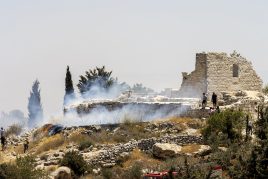
As I said, we are talking about assaults and beatings, and shootings intended to intimidate or injure. Sometimes these occur in front of soldiers who do not intervene. Then there are acts of vandalism and the destruction of property, such as setting fire to or demolishing houses, cars, greenhouses and livestock barns. The sabotage of water wells, the cutting down of centuries-old olive trees, and the theft or poisoning of livestock are also very serious, as they deprive families of their livelihood. Settlers often prevent Palestinians, the legitimate owners, from accessing their land, thus preventing them from cultivating it and effectively expropriating it. This sad list also includes night-time raids on villages to instill fear, particularly among women and children. Finally, sadly frequent symbols of this conflict are hateful Hebrew graffiti on walls.
Earlier, you mentioned the cutting down of centuries-old olive trees. Since 1 October, the United Nations Office for the Coordination of Humanitarian Affairs (OCHA) has documented 167 attacks by settlers in connection with this year’s olive harvest, affecting 87 Palestinian communities.
The olive harvest season has become a time of anxiety and danger. There has been a significant spike in attacks in recent weeks. Settlers are breaking into olive groves to steal the harvest and are cutting down or setting fire to trees which are often centuries old and represent the heritage and history of entire families. This has a devastating impact on the family economy. Palestinian farmers are forced to harvest their olives under the protection of international activists or Israeli volunteers, who have come to safeguard farmers’ access to their land and mitigate the risks associated with settler violence and movement restrictions.
Does the Christian community experience specific forms of intimidation or violence, or are the conditions it faces similar to those of the rest of the Palestinian population?
Although small in number at around 1% of the population, the Palestinian Christian community shares the burden and suffering inflicted by settler expansionism. Their situation forms part of the wider Palestinian tragedy.
In this regard, I would like to mention the Gianelline Sisters of Ortas, a village near Bethlehem. Settlers have occupied a small house belonging to the sisters on a nearby hill, denying them access to their own land.
Other examples include Taybeh, the last entirely Christian village in the West Bank, and Aboud, home to a parish of the Latin Patriarchate. Both of these places are surrounded by Israeli settlements and outposts, which restrict their natural development and access.
Where does the violence of the settlers originate?
It is often justified by a combination of extremist nationalism and a distorted theological view that treats Muslims and Christians as one and the same. They see all Palestinians as an obstacle to Jewish sovereignty over the entire Land of Israel.
We were pleased when Steve Witkoff, the White House special envoy for the peace process, came to visit Taybeh. Following his visit, he informed his government of the situation. The American government protested against the settlers’ incursions. Recently, the Israeli president and army chief criticized the settlers’ extremism. We hope that these denunciations will be followed by deterrent action.
The ongoing situation linked to the Israeli occupation is pushing more and more Palestinians to emigrate. Many of these people are Christian. Are there other factors contributing to this exodus, in your view?
One such factor is certainly the political stalemate and the complete lack of a viable peace process. The prospect of indefinite occupation, the war in Gaza, and the increase in settler attacks in the West Bank destroy all hope for the future, particularly among young people. Then there is the economic situation: the 50% unemployment rate in the West Bank is dramatic. The occupation is stifling the Palestinian economy through restrictions on the movement of goods and people, checkpoints throughout the West Bank, control of resources, and Palestinians’ inability to access much of their own land. This makes it difficult for them to build a prosperous future. Add to this the separation wall, which turns simple actions such as going to work, school, the doctor or visiting relatives into an ordeal.
For a small community such as the Christian community, which has strong international ties, emigration is a rational choice when faced with such an ordeal.
Although the coexistence of Christians and Muslims in Palestine has a strong historical basis, the broader regional landscape contributes to a sense of vulnerability.
Emigrating in the hope of a better future…
Palestinian Christian communities in the diaspora, such as those in Chile, the United States and Australia, are attractive because they are well organized and offer a way out. For the 30 Christians from Gaza who obtained a visa for Australia, it was not just an opportunity, but a lifeline. Having experienced the hell of war and realized that there is no future in a besieged and destroyed Gaza Strip, accepting an Australian visa is not a choice for these people; it is the only way to survive and provide a future for their children.
What concrete steps should the international community take to support the Palestinian population in the West Bank and prevent violent actions by settlers?
The international community is at a crossroads: should it continue with ineffective statements of condemnation or take consequential action? In my opinion, we need to move from words to deeds and impose sanctions on violent settlers and their organizations. Their identities are often known to NGOs and intelligence services. Restricting their financial resources and freedom of movement would be a more effective deterrent than any press release or statement. Furthermore, we should launch investigations to trace the sources of public and private funding that allow colonial outposts to be created and maintained, which are illegal even under Israeli law. We must take a clear position on the settlements and stop considering them merely an ‘obstacle to peace’; we must start defining them as colonization of occupied territory under international law. Another possible measure would be to increase the number of international civilian personnel, such as activists, human rights observers and ecumenical accompaniment workers, in high-risk areas such as the Jordan Valley. Although they are unarmed, their physical presence acts as a deterrent against abuses and enables them to document what is happening in real time. The international community must therefore reiterate that Israel has a legal obligation under the Fourth Geneva Convention to protect all civilians under its military control, including Palestinians and Israelis.
Finally, could recognizing the State of Palestine be useful to the Palestinian cause?
In my opinion, it would bolster Palestinian legitimacy and reaffirm the international consensus in favour of the ‘two peoples, two states’ solution, which is being deliberately sabotaged by the expansion of settlements.