
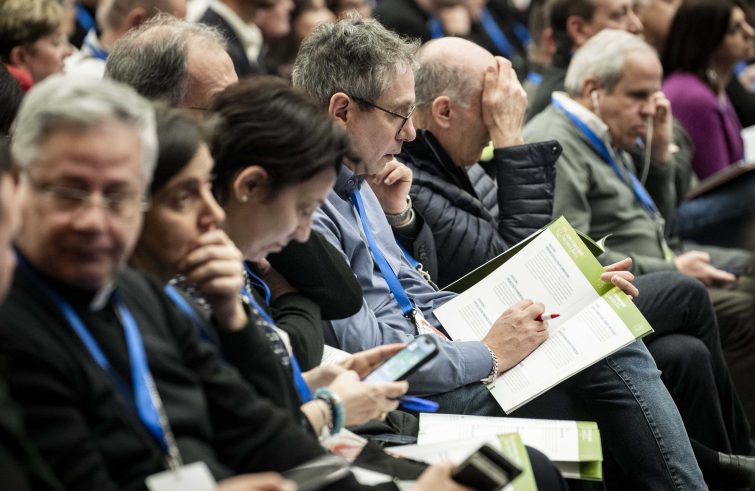
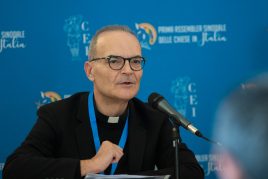
Following four years of listening, discussion and discernment, the Synodal Path of the Italian Church has reached its decisive stage. The third Synodal Assembly, the culmination of a process begun in 2021 to rethink the role of Christian communities in the present day, will be held in Rome on 25 October. Composed of bishops, diocesan delegates, regional representatives and members of the Synodal Committee, the assembly will present and vote on the Summary Document containing over one hundred proposals. Monsignor Valentino Bulgarelli, secretary of the National Committee of the Synodal Journey and undersecretary of the CEI, discusses this process.
What is the significance of the third Synodal Assembly for the Italian Church?
This stage represents the culmination of a lengthy and intricate four-year process that coincided with the Synod of Bishops on communion, participation and mission. In 2021, Pope Francis urged the Italian bishops to embark on a journey of listening and discernment in the post-pandemic context, which had profoundly affected ecclesial participation. 25 October will mark the end of this phase, with the aim of gathering all the proposals that have emerged along the way.
In recent years, the word ‘synod’ has become familiar also to the people of God. Is this one of the main fruits of the journey?
Above all, the synodal journey has been an opportunity to develop a deeper awareness of the Church’s very nature: it is essentially ‘synodal’, called to walk together, never alone, but always with the risen Christ who is alive and present. It is not just a pastoral method or strategy:
Synodality is who we are; it is how we listen to one another, make decisions and discern the future. It is the shared responsibility of the bishops, who guard and accompany the entire people of God.
The first two assemblies addressed important issues, including the shared responsibility of those who have been baptized, the role of women, and the reform of ecclesial structures. What is the Italian Church’s view on these issues today?
First of all, I would like to emphasize a beautiful aspect of the Church that emerged from this process. I witnessed genuine participation and widespread involvement, at least at diocesan level, as well as a strong pastoral concern: how can we proclaim the Gospel in such complex times? Over the past fifty years, awareness of what it means to be the Church has grown, and many of the proposals in the final text are the result of experiences, reflections and attempts to implement the Second Vatican Council.
Which aspects of the document do you consider to be the most significant?
While every point in the text opens up interesting possibilities, what I would like to emphasize is the need to read it in its entirety, as it outlines the stance that the Christian community is called to take today.
This involves paying attention to every stage of life, viewing formation as an essential process and adopting a shared sense of responsibility as a common approach.
These elements should not be considered separately: they are interrelated and give concrete form to a shared ecclesial identity.
In recent years, there has certainly been no shortage of discussion, even on sensitive issues. Has the Synodal Path succeeded in maintaining an atmosphere of openness and transparency?
Transparency has always been a priority. A notable example of this occurred during the second assembly, when the delegates requested further work on a text with which they did not agree. This was a significant step which confirmed the desire to create spaces for genuine dialogue, even on complex issues. This is precisely what synodal participation entails: sharing efforts, recognizing unresolved issues, and entrusting the task of guiding the path of the Churches in Italy to the bishops’ discernment at the next General Assembly.
Could it also have been a way to ‘reawaken’ the Church’s public presence, encouraging more active participation in society and culture?
Yes, absolutely. The Second Vatican Council gave us the insight of a Church called to evangelize a new era, with unprecedented challenges.
This journey has exposed a veritable missionary zeal: the desire to bring the good news of the Gospel to everyone.
It is a dynamism that I have experienced first-hand, and I am certain that it will continue to evolve. Naturally, a process of this kind requires time, in-depth analysis and study. However, I believe it has already catalyzed a renewal of ecclesial protagonism.
What significance will the final vote have for the Synodal Path of the Italian Church?
The vote marks the moment when the work carried out over the past four years is transformed into a shared and collegial act. It is not a point of arrival, but a decisive step in the process of ecclesial discernment, because it returns the outcome of a real dialogue, based on listening and participation, to the churches in Italy. Through the vote, the communities express their mature consent to follow this path together: the approved proposals will not remain on paper, but will instead become the basis for future pastoral choices, guiding the work of bishops and the life of the dioceses in the coming years. In this sense, the vote is not only a form of ratification, but a concrete sign of a Church that decides its future together.