
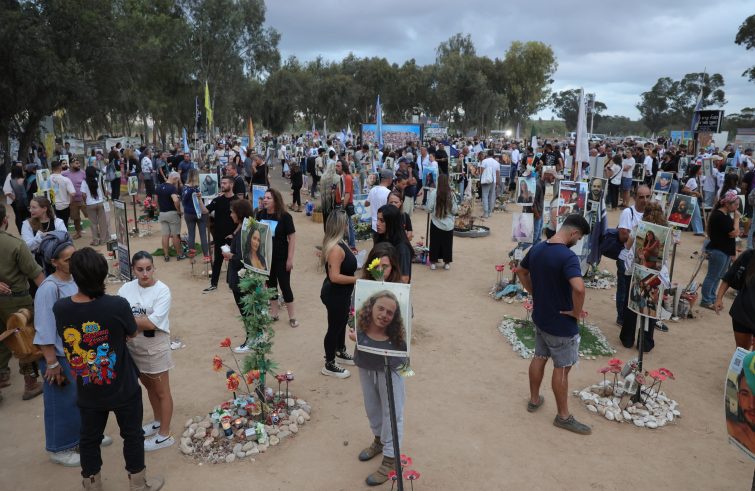
Two years of war have not obfuscated the questions surrounding October 7, a date that marked a pivotal ‘before’ and ‘after’ not only for Israel but for the entire Middle East. It marked a point of no return in a conflict that altered political balances, power relations and collective perceptions of national security.

Fabio Nicolucci, strategic analyst at ISPI – Institute for International Political Studies – and at the NATO Defence College Foundation, an expert on Israeli affairs, jihadism, Africa and the Arab world, discussed the matter with SIR. In his book, “Israele e il 7 Ottobre. Prima e dopo” (Guerini e Associati, 2024), Nicolucci explores the origins and consequences of an event that was set to reshape the region’s geopolitical landscape.
After two years of war, 7 October has become a defining date for Israel, marking a radical “before and after” moment, perhaps also for the entire region. Why was it a “game changer”?
Because of the sheer magnitude of Hamas’ attack, which took Israel completely by surprise. The violence, brutality, and political impact were so severe that they produced unexpected and long-lasting consequences.
However, 7 October is also a turning point in terms of Israel’s response, particularly Netanyahu’s handling of the military and political challenges, which escalated into a systemic crisis.
Hamas, and in particular its leader Yahya Sinwar, perceived a political vacuum: Israel was about to sign an accord with Saudi Arabia, the cornerstone of a regional agenda, relegating the Palestinian question into the background, as if it were obsolete. Sinwar exploited Netanyahu’s delusions, demonstrating — as I explain in my book — remarkable strategic vision and military acumen.

But in the first few months after the attack there was a seemingly unified response from Israel…
The first responders were the democratic reservists who had been protesting for forty weeks against the judicial reform and the measures that curb the power of the Supreme Court. They were the ones who rushed to defend the nation against the attack by Hamas, while Netanyahu was paralysed by the collapse of his political vision. For the first three or four months, the war was perceived as a legitimate and necessary response to the attack, enjoying the support of the international community. Had Israel stopped in February 2024, it would have won. It would have achieved a political defeat of Hamas and regained global consensus while acknowledging the reality of the unresolved Palestinian issue. However, Netanyahu’s decision to deny this reality and promise an impossible “total victory” led to the current disaster.
Hamas employed a judo-like tactic, exploiting the opponent’s strength to bring them down. And that is exactly what happened.

Two years on, who has won and who has lost?
Israel won the military confrontation, as expected. But politically, Hamas is the winner. In my book, “Israele e il 7 Ottobre. Prima e dopo” (Israel and October 7: Before and After), in the chapter “La trappola di Hamas” (Hamas’ Trap), I argue that Sinwar had become very familiar with Israeli society after spending two decades in an Israeli prison. He knew that, in the event of a just war, the country would unite and its military would be unbeatable. He thus dragged Israel into the wrong war, into the quagmire of an amoral ethical conflict, where the enemy was dehumanised. Netanyahu, with his messianic and warmongering rhetoric, fell into the trap. Today, Hamas has achieved its objectives and accepted the truce, even at the cost of sacrificing its leadership. Netanyahu, on the other hand, is caught between two alternatives: acknowledging defeat or continuing to pursue the delusion of total victory, wasting time, lives and resources — not only those of the Palestinians, but also those of young Israelis.
What effects has October 7 had on Israeli society?
It reversed the paradigm of power. For a sovereignist like Netanyahu, this is paradoxical: the elite groups in both Israel and the Palestinian territories have lost touch with the people.
The real crux of the matter is the West Bank, not Gaza.
The political conundrum boils down to this: the safety of the people or the conquest of land? By plunging an entire country into strategic confusion, Netanyahu has exacerbated tensions and undermined democracy, which is now more of a ‘démocrature’ than a democracy. Many Israelis oppose the war, but not because they want peace; they oppose it because war prevents the release of hostages. It is precisely this ambiguity that Netanyahu continues to exploit.
To what extent could the so-called “Trump plan” impact the situation today?
Actually, it is not Trump’s plan. I believe it originated from a French-Saudi initiative presented to the UN and subsequently backed by Turkey, Saudi Arabia and much of the Arab world. Riyadh asked Trump to intervene because he is the only leader who has any influence over Netanyahu, not least for personal reasons. Trump had no intention of dealing with the Palestinian issue; it was forced upon him, and he ended up adopting almost the entire Biden plan, containing the same provisions that had been proposed a year earlier. At the time, neither he nor Netanyahu were ready. Today, however, the situation has deteriorated, the world is in turmoil, and even Trump seems weary of this endless war.
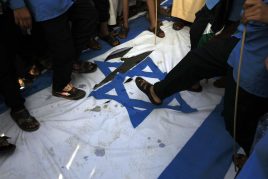
Israel is becoming increasingly isolated on the international stage. An increasing number of countries are recognising the State of Palestine, while anti-Zionism and anti-Semitism are dramatically resurfacing. Is an “Israeli question” arising alongside the Palestinian question?
Unfortunately, this is the case, and Israel is responsible for this dangerous drift. The Israeli state’s delusions of omnipotence — denying humanitarian aid, preventing journalists from accessing the area, and carrying out indiscriminate strikes — are inhumane and self-defeating. The Greeks called this error ‘hubris’: the excess that precedes the fall.
There is a risk that Israel may turn into a new Sparta, winning the war while losing the peace.
Is there still room for a two-state solution?
The situation is dire, as it is in Gaza. But I see no alternative. Removing the physical and moral rubble is bound to be extremely challenging, as is the process of disentangling the settlements from the fabric of the West Bank. Nevertheless, the two-state solution remains an option. Another option would be a binational state similar to the old British Mandate, where everyone votes regardless of ethnicity. However, this would mean the end of the Jewish state as envisaged by democratic Zionism. Hence the opposition of the Israeli security apparatus: they know that it is not possible to have both a Jewish and a democratic state if you exert control of another people. You have to choose.
Did the Nation-State Law of 18 July 2018 that officially defines Israel as “the Jewish nation-state’ for the first time in Israel’s history, contribute to this development?
Indeed it did. This law de facto excludes Israeli Arabs from full political participation and marked the beginning of the formalisation of this drift. This is when the first cracks in the democratic dream started to appear.