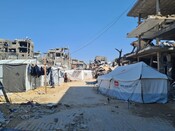

The 20-point peace plan announced by Trump and Netanyahu at the White House is a mishmash of announcements, promises, threats and intentions, along with a few concrete measures. The latter were already known, partly because they formed part of previous ceasefire agreements, including during the Biden administration. These elements all stem from negotiation and diplomacy, not from indiscriminate massacres. However, this time it feels more like a diktat.
In addition to a deradicalized and “terror- free” Gaza (i.e. without Hamas) the steps to be taken immediately are the following: the release of all living and deceased hostages in exchange for the release of 250 life sentence Palestinian prisoners, plus 1,700 Gazans who were detained after 7 October 2023 without trial; the reopening of border crossings to allow access for humanitarian aid; no Palestinian residents of Gaza will be forced to leave the Strip; Israel will not occupy or annex Gaza.
All of this is subject to Gaza’s demilitarisation and assurances of non-indictment and safe passage for Hamas members who wish to flee abroad.
The relatively new elements concern the government of the Strip, which would be handed over to a “technocratic, apolitical” Palestinian committee, as was widely anticipated in the Arab peace plan. Oversight would be provided by a “Board” chaired by Trump himself and other international figures, including Tony Blair. The plan also envisions an “International Stabilization Force” that would temporarily oversee security in Gaza, gradually replacing the Israeli army.
In line with this “corporate” approach, the 20-point plan sets out a reconstruction programme that looks very much like a real estate development project, involving the creation of preferential economic zones and an economic plan explicitly labelled “Trump”.
In this jumble of proposals, Gaza and its inhabitants appear to be treated as expendable objects, with no regard for the Strip’s thousand-year history or the dignity of its people. Moreover, there is a contemptuous disregard for the tens of thousands of innocent lives lost, who are to be removed (both metaphorically and quite possibly physically) alongside the rubble. Gaza would then become something akin to the famous ‘Riviera’ (or a new Dubai), an entity arbitrarily decreed by a coalition of states rather than the United Nations, with no mention of the Palestinian National Authority. As if that were not enough, Gaza is presented as a separate entity that does not appear to form part of the vision for a Palestinian state. Indeed, what happens to the idea of Palestinian statehood? The final points of the so-called plan are indicative. Once Gaza has been stabilised and Palestinian reforms have been implemented, “conditions may emerge for a credible path towards Palestinian self-determination and statehood.”
This clearly hypocritical rhetoric is turning the clock back to the period before the 1993 Oslo Accords. Hard as one might try, nowhere in the elaborate US plan is there any reference to the West Bank, nor any mention of Israel’s withdrawal from the Occupied Territories.
The icing on the cake is the diplomatic role – so as to say – that the plan reserves for the United States, which will “establish a dialogue between Israel and the Palestinians to agree on a political horizon for peaceful and prosperous co-existence”, a process that, in this quasi-pacifist spirit, is to be supported by “an interfaith dialogue process” to promote tolerance. Yet this conflict, even before the emergence of Hamas and particularly prior to the rise of Israel’s religious right, was never religious in nature, but territorial. Rather than this elaborate proposal, it would suffice to return to the age-old yet still relevant formula of “land for peace”, that is, land for the Palestinians and land for the Israelis, and peace throughout the region.
(*) former ambassador, Diplomacy and Negotiations Professor