
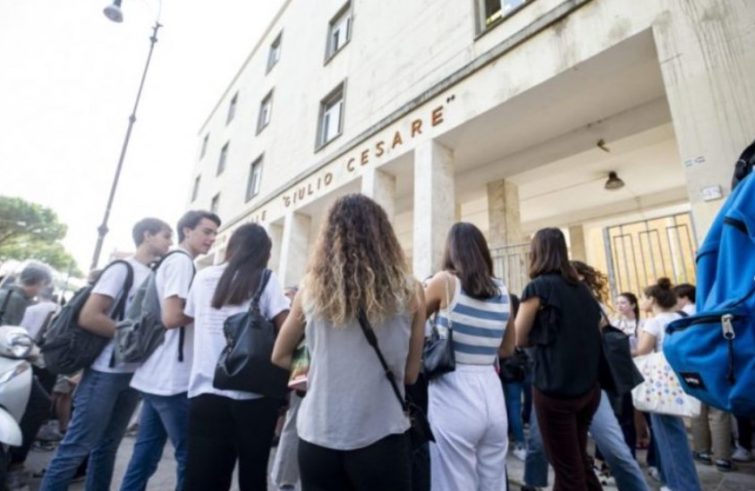
Almost seven million Italian pupils will return to the classroom in the coming days . The first schools to reopen are those in the autonomous province of Bolzano on 8 September, followed by those in other regions, including Apulia and Calabria, on 16 September. A number of changes are in store for them all. Firstly, the ban on mobile phones in the classroom will be extended to secondary schools. Another change is the introduction of a behavioural grading system: a mark of 5 will result in failure, a mark of 6 will mean having to sit the exam again in September, and in order to pass, students will have to demonstrate their knowledge of citizenship values. Suspensions will no longer be purely punitive; pupils will be given the opportunity to reflect on their behaviour or take part in solidarity initiatives. Furthermore, from 11 September, 1,000 teachers of Italian as a foreign language will be tasked with promoting immigrant student integration and reducing dropout rates. The final new measure concerns the final school-leaving exam. Unlike in 2025, students who refuse to take the oral exam will fail, regardless of their written exam results.
Eraldo Affinati is a writer, teacher and the founder, together with his wife Anna Luce Lenzi, of the Penny Wirton school, which offers free Italian-language courses to immigrants with 65 learning centres across the country. This year, he released two books on education: “Testa, cuore e mani: Grandi educatori a Roma” (Lev) and Amore del futuro. Educare oggi” (Edizioni San Paolo). We asked his opinion on the new measures, excluding the ban on mobile phones, which he had already commented on for us here.

(Foto: Issr Marvelli)
Professor, can behavioural grading as an educational and disciplinary tool actually encourage more respectful and informed behaviour?
In my opinion, stricter behavioural grading is only a quick fix.
It will not encourage more respectful behaviour or genuine awareness among difficult pupils. It will merely make confrontations between pupils and teachers more dramatic and exacerbate them. Even worse, it will increase the artificial sense of “being at school” experienced by pupils.
What would you recommend as an alternative?
The most difficult teenagers tend to have underlying issues related to their family life, and a good teacher is expected to resolve these by trying to understand their inner world. However, they cannot manage this alone. In such cases, teacher staff meetings should provide unruly pupils with educational experiences that enable them to see life in a broader context, helping them to free themselves from the existential gloom that tends to prevail in times of crisis.
How can a school suspension become an opportunity for growth?
This question reminds me of the many young people who, over the years, voluntarily taught their immigrant peers at Penny Wirton School. They had been suspended from their own schools and consequently referred to us. They had been portrayed to us as petty criminals — perhaps some of them were — but when I saw them teaching Italian to Mohamed or Ibrahim, they seemed like different people. The more I learned about them, the more I realised that there had been misunderstandings and misinterpretations, and that they had hidden and undiscovered talents. This dispelled any temptation I had to impose strict disciplinary measures.
A fifteen-year-old who makes a mistake needs to understand why they made that mistake.
Which civic skills should be prioritised in the exam for those who are awarded a grade of 6?
Students with a grading of 6 must understand that every action has consequences, and that they must own up to them.
It is unrealistic to expect to pass through the fire of our own making unscathed. Those who cause harm must ultimately answer for it.
This is the foundation of all so-called civic competence. However, we must not delude ourselves into thinking that giving a bad mark is enough to successfully instil this competence in a schoolchild.
Based on your experience in this area, what is your view on recruiting Italian-language teachers for immigrants? Is it a first step towards tackling early school leaving and fostering inclusivity? Is it enough?
This is just the first step. It remains to be seen how these language support teachers will interact with new immigrants and second-generation immigrants. How many teaching hours will they spend with them, and what will the teaching environment be like? While individual institutions must address these questions, it is equally clear that this positive measure must be implemented systematically rather than as a one-off initiative.
The topic of social inclusion is also relevant in the case of the four Roma children who were driving the stolen car that hit and killed Cecilia De Astis on the outskirts of Milan on 11 August. It has been reported that these children had been living in an illegal camp several miles away from everything, with no school transport available to them. There are many other children in similar situations. How can they be ‘engaged’, bearing in mind that the issue is very complex and has deep cultural roots?
Roma children are the most challenging to engage with because of the destitute conditions in which they grow up and live. However, this is precisely why the government cannot ignore them and delegate all responsibility to the non-profit sector.
Local councils and associations have implemented numerous initiatives to promote schooling for children born into Roma communities, and these initiatives should receive greater support.
Personalised assistance is more effective. I could cite numerous examples of good practice, such as small daily successes that do not hit the headlines. However, one sensational incident is enough to discredit all efforts.
(Foto ANSA/SIR)
How do you view the possibility of disqualifying candidates who refuse to take the oral exam, when students who remained silent during their final exams this summer passed nonetheless?
The quiet protests during last year’s school-leaving exams signal a serious problem linked to the format of the exams, which has resulted in a negligible failure rate for a long time. There is a need for a complete overhaul of these exams, but I think this is unlikely to happen in the short term. Therefore, we will inevitably have to continue accepting the formality of these final exams, which some students deem unreasonable.
In conclusion, from an educational perspective, what do you consider to be the top priorities for Italy’s school system today?
The real priority is the digital revolution, which requires a radical change in education that is still a long way off. While the house is burning down, we continue to argue about details and minor issues that are too often exploited politically.
Today’s young people have different perceptions and are presented with unparalleled opportunities to learn in novel ways. However, when they sit in the classroom, they are effectively transported back in time to a 20th-century world that has largely become obsolete. Nevertheless, I am confident that we will be able to bridge this intergenerational divide.