
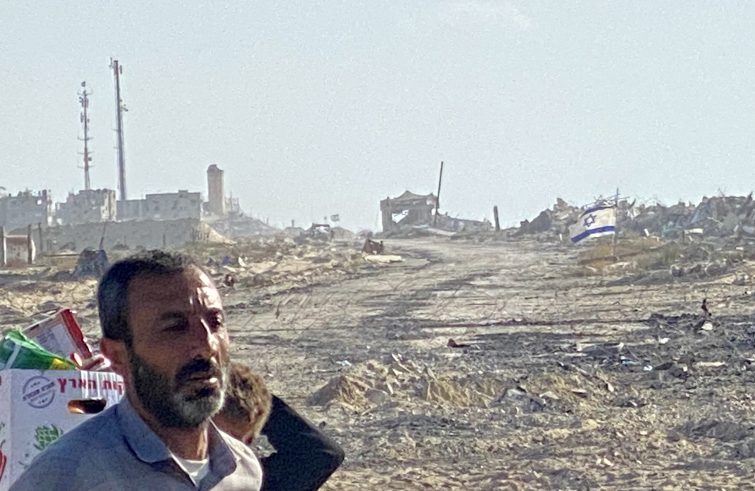
“On 7 October 2023, at 6 a.m., I was abruptly awoken by the roar of bombs. We have become accustomed to this situation; it happens every three or four months. I grew up with this as my norm. I phoned a friend to check if we were going to work, but he told me off for not making sense and said that we would never return to work. For the first time, he was right.” Joseph —not his real name— is a young man from Gaza who began sharing his story in a Tuscan parish on 4 July.
“All we want is to live in peace.” He finds it hard to open up: “It’s something we’re unfamiliar with. We only talk about the war in whispers and briefly.” In any case, he says reassuringly: “My family is not linked to any political factions. We are ordinary civilians: all we want is to live in peace.” In 2023, he spent six months in Italy learning the language and pursuing his studies. “When my residence permit expired, I had to choose between staying illegally or returning back home,” he says. “I had the opportunity to study in Egypt, so I spent two weeks there. Then, for no specific reason, I decided to return to Gaza.” “Leaving Gaza is more difficult than entering it,” he explains. “I worked for two weeks, taking up the job I previously held, until 7 October. On that day, everyone we knew started to flee,” he says. “It was a Saturday. We remained in our home until Wednesday, confident that the situation would improve. But in the meantime, the house of my sister – who in the meantime was sheltered in a church with her family – was destroyed in a bombing raid. That’s when we decided to leave.”
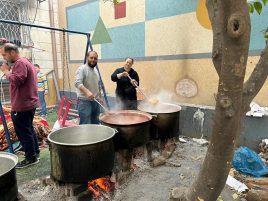
Life in Gaza’s parish church. Thus begins his account of daily life in the Holy Family Catholic Church, wherein he was sheltered along with 600 other people, while the neighbouring Orthodox church housed 500 more Christians. Sleepless nights meant that people tried to rest during the day while the priests organised community life. They kept everyone busy with readings from the Bible, explained the Word of the Day and said Mass. At around 7 p.m., they stood guard to see if they could connect to the internet long enough to receive Pope Francis’ daily phone call. “In December, military forces surrounded the parish,” Joseph continues. “We could only use the bathroom at night, and we had to crawl on the ground to get there. Anyone seen inside a building was killed, regardless of who they were.” Then, one day, “we noticed fragments of shrapnel were falling through the windows. My sister went back to get her son while she was running away, but a piece of shrapnel pierced her right leg and wounded her other leg. We were unable to leave until the soldiers had gone. Two weeks later, she underwent surgery and her wound was disinfected at a nearby hospital which was overcrowded with wounded civilians.”
A way out. Since then, Joseph’s family struggled to find a way to leave Gaza. “Even though many people had been forced to move from the north to the south of the Strip, our Christian community agreed not to abandon the churches. We didn’t want to return and find that they had been reduced to rubble, like our homes. However, my sister needed medical treatment, so she had to exit the Strip,” he says. At the time, Egypt imposed a fee of $5,000 per person to leave through the Rafah crossing. “At first, we planned to sell everything we owned, including our clothes, in order to raise the money needed to leave. But the crossing was subsequently bombed and closed,” he recalls. Then, between January and May, there was a shortage of food.
“We could only find pet food, which we kneaded to make flatbread. We ate it as if it were bread,” he says. “While we asked God why he had made face such an ordeal, we realised that he hadn’t abandoned us. I ate the pet food, but I never went to bed hungry.”
“Six p.m. Mass and the Rosary prayers had become important moments that strengthened our faith and gave us hope,” he explains.
Arrival into Italy. Meanwhile, people who knew Joseph in Tuscany prayed tirelessly until September, when were informed that an international organisation had helped the group of brothers from Gaza leave via a border crossing that had only been opening to allow goods into the Strip before 7 October. “We got there by ambulance,” Joseph explains. “While it normally takes half an hour to cross the Strip, our journey took 12 hours. The subsequent flight from Jordan to Italy took a week due to the numerous security checks.” He concludes: “Despite everything, mine is not one of the most dramatic stories. The situation there has worsened considerably. Every day we learn that one of our acquaintances has been injured or has had to leave the church for some reason, and no one knows if they will return alive. It’s all part of everyday life in Gaza.”
(*) Toscana Oggi