
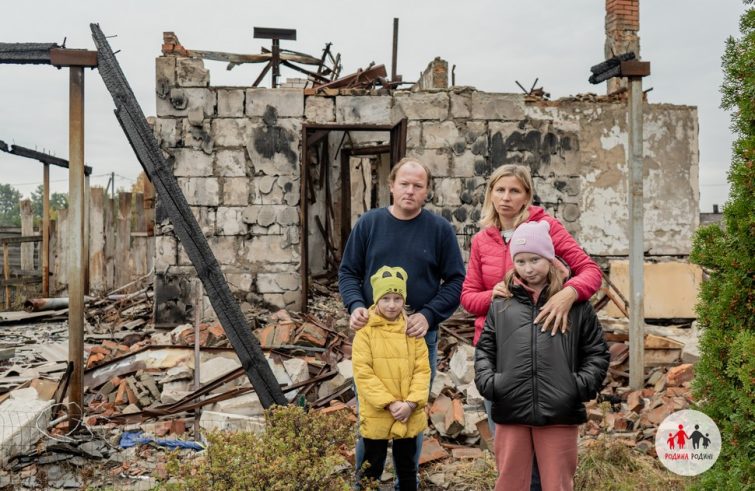
As of April 2025, more than 6.9 million Ukrainians remained displaced due to Russia’s aggression against Ukraine. This means that one in eight Ukrainian families has been forced to flee the country in fear for their safety. Most of them – 6.3 million – have found refuge in European countries. These findings emerge from a report on the situation of families in wartime Ukraine, presented during the Synod of Bishops of the Ukrainian Greek Catholic Church in Rome by Yuriy Pidlisnyi, deputy head of the Patriarchal Commission on Family and Laity of the UGCC. The report shows that 90% of Ukrainian refugees are women and children. Men either remain to defend their homeland or are unable to leave as a result of mobilisation restrictions.
Ukrainian communities have formed outside Ukraine following Russia’s large-scale aggression. The largest are located in Germany (1.18 million), Poland (995,000), the Czech Republic (398,000), Great Britain (more than 200,000), and the United States (170,000).

Kharkiv, stazione (foto Biagioni)
Refugees’ plans to return home pose an increasing challenge. At the start of the war, the majority of Ukrainian refugees wanted to return home as soon as possible, but now a quarter of them are thinking of settling permanently abroad. The main reasons for wanting to return include family reunification (56%), resuming normal life (56%), and contributing to Ukraine’s reconstruction (47%). However, only 12% have returned so far.
Maria Trakalo, a psychologist and co-founder of the Mental Health Hub, briefed the bishops on the devastating impact of the war on the daily lives of Ukrainian families, whether at the front, behind the front lines, or living as evacuees or refugees in other countries. Those with a family member on the front line are hit particularly hard, as they are in a constant state of ‘emotional turmoil’: living in anticipation of phone calls from the front; often having to provide alone for their loved ones on the battlefield; and feeling abandoned. Even a soldier’s return home can throw the family into “a state of severe psychological distress.” “When a veteran returns from the battlefield, they change, resulting in new challenges in terms of communication, family roles and daily routines.” Ultimately, what remains is the grieving process.
“In the aftermath of bereavement, people need to discover a new way of living, and occasionally a new identity, while preserving the memory of the deceased.”
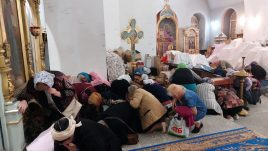
(Foto Facebook – vescovo Nikodym)
A study carried out in December 2024 and January 2025 revealed that 83% of Ukrainians experienced elevated levels of stress, with 78% attributing the war as the primary cause.
The demand for psychological support has surged – from 41% to 71%. Concurrently, there is “a critical shortage of specialists capable of offering comprehensive assistance to the population. The situation is even worse in rural areas.”
Bishop Arkadij Trokhanovskij outlined the challenges and priorities. The armed aggression not only destroyed the country; its effects have also impacted personal relationships and family ties. More specifically, there are women left widowed or orphaned children; husbands or fathers at the front with no family ties and families who lost their loved ones or are torn apart by displacement abroad along with the issue of Ukrainian children facing integration into a foreign culture. On top of this, Ukraine will soon have to deal with a demographic crisis. “Based on data from the first half of 2024,” the bishop pointed out, “there were 286 deaths per 100 births in Ukraine, as opposed to 265 in 2023.”
“Ukraine is entering a critical phase of demographic decline, and solving this problem must become a national priority.”
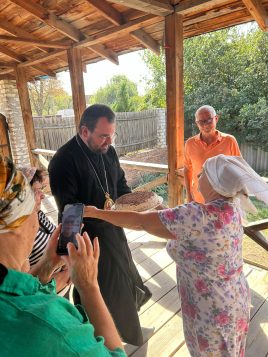
Ucraina, mons. Maksym Ryabukha, esarca greco-cattolico di Donetsk
The Church in Ukraine has unequivocally chosen to continue providing assistance to bereaved families through various initiatives. The Rector of the Theological Seminary in Lviv, Fr. Ihor Boyko, addressed the Synod on the subject of “Accompaniment of families in mourning.” “Mutual support groups are safe spaces where bereaved families can express their grief and unburden their hearts” he said. “These places allow people to connect with others who have experienced similar pain and bereavement, providing understanding and compassion.”
“It is a school of affliction where much can be learned. It is not merely a ‘repository of wounds’, but a place in which to remain in order to cultivate hope.”