
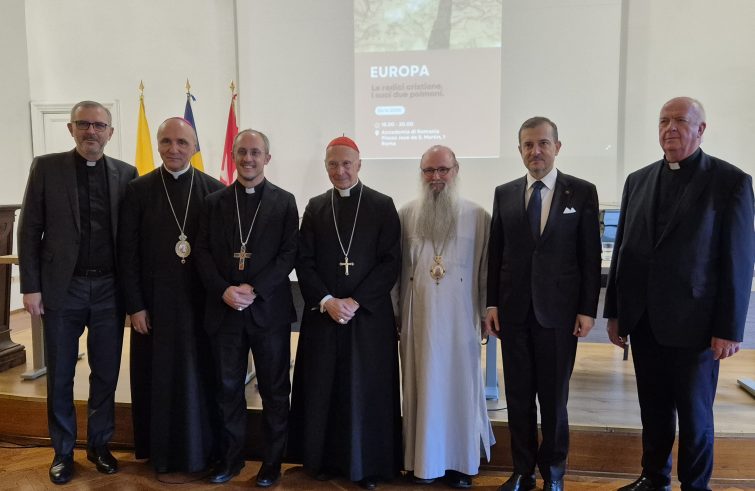
“That they all may be one” and “United in diversity”. These two phrases — the former from the Gospel of John and the latter the motto of the European Union — encapsulate the meaning and theme of the meeting, “Europe: Its Christian Roots. Its Two Lungs”, which took place on 26 June at the Romanian Academy in Rome, an initiative of the Romanian Embassy to the Holy See under the auspices of the Council of Bishops’ Conferences of Europe.
“We are guided by spiritual, ethical, and anthropological values.” “Today”, said Ambassador George Bologan in his opening remarks, “the EU is confronted with major challenges while remaining faithful to the principles and values underlying its foundation.”
“Europe, then, must not only breathe fully with its two lungs, it must also have one and only heart.”
The “catalyst for the European heart is ‘identity’, which comprises cultural, spiritual and national differences. For the ambassador,
“Christianity has the potential to serve as a unifying force on our continent, fostering unity among its people.”
“We are united in our diversity” said Ambassador Bologan, going on to explain that “the world needs the oxygen of the Holy Spirit to be able to breathe in the words of the Gospel.” “We recognise respiratory failure when we see it”, he observed. “The same thing happens when the Orthodox and Catholic Churches are hindered by prejudices on both sides.” “The division between Churches is absurd and shameful,” the ambassador told the audience, calling for “the urgent need for reconciliation among Christians, rooted in their shared theology and culture.”
“Rediscover the purpose of our unity.” The Secretary of the Dicastery for Promoting Christian Unity, Monsignor Flavio Pace, conveyed the greetings of the Prefect of the Dicastery, Cardinal Kurt Koch and went on to note that, just yesterday, addressing the participants in the Plenary Assembly of the Reunion of Aid Agencies for Oriental Churches, Pope Leo XIV quoted Saint John Paul II’s words on 2 June 1985: “The Church must learn once again to breathe with both lungs, the Eastern and the Western.” “That phrase, ‘once again,’ commented Monsignor Pace, “is telling us that
it is necessary to recover a dimension that lost its ability to communicate and indeed split apart.” “These two dimensions must learn to communicate with each other again”,
remarked secretary of the DFPCU, adding that “the meaning of our unity can be rediscovered through knowledge, esteem, and mutual love for our two traditions”. That unity, he clarified, “is not to be understood as uniformity or standardisation, but rather in the recognition that the foundation of unity is the proclamation of Christ in the differences and colourful nuances that the Holy Spirit brings forth.” Reflecting on the history of the Council of European Bishops’ Conferences, its current composition of 39 members representing 45 European countries, including Russia and Turkey, and its dedication to serving the Catholic Churches in Europe, Secretary General Don Antonio Ammirati said he hopes that
“the European continent will restore Christ at the centre of its life.”
Monsignor Virgil Bercea, the Romanian Greek Catholic bishop of the Eparchy of Oradea, attended the event in Rome for the Jubilee of seminarians, priests and bishops to
offer his “personal testimony that unity can be achieved even in diversity”.
Referring to his experience in Romania, the prelate highlighted the importance of “being together, all of us.”
(Foto Sir)
“For us Westerners, Eastern Christianity is a lung we are called to recover”. Christian unity is a “lofty goal, albeit a difficult one to achieve in light of current events, but we must not give up or lose heart”. Cardinal Angelo Bagnasco, president emeritus of the Council of the Bishops’ Conferences of Europe, made this observation as an introduction to his reflection: “Looking at our continent”, he said, “the feeling of belonging is weakening, and it seems that there is a growing distance from that great project, desire and ambition known as European unity”
“That unity,” he remarked, “was born not of urgent needs, security concerns or fears, however legitimate they may be”, but of a “culture that reflects a vision of the human person and of life — an anthropological vision that provides a comprehensive and integral response to the identity of every human being.”
“At the foundation of every culture there always lies a system of beliefs, a connection with the transcendent, understood in various ways,” the cardinal explained, adding that
“A state or culture that fails to recognise or denies a person’s openness to the transcendent is inherently flawed, insufficient, and ultimately a threat to freedom.” “A society that denies transcendence is not a fairer or freer society; it is more inhuman,”
the Cardinal pointed out. Noting that “the encounter between Athens, Jerusalem and Rome occurred on our continent. We cannot ignore this historical fact”, he added. “It was not a random occurrence, but a providential one,” as Benedict XVI said.
“Europe has one soul and it breathes with two lungs”,
Bagnasco said, adding a reflection on the “reasonableness of faith. Faith is a gift, but it must be desired, sought and invoked.” “We should reconnect with the foundations of our faith,” said the cardinal, “in order to communicate more effectively with modern man, whose inner disorientation is concealed by a façade of euphoria, distraction, and a false sense of security. Not only does he need the Gospel, he is thirsting for it, even if he is unaware of it.” Bagnasco recalled that, during his time as president of the CCEE, a survey was conducted to determine the prevailing sentiments among young people in Europe. “Anxiety emerged as the most prevalent feeling,” he said. “We need to raise awareness if we are to engage with the members of today’s society, both young and old. Everything can change except human beings.” Before concluding, the cardinal noted that, for those of us in the West, the East “is a lung we ought to recover and rediscover with determination.” This is because it “has retained the mystical aspects of the faith across Christendom.” And, “in light of Eastern spirituality, Westerners should learn to embrace a slower pace of life”, Bagnasco advised. “We are always in a hurry, but having too many commitments is no excuse. It is a matter of “taking time to pause and contemplate, not the endless stream of messages we have allowed into our lives through social media”, which “distract us from what is essential.” “It is not quantity that we need but the depth of meaning,” he specified, highlighting an important point:
“Stop and contemplate, and let yourself be embraced by the beauty that surrounds you, expressing that very passive contemplation that Westerners, including Christians, are progressively erasing from their vocabulary.”
“God does not need the actions we perform; we must surrender to God’s guidance, relinquishing command of our hectic Western lifestyle and placing it in Christ’s hands.” ‘Let yourselves be embraced by beauty,” he urged in his closing remarks, “for, as Plato wrote, beauty is the radiance of truth.”
“It is incumbent upon us to cultivate complementarity.” “Christian Europe is a complex mystery, which is why dialogue and discussion are necessary,” said Msgr. Siluan Şpan, bishop of the Romanian Orthodox Diocese of Italy. “If we focus only on our own personal or national religious dimension, our lives will be incomplete.” “The unprecedented migratory phenomenon of the last 20–30 years, impacting the entire world, has plunged us into a crisis,” he noted. Today, he continued, “we are confronted with a significant challenge that, if properly harnessed, will yield positive outcomes for individuals born far from their parents’ country of origin.” For Monsignor Siluan,
it is necessary “to engage in dialogue and share experiences with other Christian denominations, as this will enrich us far more than our current practices.”
The Orthodox bishop called on his compatriots “not to sever ties with the spiritual and intangible heritage that emigrants bring with them.” He added addressing his fellow nationals: “If only we were as faithful to the Gospel as we are to the recipe for Romanian doughnuts…” “The encounter between two Christian traditions and cultures is conducive to positive change,” said Monsignor Siluan.
“The time for theological simplifications, indifference or mutual disregard is gone.” Instead, “it is our duty to foster complementarity, and as Pope Francis said, “while theological dialogue is ongoing, albeit at a slow pace, we must learn to love one another as Christians.”
“It is a dialogue that should have lofty goals,” he pointed out, while “acknowledging our responsibility towards all, including those who are thirsty for a living witness and a source of hope.”