
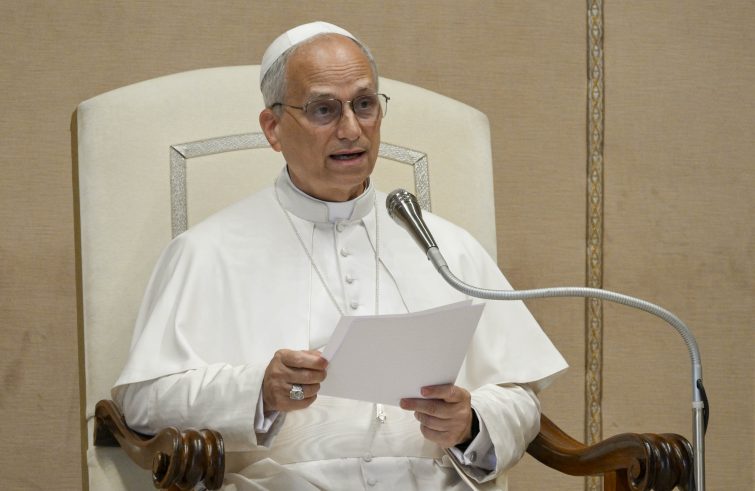
“The seminary, in whatever form it is conceived, should be a school of affectivity”, Leo XIV remarked in a meditation delivered to seminarians whom he met for the first time on the occasion of the Jubilee dedicated to them. The Holy Father cited Pope Francis’s encyclical Dilexit Nos, inviting those present to “turn their attention to the centre, to the heart, the driving force of your journey!”. ‘In our hyperconnected age, the experience of silence and solitary reflection is increasingly challenging”, the Pope said, outlining specific guidelines for those responsible for the formation of candidates for the priesthood in semiaries.
“In today’s social and cultural context, where conflict and narcissism are rife, we need to learn to love, and to do so as Jesus loved.”
The Pope’s guidance: “As Christ loved with the heart of man, you are called to love with the heart of Christ,’ he said. “However, in order to master this art, it is essential to reflect on one’s inner thoughts and feelings, as this is where the voice of God can be heard and where the most profound decisions originate. But it is also a place of tension and conflict, so the heart must continuously be converted so that your entire being is imbued with the Gospel. The first task, therefore, is to cultivate your inner life,” the Holy Father explained, drawing on a teaching of St. Augustine.
“Descending into our hearts can sometimes cause us fear because there are wounds there,’ the Pope said. ‘Do not be afraid to take care of them. Do not be afraid to accept help because it is precisely from those wounds that your ability to support others in their suffering will emerge.”
Special training is needed to learn to recognise the deepest sentiments of the heart: “not only the fleeting emotions that characterise the spirit of young people, but your feelings especially, the ones that help you discover the direction of your life. If you learn to read your heart, you will grow in authenticity, and you will never be tempted to wear a mask.”
“Without an encounter with God, we cannot truly know ourselves”, – the direction of spiritual life indicated by the Pope, accompanied by an exhortation to “invoke the Holy Spirit frequently, so that He may shape in you a docile heart, capable of perceiving God’s presence even by listening to the voices of nature and art, poetry, literature and music, including the human sciences.”
“As you pursue your theological studies, learn to listen with an open mind and an open heart to the voices of culture, such as the recent challenges of artificial intelligence and social media”
Leo XIV’s second recommendation to seminarians:
“Above all, as Jesus did, listen to the silent cries of the little ones, of the poor and the oppressed, and of the many young people who are searching for meaning in their lives.”
“If you nurture your heart with silent reflection, meditation and prayer each day, you will learn the art of discernment”, the Pope assured. “When we are young, we harbour many desires, dreams and ambitions. Our hearts are often overcrowded, and we can feel confused.” “Instead, following the example of the Virgin Mary, our inner life must learn to cherish and meditate,” the Pope explained, quoting St Luke and using the verb “synballein”, which denotes “putting together the fragments”.
“Beware of superficiality and piece together the fragments of your life”
in prayer and meditation. Ask yourselves: what is my experience teaching me? What is it showing me along this journey? Where is the Lord leading me?”, said Pope Leo, offering a specific itinerary. At the beginning of his meditation, the Pope thanked the seminarians, addressing them partly in Spanish: “Thank you for your joy and enthusiasm. With your energy, you fuel the flame of hope in the life of the Church!” “There is nothing in you that should be discarded”, he told those present, who greeted the Pope with a long round of applause. “But everything must be taken up and transfigured in the logic of the grain of wheat, so that you may become happy persons and priests — bridges and not obstacles to the encounter with Christ for all those who draw close to Him. Yes, He must grow and we must diminish, so that we can be shepherds according to His heart.”
“It is important, indeed necessary from the time of seminary, to place great emphasis on human maturation, rejecting all forms of disguise and hypocrisy.”
The Pope went on to emphasise the importance of the formation of future priests, who are called to “have a meek and humble heart like that of Jesus” in order to progress in human maturity, especially affective and relational maturity. “Keeping our gaze fixed on Jesus,
we must learn to give a name and voice to sadness, fear, anguish, and indignation,
bringing everything into relationship with God”, the recipe of Leo XIV, for whom
“Crises, limitations and frailties are not to be hidden,
rather, they are opportunities for grace and a paschal experience.” “In a world where ingratitude and thirst for power often dominate, where the logic of exclusion can prevail, you are called to witness to the gratitude and gratuitousness of Christ, the exultation and joy, the tenderness and mercy of his heart,”, the final counsel: “To practice a style of welcome and closeness, of generous and selfless service, allowing the Holy Spirit to ‘anoint’ their humanity even before ordination.” The example chosen is that of Jesus, the Good Samaritan of humanity, with the invitation to “never settle for less, never settle for mediocrity, never be passive recipients, but be passionate about your priestly life, living fully the present and looking to the future with a prophetic heart.”