
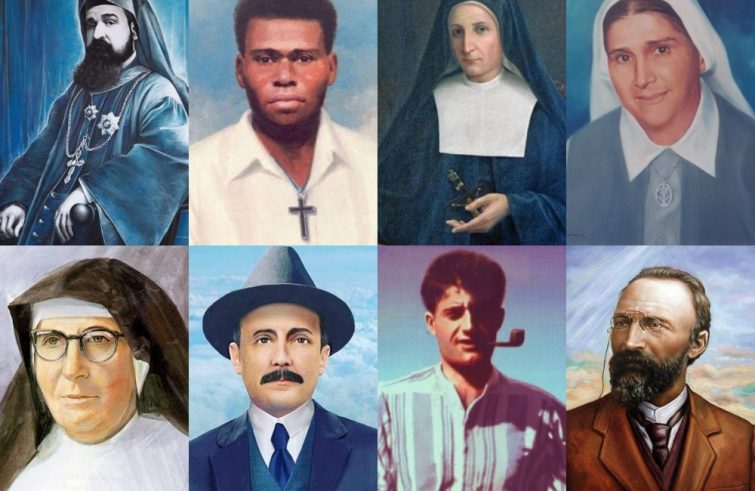
At the Ordinary Public Consistory held this morning in the Vatican, Pope Leo XIV set the dates for the canonisation of eight Blesseds, from different countries and backgrounds, united by a luminous and timely witness. Pier Giorgio Frassati and Carlo Acutis will be canonised on 7 September; Ignatius Choukrallah Maloyan, Peter To Rot, Vincenza Maria Poloni, Maria del Monte Carmelo Rendiles Martínez, Maria Troncatti, José Gregorio Hernández Cisneros, and Bartolo Longo on 19 October. Diverse profiles, united by a journey of dedication and faith, culminating in the total gift of self.
Ignatius Choukrallah Maloyan
Born in Mardin, present-day Turkey, in 1869, Ignatius Choukrallah Maloyan was ordained a priest in 1896 and became Armenian Catholic Archbishop of Mardin in 1911. During the Armenian genocide, he was arrested along with his clergy and, when asked to renounce the faith, publicly reaffirmed his belief. He endured torture and abuse before being killed on 11 June 1915. His martyrdom remains a sign of unwavering fidelity in the darkest periods of history.
Peter To Rot
A lay catechist from Papua New Guinea, Peter To Rot was born in Rakunai in 1912. From a young age, he generously dedicated himself to proclaiming the Gospel and serving his community. During the Japanese occupation in World War II, he publicly opposed polygamy and continued catechesis in secret. Arrested and imprisoned for his commitment to Christian marriage, he died a martyr in 1945. His life represents the strength of faith lived daily and the value of the Christian family.
Vincenza Maria PoloniBorn in Verona on 26 January 1802, Luigia Francesca Maria Poloni—known as Vincenza Maria—showed early compassion for the poor and sick in her city. In 1840, together with Charles Steeb, she founded the Sisters of Mercy of Verona, dedicating her life to assisting the needy, the marginalised, and the ill, in a time marked by famine and epidemics. With a simple and practical approach, she took on the suffering of others, forming generations of religious sisters devoted to silent and faithful service. She died in Verona on 11 November 1855.
Maria del Monte Carmelo Rendiles Martínez
Born in Caracas, Venezuela, in 1903, she grew up in a large family and from childhood faced the challenge of a physical disability (she was born without her left arm). She soon felt called to religious life and in 1965 founded the Congregation of the Servants of Jesus, with the aim of responding to the emerging needs of society and the Church. She led the congregation with wisdom and dedication, committing herself to education and care for the vulnerable. She died on 9 May 1977, leaving an indelible mark on the Church in Venezuela.
Maria TroncattiBorn in Corteno Golgi, in the province of Brescia, in 1883, she joined the Daughters of Mary Help of Christians at a young age. During World War I, she served as a nurse at the military hospital in Varazze, where she developed a strong sense of service and self-sacrifice. In 1922, she left as a missionary for Ecuador among the Shuar people, where she worked for nearly fifty years as a nurse, educator, and spiritual mother. Skilled in performing makeshift surgical procedures, she committed herself to evangelisation, human development, and dialogue with local cultures. She died in a plane crash in Ecuador on 25 August 1969.
José Gregorio Hernández Cisneros
Born in 1864 in Isnotú, Venezuela, he studied medicine in Caracas and completed his training in Europe before returning home. He was a beloved physician known for his generosity: he treated the poor for free and never refused help to anyone in need. A devout believer, he was also a scientist and university professor. He died in 1919 in a traffic accident while on his way to assist a patient. He is venerated throughout Venezuela as an example of faith lived in daily life, in hospitality and solidarity with the least.
Pier Giorgio FrassatiBorn in Turin in 1901, he was raised in a middle-class family. From an early age, he combined social and political engagement with a love for the mountains and prayer. A Dominican tertiary, he was an active member of Catholic Action and the Saint Vincent de Paul Society, dedicating his free time to personally helping the poor in the city. A student of engineering, he lived his faith in a simple and joyful way, offering a model of “modern” sanctity accessible to all. He died at the age of just 24, in 1925, of sudden poliomyelitis.
Bartolo LongoBorn in Latiano, in the province of Brindisi, in 1841, he moved to Naples to study law. Attracted for a time to paths far from the faith, he experienced a deep spiritual crisis before rediscovering the Gospel and becoming a Dominican tertiary. He settled in Pompeii, where he dedicated his life to promoting the prayer of the Rosary, building the sanctuary, and founding social works for orphans and families in difficulty. His life was marked by obstacles and misunderstandings, but his journey remains a sign of conversion and active charity. He died in 1926.
The canonisations scheduled for 2025 present the Church with witnesses from different times and backgrounds, yet united by a common vocation to self-giving. The new saints remind us that holiness can flourish anywhere: in the hidden corners of hospital wards, in silent martyrdom, in missionary service among peoples, in the struggle for justice and charity. Their spiritual legacy remains an open invitation: to live the Gospel each day, letting hope take shape in concrete and shared actions.