
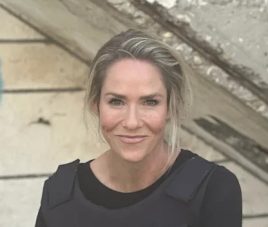
“What is happening in Gaza is like a horror movie, and children are paying the highest price.” Georgia Tacey (in the photo), Gaza Project Director for Save the Children, originally from Australia, does not mince her words. SIR spoke with her last evening during a Zoom connection with Deir el-Balah where she is based, in the centre of the Strip.
After 600 days of war and restrictions on the supply of food, water, fuel and medicine, what is life like for children in Gaza?
The situation is desperate. I spent about three weeks abroad, and when I returned two weeks ago, I witnessed a shocking physical and psychological deterioration among our staff members and the children participating in our programmes. The past few weeks without access to nourishing food have been incredibly difficult.
Many children and mothers are at risk of undernourishment.
Which children are you helping in particular?
We are helping children whose parents were killed and who have been entrusted to the care of other families who already have many children of their own. If these foster parents are killed, families of 10 to 12 children will be left with no adults to care for them.
These children are experiencing immense loss and grief, and are left with no form of physical or psychological security.
They are living in a truly dangerous and desperate situation.
Do you believe that the food insecurity is deliberate? Is hunger being weaponised? Most definitely. That’s exactly what it is. The problem isn’t a lack of food. There are thousands of trucks loaded with food and medical supplies stuck at the borders because the Israeli authorities won’t allow NGOs and the UN to bring them in. This is a political decision:
food and aid are being weaponised, and it is children who are paying the highest price.
Why won’t they let you distribute food, aid and medicine?
That’s a good question. For more than three months, the Israeli authorities have blockaded all incoming aid based on the spurious claim that Hamas is stealing aid intended for the population. They only allow a small number of UN trucks to enter, which is a mere drop in the ocean.
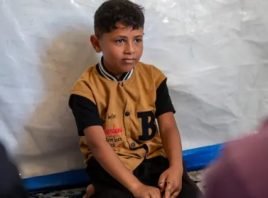
It’s terrible. Thankfully, it appears that Adam, the 11-year-old boy who was the sole survivor of his family’s massacre while his mother, a paediatrician, was at work, will soon be able to leave the Strip to receive treatment in one of our hospitals in Italy. How many other children in Gaza need treatment that they cannot receive there?
This is fantastic news for Adam! We don’t have our own hospital, so I do not know the exact number of children, but our fellow surgeons at Nasser Hospital tell us that at least 50% of their patients are children from whom they remove shrapnel and bullets. They treat serious wounds and attempt to mend severe fractures. They do all this without anaesthesia because of the lack of medicines…
Today, there are more amputee children in Gaza than anywhere else in the world.
Furthermore, a significant number of children succumb to preventable diseases that, due to their inability to be treated locally, result in life-threatening conditions. This is both unbelievable and unforgivable.

A surgeon from the US told the UN Security Council that when children realise their families have died, they wish they were dead too.
This happens frequently. Many of the children who attend our education programmes in dedicated facilities with the support of qualified social workers to help them process their grief — or at least to offer them a safe environment — speak openly about suicide. A great number of children have been witness to the death of their friends. They saw arms and legs blown off; they saw their parents die, trapped under the rubble. They witnessed horrifying sights that no child should ever see. So we are not surprised that
Many of these children express suicidal thoughts and talk about wanting to join their families in heaven.
There are many young women in Gaza. How will they give birth and care for a newborn baby in a context where the few remaining hospitals are on the verge of collapse?
Approximately one hundred women give birth every day in the Strip, wherever they can — in tents or amidst the rubble of bombed-out buildings — with no access to sanitation, doctors or midwives. Some of them die from complications that could be resolved in hospital. Newborn babies who survive are placed in cardboard boxes to protect them from ants and other insects. The total lack of hygiene is exacerbated by the fact that many new mothers are so malnourished they have no breast milk to feed their babies.
Meanwhile, the US vetoed a UN resolution calling for a ceasefire.
It’s very frustrating. While it’s not surprising, it’s still very frustrating.
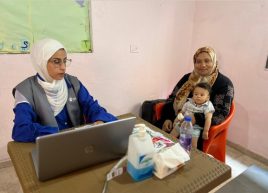
What is Save the Children’s request?
We are calling for an immediate and unconditional ceasefire and for borders to be reopened to enable NGOs and their trucks loaded with food and medical supplies to access the area.
Everything must be allowed to enter. This must be a large-scale operation rather than the trickle of supplies we are seeing today.
Even before the blockade, only 500–600 trucks were entering per day, which was not nearly enough to meet the needs of two million people. It is extremely frustrating that they are being blocked by the Israeli authorities.
After a suspension of one and a half days, the Gaza Humanitarian Foundation resumed its operations at a new site this evening (Thursday evening – Ed.’s note).
Yes, we have been told – but have not been able to verify – that they will operate from two sites for only one hour. In any case, the GHF only provides food, not other vital support, and it has only four distribution centres, whereas we operate 400. This means that people are forced to walk for hours in the sun on dangerous, combat-torn roads to reach them. They are hungry and desperate people, and the military has even opened fire on them, killing more than a hundred. We have all the necessary tools, experience and distribution chains. We have always delivered aid safely. We distribute food and water inside a sheltered area and give priority to the most vulnerable, so that they need to walk less than 20 metres to reach their camp with what they have received.
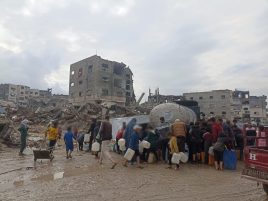
For those of us living in Europe, the tragedy unfolding in Gaza is hard to fathom.
It is both cruel and inhumane. It’s like a horror movie that nobody could have imagined would actually happen. I am Australian and the children we work with often ask me, ‘When are the adults going to arrive?’ When will they put an end to this insanity?’
They can’t understand why the international community hasn’t intervened yet.
It’s painful not to have answers for these children, who realise that their human rights aren’t guaranteed like those of their peers in the rest of the world.