
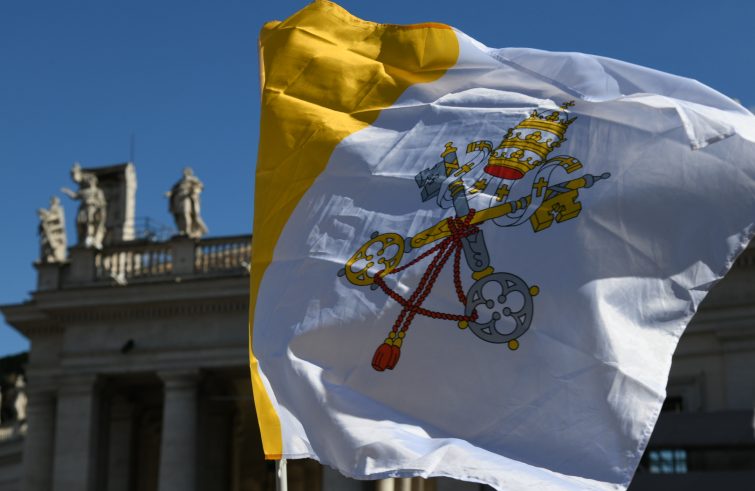
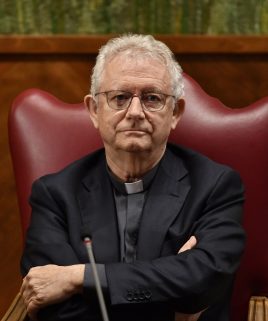
The Holy See’s diplomacy is frequently perceived as cloaked in secrecy and authoritativeness. However, a pastoral vision of listening, closeness and peace among peoples underlies the official diplomatic protocols. Monsignor Patrick Valdrini, Professor Emeritus at the Pontifical Lateran University and Rector Emeritus of the Catholic University of Paris, outlines this vision, illustrating how the Holy See can remain faithful to the Gospel in the face of complex geopolitical scenarios.
Beyond the formal protocol and diplomatic formulas, what is the most authentic aspect of Holy See diplomacy?
The Holy See is the title used by the Church when interacting with national governments and multilateral organisations through the Pope’s representatives, known as pontifical legates. However, their role is not only diplomatic. Their primary function, as defined by Church law, is to represent the Pope in local communities. Believers should indeed recognise the good fortune of the Church, and of their own communities, in having a representative of the Pope – the principle of the unity of the entire Church – present in their territory, and through him and the Holy See, serving as intermediaries with public authorities at national and international levels, thereby enhancing the role of local communities.
What insights have you gleaned from your experience with the ‘laicité” of the French state and the presence of the Holy See in institutional contexts?
I served as cultural counsellor of the Holy See to the Quay d’Orsay for two years – a brief period, but long enough to realise that a secular state such as France has an interest in maintaining good relations with the Holy See. This interest is manifested in a
mutual willingness to foster peaceful relations with the Church, but even more importantly — and perhaps this is the crux of the matter — in recognising the Catholic Church as a partner and interlocutor in international affairs.
Specifically, I experienced the embassy to which I was posted as a place that fostered mutual understanding, exchange of views and sharing of information between the Holy See (i.e. the Catholic Church) and the French state.
About: the ‘Quai d’Orsay’
The Quai d’Orsay is the informal name for the French Ministry of Foreign Affairs, so called because its historic headquarters are located on Quai d’Orsay in Paris. At the heart of French diplomacy, it coordinates the French Republic’s relations with other countries.The role of the Cultural Advisor, operating under the auspices of the Ambassador, is to foster constructive dialogue between France and its ecclesial, cultural and institutional interlocutors.
What gives the Holy See’s mediatory role in international conflicts its credibility and uniqueness?
The funeral of Pope Francis and the inaugural Mass of Pope Leo offered a providential opportunity to illustrate the essence of the Holy See and its function on the international stage. These occasions, which are specific to the Church — the death and election of the Bishop of Rome, the Pastor of the Universal Church — exemplify the lofty stature of the Church’s moral authority and influence with its unique characteristics as an “unarmed and disarming” community. Its actions are chiefly centred on the power of words and participation in international relations, guided by a commitment to unity and peace.
The Holy See’s sole interest is to promote the Church’s spiritual message, known to all: building a community on Earth where everyone can live with dignity.
In the age of new media, what challenges and responsibilities lie ahead for the Holy See’s institutional communications?
All institutions face the same problem. Information is increasingly bypassing traditional media and circulating without any indication of its source. No one is immune to the circumstances created by this new mode of communication. This underscores the need for the Holy See to showcase expertise and professionalism, ensuring the clarity of its message and commitment to truth, especially given the dissemination of fake or distorted content. Pope Leo XIV addressed this issue in his address to media professionals on 12 May.
Leo XIV’s address to media professionals
In his address in the Paul VI Hall on 12 May 2025, Leo XIV highlighted the importance of “disarmed and disarming” communication that transcends the dynamics of confrontation and hatred. He asked journalists to promote truth, justice and dialogue by placing listening, responsibility and human dignity at the centre. In the digital age, this was a powerful appeal to build environments that generate peace and freedom.
In today’s rapidly changing world, what personal skills and qualities do you think are essential for a diplomat of the Holy See?
In response to the fundamental challenge of preparing future diplomats, the Holy See has reformed the Pontifical Ecclesiastical Academy.
The Church expects its diplomatic staff to be qualified and competent enough to serve as credible interlocutors in the international diplomatic arena.
The Pope’s chirograph outlines the qualities he expects from his diplomats, primarily in relation to the field in which they carry out their duties. Above all, however, the Pope wishes for his diplomats to possess personal qualities inspired by the Gospel, such as closeness, a willingness to listen, and consistency in their witness.
How can the Holy See preserve its evangelical mission without succumbing to the logic of power or appearance?
I remember Cardinal Jean-Louis Tauran emphasising the “pastoral” nature of the diplomat’s role in the Church. This description may seem strange to us, since diplomacy is an activity governed by entirely different operating rules compared to those of a parish priest. Cardinal Tauran wished for the actions of the Holy See’s diplomats to have a spiritual purpose. The image of Christ as the ‘Good Shepherd’ is invoked in the aforementioned text of Francis’ reform to illustrate the ideal example of diplomatic action.
Pope Francis’ Chirograph on Vatican diplomacy
In his Chirograph of 25 March 2025, Pope Francis established the Pontifical Ecclesiastical Academy as an Institute ad instar Facultatis for the study of Diplomatic Sciences. The document emphasises the pastoral nature of diplomatic service, which is grounded in evangelical witness and the spirit of the “Good Shepherd.” Pope Francis calls on future papal representatives to be not only legally and culturally competent, but also to possess human qualities such as closeness, attentive listening, witness, a fraternal approach, and dialogue. By doing so, they will offer visible signs of the closeness of the Bishop of Rome to the local churches and the international community.