
“Bronze can last for thousands of years. Just like the Gospel.” Canadian artist Timothy Schmalz’ sculptures encapsulate some of the most compelling moments of Pope Francis’ Pontificate. His works, including Homeless Jesus and Angels Unawares, are globally recognised symbols of mercy and welcome. Following the death of the Pontiff, Schmalz reflects on the importance of preserving his vision: “It can endure eternally through artistic expression. My sculptures will continue to speak out, without words, in public spaces worldwide.”
How can art preserve the memory of Pope Francis?
One of the great things about bronze is that it lasts for thousands of years. It does not decay. Capturing the essence of Pope Francis’ ideas and principles in bronze makes them visible and tangible. The Holy Father has placed the Gospels, which are eternal themselves, at the heart of his ministry. Therefore, combining bronze, a material that stands the test of time, with such profound truths is the perfect union of medium and message.
A sculpture is there day and night, silently preaching its message. Unlike a painting or a song, it does not require time or the right context.
I believe it is the most direct and powerful way to preserve and disseminate that which Pope Francis wished to engrave in the memory of humanity.
Do you remember your first meeting with Francis?
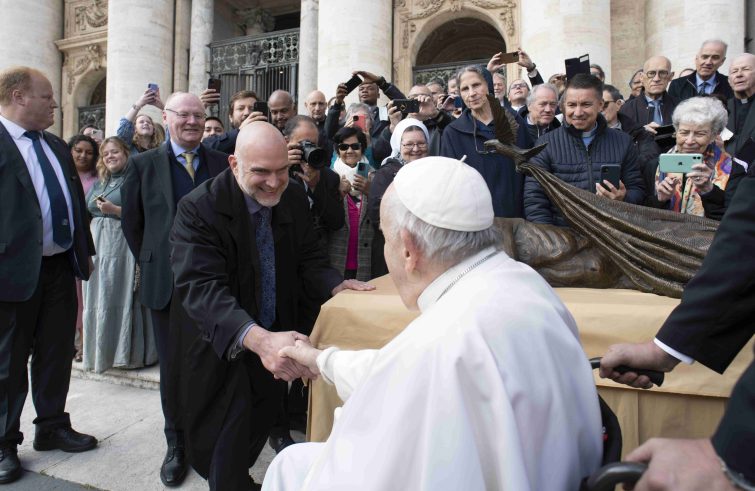
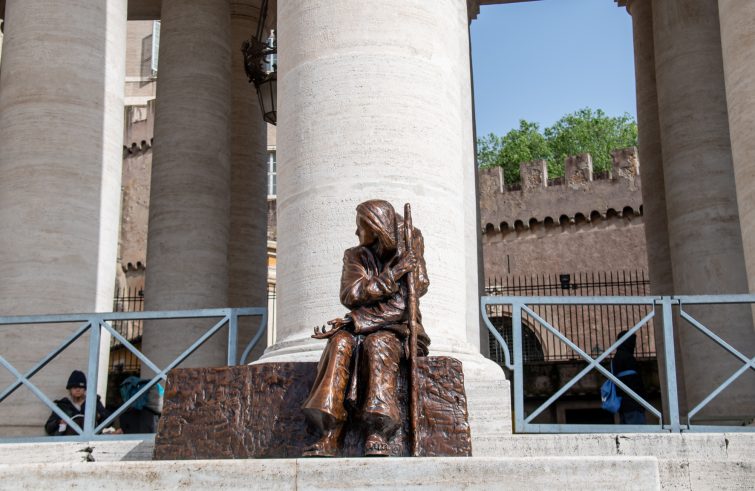
‘Homeless Jesus’ marked the first encounter between one of my sculptures and the Holy Father ten years ago. It was the first depiction of Jesus as a homeless person. In those days, homelessness was perceived as being less of an emergency than it is today. But Francis instantly recognised the power of that image. He strengthened that message, which is so necessary today, with his blessing.
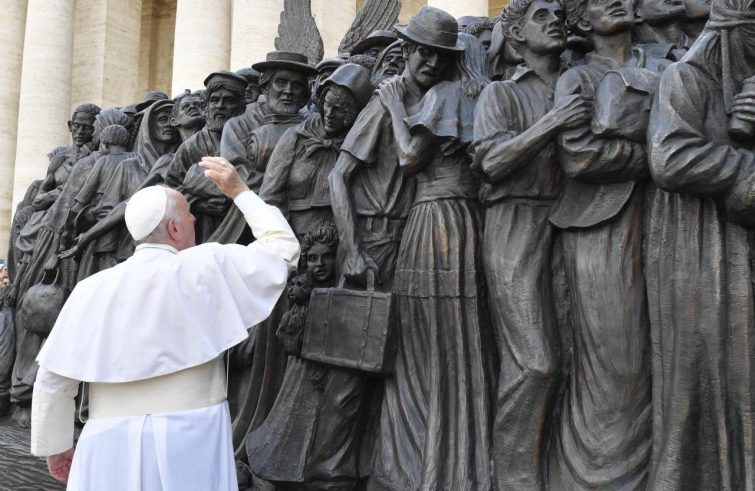
A shared dream took shape in St Peter’s Square. What does ‘Angels Unawares’ represent today?
Installed in St. Peter’s Square in 2019, the sculpture bears an even stronger meaning today. Pope Francis chose to place this sculpture there as a reminder that every human life is sacred.
The angel’s presence among the migrants highlights the spiritual dimension of migration. If we fail to recognise this, we risk losing our humanity.
Positioning the sculpture between Bernini’s columns, reminiscent of a welcoming embrace, further strengthens the original symbolism. In the words of Cardinal Krajewski, “It is of no consequence if it does not align with Bernini’s design, for it does align with the Gospel.” These words perfectly describe Pope Francis: not an ornament, but the Gospel lived out every day. At its core, this sculpture is his visual biography.
-

- (Foto Vatican Media/SIR)
-

- (Foto Vatican Media/SIR)
How should his artistic mandate be perpetuated in today’s world?
Following his death, I feel an even greater urgency to promote his vision.
I will continue to produce and distribute copies of the sculptures he blessed and install them in various parts of the world.
Pope Francis’ message is not only for Rome. It must resonate across every continent. ‘Homeless Jesus’ was installed in Hong Kong this year and will soon be installed at St Mary’s Cathedral in Edinburgh. His spiritual legacy can live on and become more widespread through these sculptures.
If you were to sculpt him today, which image would you choose?
I would depict him embracing the peoples of the earth. To me, that image perfectly reflects his spirit.
I am currently working on a sculpture based on a project I am creating for Assisi, depicting St Francis embracing the world. I am also planning a sculpture park inspired by the encyclical ‘Laudato si” where visitors will be able to read the encyclical surrounded by nature.
I am sure that Pope Francis would have appreciated the idea of transforming a text into a living experience. His memory should not be tied to a static monument, but to the dynamism of the Gospel, which he tirelessly promoted in the form of concrete works of mercy and justice.