

“Faith must permeate the entirety of the human experience.” Cardinal Giuseppe Betori, Archbishop Emeritus of Florence, pays tribute to the memory of St John Paul II on the twentieth anniversary of his death. The Cardinal’s recollections start from the memorable homily “Do not be afraid”, and continue until his final farewell in St Peter’s Square, highlighting the Pope’s commitment in favour of young people, the centrality of the human person in the light of Christ, and finally the cultural transformation initiated by the ecclesial conference in Palermo. His guidance, deeply rooted in prayer, remains strong and prophetic. “It was from that unwavering relationship with God that he drew the strength to carry his cross and bear witness to the Gospel”, the Cardinal said.
Your Eminence, of all the memories you have of Saint John Paul II, which episode or lesson had the greatest impact on you as a man of faith and shepherd during the years of your collaboration with him?
The first lesson that immediately comes to mind is, of course, related to the inaguration of his pontificate and to the homily he preached during that celebration, when he invited mankind to extend its gaze to Christ, not to be afraid of him, to welcome him and embrace his lordship, to “open the doors to Christ”, because only He knows the innermost depths of man, and only in Him can man find his truth. Since that moment, we embraced the Pope’s invitation to unite the mystery of Christ and the mystery of man that was to become the spiritual horizon of his magisterial teachings. At the time, I was a young priest and had not yet been given an assignment within the Italian Episcopal Conference. However, upon hearing John Paul II’s homily, I instantly understood the way in which faith permeates the whole of human experience and all the problems of our contemporary world.
The pontificate of John Paul II was characterised by a strong reaffirmation of the faith, of the need to bear witness to that faith, to proclaim its truth and its challenges to humanity. I would like to add to this a recollection of the moment of the Holy Father’s death.

(Foto Siciliani-Gennari/SIR)
Please do…
On that very evening, at that precise moment, I had been entrusted with the solemn recitation of the rosary in St Peter’s Square. The image of the square, overflowing with people eager to express their affection for a much-loved Pope, is indelibly etched in my memory. Five days later, I was invited to preside over a prayer vigil with young people in the Basilica of St John Lateran on the eve of the Pope’s memorial service. I wished to convey a message of hope to the crowd of young people gathered in the Basilica at a time when we were all obviously overwhelmed by the sorrow of separation. We were all mourning the loss of someone important in our lives. In my homily, I said to the young people that their sadness was understandable, but that we were not there to seek consolation for the emptiness that had befallen our lives, or to express nostalgia for a presence that was now gone. Instead, we had come to make a strong profession of faith, an act of love for John Paul II, whom we knew to be alive beyond death, alive in Christ and therefore alive among us.
During the final years of John Paul II’s pontificate, you served as Secretary General of the Italian Episcopal Conference. How would you describe the guidance offered by John Paul II to the Italian Church during that period? How did the Pope engage with the Italian bishops on crucial decisions regarding pastoral care?
As Undersecretary and later Secretary General of the Italian Episcopal Conference (CEI), I was in charge of promoting the Pope’s pastoral guidelines through the Italian Episcopate, under the direction of its President. In particular, through Cardinal Camillo Ruini, I received direct feedback on John Paul II’s vision for the Italian Church, as part of a wider horizon of evangelisation that marked the CEI’s path after the Council.
Among the numerous significant moments in this dialogue between the Pope and the bishops, an initiative that Pope John Paul II wished for the Italian Church stands out in my recollections: the Great Prayer for Italy proclaimed by the Pope, with the support of the Italian bishops, for the year 1994.
The image of our country offered by the Holy Father in his Letter to the Italian Bishops on Catholic responsibilities in the face of the challenges of that moment in history (6 January 1994) is particularly memorable to me. In order to inspire the faithful to engage in prayer, Saint John Paul II called upon all of us to return to our roots and to revive them in our own time.
What was his vision of Italian identity and the role of Italian Catholics in society? For St John Paul II, the cultural identity of Italy and its heritage to be revived were marked by a faith anchored in the apostolic proclamation, deeply rooted in the soul of the people, which fostered their civic progress. The cultural expression of this identity, which also derives from the faith, was expressed in literature, in the arts, in humanitarian initiatives, in judicial institutions and in the living fabric of customs and traditions, a culture respected throughout the world, something to be proud of; the identity of a united people, which, in spite of the diversity of times and places, formed a community with a strong sense of self-awareness. For these reasons, the Church, and Italian Catholics in particular, were called upon to fulfil their responsibilities and actively participate in the process affecting Italy at that time. Italian Catholics: deeply rooted in history, conscious of their own identity and committed to using it for the good of the entire national community.
Pope John Paul II notably emphasised the importance of involving the young in the life of the Church. The World Youth Day in Rome in the year 2000 saw you play a major role in its organisation at the Pope’s side. What was the message of young people that John Paul II cherished for the Church of the new millennium? Firstly, his intuition was not to wait for young people to come to the Church, but that the Church should go forth to reach young people. John Paul II thus sought and reached out to young people all over the world.
The World Youth Days were a sign of the Church’s special attention to young people, with whom the Church sought to enter into dialogue.
This spirit characterised the World Youth Days, which formed part of a process of encounter between the Church and young people. The Days marked a before and an after, that continues to this day. The World Youth Days were not mere recreational gatherings, but rather represented a significant stage in a journey of formation.

(Foto AFP/SIR)
What more?
A further fundamental point highlighted by John Paul II was that young people were gathered together not for the sake of being together, but in order to be guided towards Christ. The Pope taught young people to contemplate Jesus, to fix their gaze on him in order to discover his beauty and thus the beauty of the plan of life that he is for us; to listen to Jesus, to his word of truth, which gives answers to the most intimate questions of the human mind and heart, and to follow him on the path of life. For their struggles, their problems, their fatigue, their questions, the Pope always offered them a single answer that was also an invitation:
“Do not be afraid! Open, rather, throw open the doors to Christ! Do not be afraid, Christ knows what is in man. Only He knows!”
To visually express this desire, the Pope’s seat during World Youth Day 2000 in Rome was placed beneath a large image of Christ that towered over him, yet clearly conveyed his desire to bear witness, as one who showed the way, who directed our gaze towards Jesus Christ. He was speaking to young people.
Was there a special value associated with the community dimension of faith as experienced by young people at the WYD? The WYD events were and continue to be gatherings of young people, an experience of faith that forms a community, a people. The Christian faith indeed has a personal dimension, but it is fulfilled in the life of a community, the Church, becoming a people among other people. With Christ we are a people, the young are a people, the people of Jesus.
During the 1995 Ecclesial Congress in Palermo, John Paul II exhorted Italian Catholics to engage in a ‘pastoral conversion’ and to renew their cultural and social commitment. Thirty years on, to what extent has the Italian Church succeeded in putting into practice these prophetic words along its own journey?
The turning point that John Paul II ushered in in the Italian Church has its roots, above all, in the Ecclesial Conference of Loreto, when he invited the Church to “inscribe the Christian truth about man into the reality of the Italian nation”, in the awareness of proclaiming a salvific truth, which required the recovery of the driving force of faith in the journey of Italian society towards the future.
It was an exhortation to the Italian Church to play a greater role in society, in order to add a cultural and social dimension to the pastoral ministry that is part of our DNA. In Palermo, this development came to fruition through a commitment to make visible the Church’s social commitment as an expression of her charitable nature and her desire to be close to the needs of contemporary humanity.
The Palermo initiative also gave life to the cultural project…
It was in this context that the Cultural Project of the Italian Church was launched, with the aim of identifying contemporary cultural and social challenges and illuminating them with the word of the Gospel. At the John Paul II Conference, he reminded us that ours could not be a time for preserving the status quo. Rather, he said, it should be a time for mission, a mission that has at its core the unshakable conviction that the pursuit of truth and moral values enhances human freedom, and that this conviction must be the driving force for the promotion of a new culture rooted in the mystery of God.
(Foto AFP/SIR)
Looking today at the figure of John Paul II, canonised and loved throughout the world, which aspect of his vast magisterium do you think is most relevant and fruitful for the Church and society as a whole? How can his witness to holiness continue to inspire our daily ministry?
The fact that he placed man at the centre, he restored the central role of the human person at the heart of the Church, man understood in the light of Christ. This is fundamental today, because the anthropological problem is the great challenge of our time.
We are overwhelmed by cultural movements seeking to change the very nature of being human, and therefore it is essential to firmly reaffirm the role of man in his relationship with Christ.
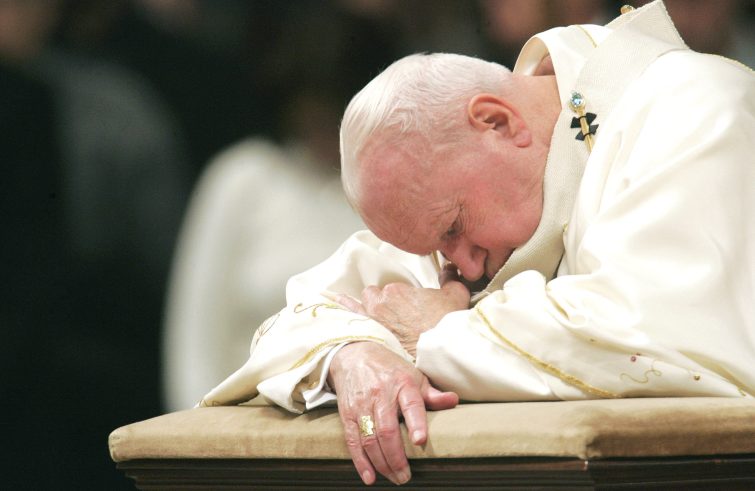
These teachings derive from Gaudium et Spes, a legacy that St John Paul II reaffirmed throughout his pontificate, developed further by Benedict XVI and now by Pope Francis. The focus on anthropology is a fundamental aspect of our faith today: the human person is not seen as a purely historical variable, but as having an essence, a nature, which is the result of having been created in the image of God. This brings us back to the question of truth, man and the truth about man in the light of Christ. This is the great legacy bequeathed to us by John Paul II, which he expounded on as regards the relationship between faith and reason, the foundations of ethics, human life, the family, social life, work, etc. Suffice it to refer to his great encyclicals, everything is connected to the centrality of man in relation to truth, an issue that presents itself today with even greater urgency. As for his powerful witness of holiness, his deep devotion to prayer is especially significant. He left us with the image of a man who drew everything from a personal relationship with the Lord, a relationship that was centred on prayer, which took up a large part of his life and was practised with rare intensity. He gave us a living example of holiness until the very end, even during the moments of suffering that he endured in the last years of his life.