
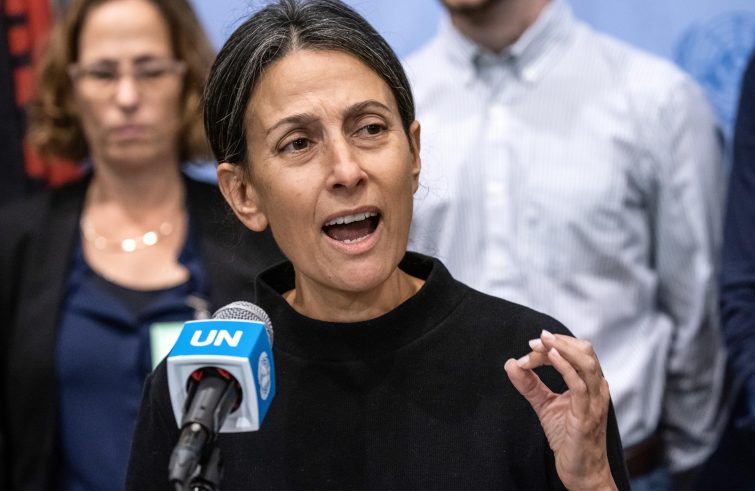
She traveled around the globe, meeting with dozens of world leaders including US President Joe Biden and Pope Francis. She was honoured by Time magazine as one of the 100 most influential people in the world; gave a speech at the United Nations in Geneva, was interviewed by the world’s leading media, and participated in numerous initiatives to raise public awareness for the release of Israeli hostages held by Hamas, including her 23-year-old Israeli-American son, Hersh, who was kidnapped on 7 October 2023 while attending the Nova Music Festival in Reim.

Rachel Goldberg-Polin did everything she could to save Hersh. Tragically, his lifeless body was found in a tunnel near Rafah, Gaza, on 31 August. Rachel Goldberg-Polin did everything she could to save Hersh. “Bring them home now” is the banner cry of the Hostages and Missing Families Forum. Despite her tragic loss, Rachel – along with the other members of the Forum – remains steadfast in her commitment to freeing the hostages, in the awareness, as she explains, that “all tears are of the same colour. There is no competition in pain, every human being experiences pain. To think that there is a competition between these two pains is both dangerous and heartbreaking. There is no competition between the suffering of the civilians who live in Gaza and the suffering of those who have been dragged into Gaza.” Rachel lives in Jerusalem with her husband Jonathan and their two daughters. Today, 8 March, Rachel spoke to SIR as a mother, a wife, a teacher and a woman, and her words are a powerful testimony to peace.
What is it to be a mother in a time of war?
I think it is a very complex and painful thing to be a mother while a war is raging, since, if we try, we can feel the suffering of every mother. It’s a big challenge, but I feel that one of the most extraordinary gifts God has given us is the ability to empathise with other people. As a mother, I have given serious thought to this question during this period of immense suffering that began on 7 October. My thoughts go out to all the mothers here in Israel who have lost their children to violence, to those whose children are fighting to protect others, and to the hundreds of thousands of innocent civilians in Gaza, both children and parents. We are all immersed in a deep abyss of suffering, and I hope that despite this pain, we can still “feel” the suffering of others.
Your son Hersh was abducted and killed by Hamas in Gaza. How can this deep suffering be transformed into a commitment to recognise and acknowledge the suffering of others without falling into a spiral of hatred and revenge?
I feel that mine was not a deliberate decision but something that simply happened. If we are guided by principles of righteousness and moral integrity, and, in my case, if our worldview is rooted in our faith, then it is almost inevitable to recognise that there are other people involved. We must rise above our pain and figure out how to live together, because
we have only two choices: either we learn to live together or we die together.
These are the only options, as we read in the Bible. In the Book of Deuteronomy (30:19), God confronts us with a choice: “I have set before you life and death, the blessing and the curse; therefore you shall choose life, so that you may live, you and your descendants.” This phrase is always present in my mind: we must choose life. Is there a ‘yardstick’ to measure the intensity of this pain? Suffering is not a competition. Suffering is not something that can be measured. The attempt to do so is ultimately a defeat for us all. Each of us, at some point in our lives, will be faced with events that we did not wish to experience. We must realise that each person bears their own suffering and that this is not a competition.
All tears are of the same colour.
Is acceptance and living with this suffering a path toward healing? Is there anything you would like to say to families going through a difficult time like yours?
The healing process is not always linear. Some days the pain is unbearable and it seems that there is no progress in this journey of inner reconstruction. But this is normal. And it’s important to know that it’s normal. The road to recovery is a winding one, and sometimes it seems to go backwards before it goes forward. We have to be patient with ourselves. For me, as a believer, delving deeper into my spirituality has been a great support. But I understand that this is not the case for everyone. I can’t imagine how much harder it must be for non-believers. The pain is immense, overwhelming, all-encompassing. And I thank God that I believe in Him.

As a mother, how important is it in the current circumstances to teach children to see others not as enemies but as friends? We are inundated with messages and comments suggesting that we should be adversaries, enemies, that we should see things in terms of ‘us against them’. We receive these messages from a very young age and we end up believing in this perception of reality. I don’t think it has helped us as human beings. I do believe that there is still room to say that while we are different, we can still respect each other. I can live my life, you can live yours, and we can do it without animosity. Peace, utopia, redemption, salvation are aspirations we can work towards. Or we can be practical, realistic and say, right now, today, let us try to reduce the suffering, the pain, the violence, the hostility. I think many people are discouraged because they feel that peace is an unattainable goal, something that is out of reach. But instead of saying that we will never have peace, we should ask ourselves: “Can we somehow reduce the pain? Can we lessen the anger? Can we diminish the hatred? These are small steps, but they are achievable. I think we’re missing a great opportunity if we don’t even consider taking these steps.

On 22 November 2203, together with relatives of other hostages, you had a meeting with Pope Francis. On that occasion the Pope said that Israelis and Palestinians “both suffer terribly. Wars do that, but here we have gone beyond war: this is not war, it is terrorism.” Pope Francis has continually appealed for peace, calling us to remain human. But how can we remain human and save our humanity? This is a deeply meaningful and important question. I believe that instead of automatically focusing on our differences, the first step is to look at the other person and ask ourselves what we have in common. When the Holy Father said those words, they were of enormous value and comfort to me. They are always in my mind. And while it is difficult, I try to put them into practice. It’s hard, especially when so much pain is involved, when we are grieving, when the loss is still an open wound. And the trauma that the Jewish people and the State of Israel – and not just the Jewish people – experienced on 7 October, is far from over. There are still 59 people of all faiths – Jews, Christians, Muslims, Hindus, Buddhists – being held captive. When you experience this kind of suffering, it can be hard to remain rational. But I believe that
our only hope is to try to understand what we have in common with those facing us.
The one thing we all feel, without exception, is pain. If we manage to understand this, perhaps we will find a way to alleviate our pain and the pain of others.