
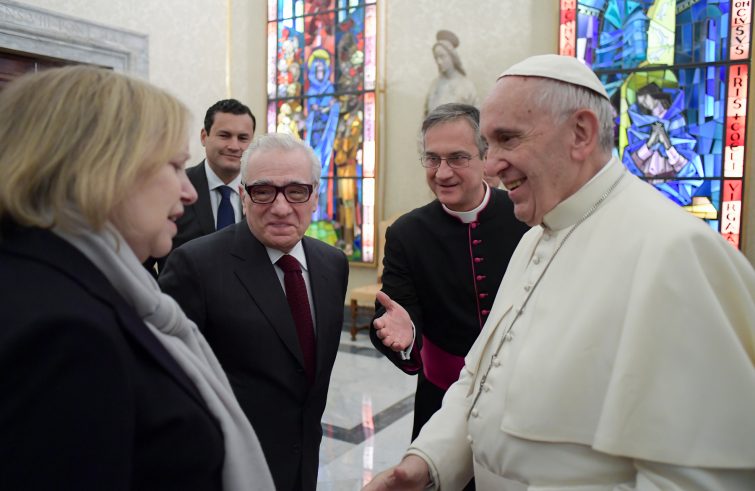
“Pope Francis’ visit to the Cinecittà Film Studios – with a stop at the famous Teatro 5, Fellini’s favourite studio – evokes those events of the past while showing us a way forward, pointing to the need to reflect and rethink the challenges that the Church has identified as priorities for the world of artists and culture in general,” said Msgr. Dario Edoardo Viganò, Vice-Chancellor of the Pontifical Academy of Sciences and Social Sciences, interviewed by SIR. On the eve of the Jubilee of Artists – during which the Pope will visit the Rome film studios – Monsignor Viganò discusses the relationship between the Popes and the world of cinema, highlighting Pope Francis’ unique reading of it.
Pope Francis will visit the Cinecittà film studios on 17 February. It will be another one of those “firsts” that he has accustomed us to. What is the significance of this event and how will the visit take place?
It is not unique in the history of relations between the Church and the world of cinema, but it is certainly a “first” in the Italian context. Let us not forget that John Paul II, manifesting his desire not to ignore the potential of the cinema medium for spreading the Christian message in the world, decided to visit Hollywood in 1987. The Pope had specifically asked for this visit on the occasion of his 36th apostolic journey outside of Italy. He was welcomed in the lobby of the “Registry Hotel” in Los Angeles by Lew Wasserman, one of Hollywood’s leading movie industry executives, by representatives of the “Catholic News Network” and by the Archbishop of Los Angeles, Monsignor Roger Michael Mahony. In all, more than 1,200 workers of the US media industry attended, including many actors, directors and producers. In a central passage of his speech, John Paul II called on all those involved in Hollywood’s film industry to unite around the evangelising mission of the Church: “The Church wishes you to know that she is on your side. For a long time she has been a patron and defender of the arts […] Today, too, the Church stands ready to help you by her encouragement and to support you in all your worthy aims. She offers you her challenge and her praise.” Other popes before him had had personal meetings with members of the film industry. Pius XII met Italian actors Totò, Aldo Fabrizi and Macario during the Jubilee Year of 1950, and in 1945 he granted an audience to members of the Hollywood Motion Picture Executive Committee. Paul VI had longstanding relations with famous film directors (Zeffirelli and Rossellini), and in May 1967, on the occasion of the first World Communications Day, he received in the Vatican members of the press, as well as film, radio and television professionals. In 1999 John Paul II wished to meet Roberto Benigni, with whom he attended a screening of the film La vita è bella in the Deskur Hall of the Vatican Film Library, while the following year he met Alberto Sordi and Monica Vitti on the occasion of the Jubilee for Artists in St Peter’s Square.
Pope Francis’ visit to the Cinecittà film studios – with a stop at the famous Teatro 5, Fellini’s favourite studio – reminds us of these events of the past and at the same time shows us a way forward, pointing to the need to reflect and rethink the challenges that the Church has identified as priorities for the world of artists and culture in general.
The world of cinema has rightly become a subject, and not just an object, of the Magisterium with the pontificate of Bergoglio. However, the pontiffs’ regard for the “seventh art” is rooted in a distant past…
The relationship between the Catholic Church and cinema dates back to the end of the 19th century, when Pope Leo XIII blessed the operators and the new tool of cinematography. In a symbolic way, however, he also blessed those who would later see what was being filmed on the opposite side of the camera lens. The event was shot by William Kennedy Laurie Dickson in the Vatican gardens and buildings using an American Biograph and Mutoscope camera. This occasion marked the beginning of the Holy See’s efforts to develop a twofold strategy that was to characterise its interaction with the media for a long time to come. On the one hand, it legitimised and supported the development of the new communications media, conceived primarily as an educational tool, while on the other hand there was a constant ethical concern to promote a comprehensive Christianisation of society.
The Catholic Church subsequently adopted a progressively positive and proactive stance towards the communications media, evidenced by an expansion of its perspective and a heightened emphasis on a strategy aimed at adapting the Church’s message to a society undergoing epochal changes.
These are the most evident signs of that path of maturation in the awareness of what the mass media represented in the social and anthropological evolution of contemporary society. The Church elaborated more fully on this in a true paradigm shift towards the communication system only after the Second Vatican Council. The numerous references to cinema in Pope Francis’s speeches, homilies and encyclicals thus represent the latest stage in this long journey, which has seen the Church’s attitude to the seventh art overcome, not without difficulty, its long-standing reticence to engage with this medium, a source of concern in the context of a broader condemnation of modernity.
Pope Francis’s known predilection for Italian neorealist cinematography is evidenced in numerous documents and speeches, and was expounded in the interview with the Pope featured in your book “Lo sguardo: la porta del cuore. Il neorealismo e la cultura cinematografica,” How do these themes resonate with the core themes of the pontificate?
Neorealism, to which Pope Francis recalls being drawn to thanks to his parents, can indeed be cited as one of the cornerstones of the cinematic culture that Bergoglio cultivated and enriched over time, and of which we find clear evidence in his Magisterium. Many neorealist films of his childhood offered a window on the world and its current events, marking a path of awareness and profound recognition of the suffering of others, and thus transmitting to young viewers a set of values that he considered universal.
Somewhat overcoming a Catholic tradition that was particularly suspicious of neo-realism in terms of its depiction of evil on the screen, Pope Francis cherished its memory and shifted the perspective of this experience, suggesting in a way its recovery at a religious and cultural level.
In the interview he granted me, the Pope noted that “the films of neorealism formed our hearts and continue to do so. Indeed I would argue that these films taught us to see reality through a new lens… […] In the present day, there is a great need to learn how to see!” Accordingly, neo-realism emerges as a constituent element inherent in the Pope’s teachings, particularly in his speeches to young people, who, from his perspective, stand to benefit most from this cinematic genre’s perspective on contemporary reality.
The tragedy of war in “Rome, open city”, the challenging gaze of children in “The children are watching us”, the message emanating from the existential peripheries in Fellini’s “The Road“: for Francis, the films he is fond of are not an expression of nostalgia, but a specific reminder for today. What lessons can we learn from them?
Films continue to have a special potential to reach everyone, to break down barriers, to create relationships and connections. For Francis, the most important aspect of these works, in addition to their ability to become an original expression of current events, is their capacity to reach and narrate even the “last” and the “forgotten ones”, thereby disclosing their vision of reality. In his homily for Easter 2016, the Pope made reference to Federico Fellini’s The Road, a greatly appreciated film and one of the most cherished because of its implicit reference to Saint Francis. In that homily, Pope Francis praised the film’s ability to “give an unprecedented light to the gaze on the least”, the Pope notes: “In that film, the narrative about the least is exemplary and is an invitation to preserve their precious gaze on reality.” Therefore, Francis felt that his message could be given new impetus through first-hand experience.
In the 2018 film directed by Wim Wenders, “Pope Francis: A Man of His Word”, Bergoglio gave renewed impetus to the process whereby cinema becomes the theme of catechesis. He chose to narrate himself through the distinctive style of cinema in order to indicate and transmit his way of understanding the Church, conceived as ‘poor for the poor’, and the world.
It is noteworthy that the film is also mentioned several times in the encyclical letter Fratelli tutti (nos. 48, 203, 281). The objective was to present a novel paradigm of expression that involved the relinquishment of distance, thereby ensuring that his words and gestures would be comprehensible and accessible to all, believers and non-believers alike. This is the lesson that cinema conveys to us today.
Bergoglio is a pope who communicates in a direct, open but never simplistic manner. He addresses the contemporary communicative needs of the world, authorising autobiographies and documentaries about himself while warning against the risks posed by digital technology if misused. Can cinema, with its vision of the world always having a social value, act as an antidote to these drifts?
Pope Francis has repeatedly stressed the importance of facing the challenges posed by modernity, as he stated in his address to the Vatican Television Centre staff in 2013, “to firmly promote ‘the evangelical perspective on this global highway of communication’ and to expand the apostolate to encompass tools that offer a new perspective on reality and awaken the consciences of believers.” In this regard, the Pope identified cinema as a potential protagonist of a proactive strategy aimed at adapting the message of Christianity in response to increasingly globalised scenarios and thus generating new quests for meaning, noting that cinema is deeply rooted in his cultural horizon and that his relationship with this medium has marked some fundamental passages in his personal and spiritual journey. While noting that “today’s media environment is so pervasive as to be indistinguishable from the sphere of everyday life” and that “digital media can expose people to the risk of addiction, isolation and the gradual loss of contact with concrete reality, blocking the development of authentic interpersonal relationships” (Christus vivit, n. 88), the Pope has also recently referred to cinema as a potent means of bringing people together that has great social value. As such, it must become recognised as a vehicle of universal values and as an instrument of a new “school of humanism” that addresses itself directly to human conscience.
Jorge Mario Bergoglio developed a fondness for cinema thanks to his parents. How can we bring young people back to the movie theaters today, when most of them are more familiar with other types of screens?
I think cinema should recover its original role as a platform for reflection, which can play a decisive role in rebuilding the social fabric, while at the same time offering the opportunity to bring people together. Pope Francis has reiterated the need to learn from the past. “Today, too, if we look beyond the present difficulties, we will see that cinema has the capacity to bring people together, or, better still, to build communion”, he said to me. “Without communion, togetherness has no soul.” In this sense, I believe that it is our responsibility, especially towards the younger generations, to ensure that this spirit of community and solidarity remains a strong guiding force for our living in society. This is an increasingly urgent concern that affects a large part of the social fabric of our country. It must be pursued, above all, through careful and effective information on the new technologies and means of communication, so that they do not become, over time, the sole protagonists of our relations and do not bind young people and adults to the delusion of a world in which we are constantly connected, but less and less truly bound by a commonality of ideas, perspectives and values.