

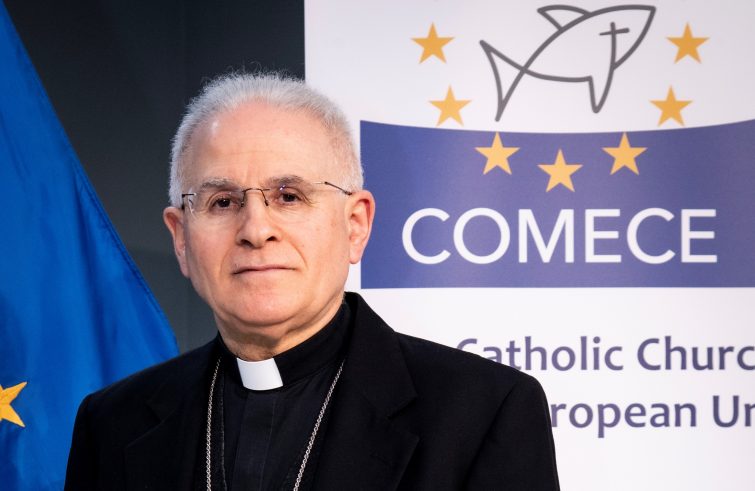
“The main concern remains the living conditions of the Ukrainian people. The three-year war has wrought death and devastation in the bombed-out regions, with incalculable damage to the rest of the country, causing widespread deprivation and impoverishment.” It is with grave concern that the Bishops of the European Union are following the tragic events in Ukraine, three years after the outbreak of the full-scale Russian invasion, urging that peace be swiftly achieved. “The main challenge is to put an end to the war”, said Msgr. Mariano Crociata, serving as President of the Commission of the Bishops’ Conferences of the European Union since 22 March 2023. “However, it seems that the conditions for achieving this end are not at all conducive to the just peace we have all been hoping and praying for since the conflict began.”
Just how complicated is the whole situation?
If we look at the impact of the war on countries not directly involved, the situation is extremely complicated. While in the early stages of the invasion of Ukraine, the EU member states adopted a largely unified line, as the months and years have gone by, the conflict has exposed some of the vulnerabilities of the European Union. I am referring, of course, to the economic crisis resulting from the rise in energy costs, which has affected people’s daily lives, and the worrying polarisation of our societies, fuelled by constant disinformation and reflected at the political level.
Could this armed conflict have been avoided? In the light of the last three years, have the EU institutions made mistakes?
It’s hard to theorise. Leading commentators have pointed out that the European Union failed to respond to certain signals at the right time and, above all, that it failed to develop adequate assessments and initiatives after the invasion of 2014.
If mistakes were made, they were made in the phase preceding the invasion three years ago.
We had all advocated the quest for dialogue and the opening of diplomatic channels, but the structural absence of a common foreign policy prevented Europe from formulating a long-term strategic vision. A common foreign policy would probably have made it possible not only to avoid or better manage the conflict, it would also have prevented energy dependency comparable to that which many of our States had with Russia.
Since the election of US President Trump – and especially his diplomatic and international “dynamism” – the EU seems even weaker. How can real peace be restored? What role should Europe play?
I think that in the current geopolitical situation that you just described, it is essential that the European Union continues to promote solidarity with Ukraine, both across the Atlantic and globally. Obviously, as I said, the European Union has been slow to pursue growing unity among its Member States, especially political unity, and to recognise the importance and urgency of that unity. The EU has similarly underestimated the potential evolution of the global geopolitical situation, with worrying consequences for its own security. The effects of the European Union’s marginalisation and inability to articulate its own political initiative as a result of internal divisions between member states, which now risk worsening, are beginning to take their toll. This is partly due to internal difficulties at national level and the consequent economic and political weakness affecting even its founding member states.
These are especially delicate and potentially dangerous times for the future of the Union, and they call for an outpouring of awareness and determination.
There have been a number of authoritative reports which have indicated the ways in which we should respond to the enormous challenges we are facing today, but what is lacking is an adequate and proportionate capacity for initiative.
On behalf of the EU Catholic Bishops, what message would you like to send to the Ukrainian people on this sad anniversary?
The first message must be addressed to ourselves. What is happening – in particular, having to witness such a despicable spectacle as that which seeks to present the executioner as the victim – is so disturbing and outrageous that the most natural reaction is one of indignation and denial. But now is the time to exercise great restraint and an equal degree of serenity of judgement, correctly identifying and evaluating words, facts and attitudes. More than ever, we must appeal to our Christian conscience and to the ethical principles that underlie it, without which, for us at least, but also for many others, all is truly lost.
Now is the time to oppose the misrepresentation of reality and the distortion of the truth.
This is the first and fundamental message that we can and must send to the Ukrainian people: under no circumstances will we allow them to be labelled as something they are not. For three years they have been subjected to an invasion and a war of which they alone are the innocent victims. We will never stop speaking out, taking action and, not least, praying for this terrible injustice to be recognised and redressed. A true, just and lasting peace must be secured.